
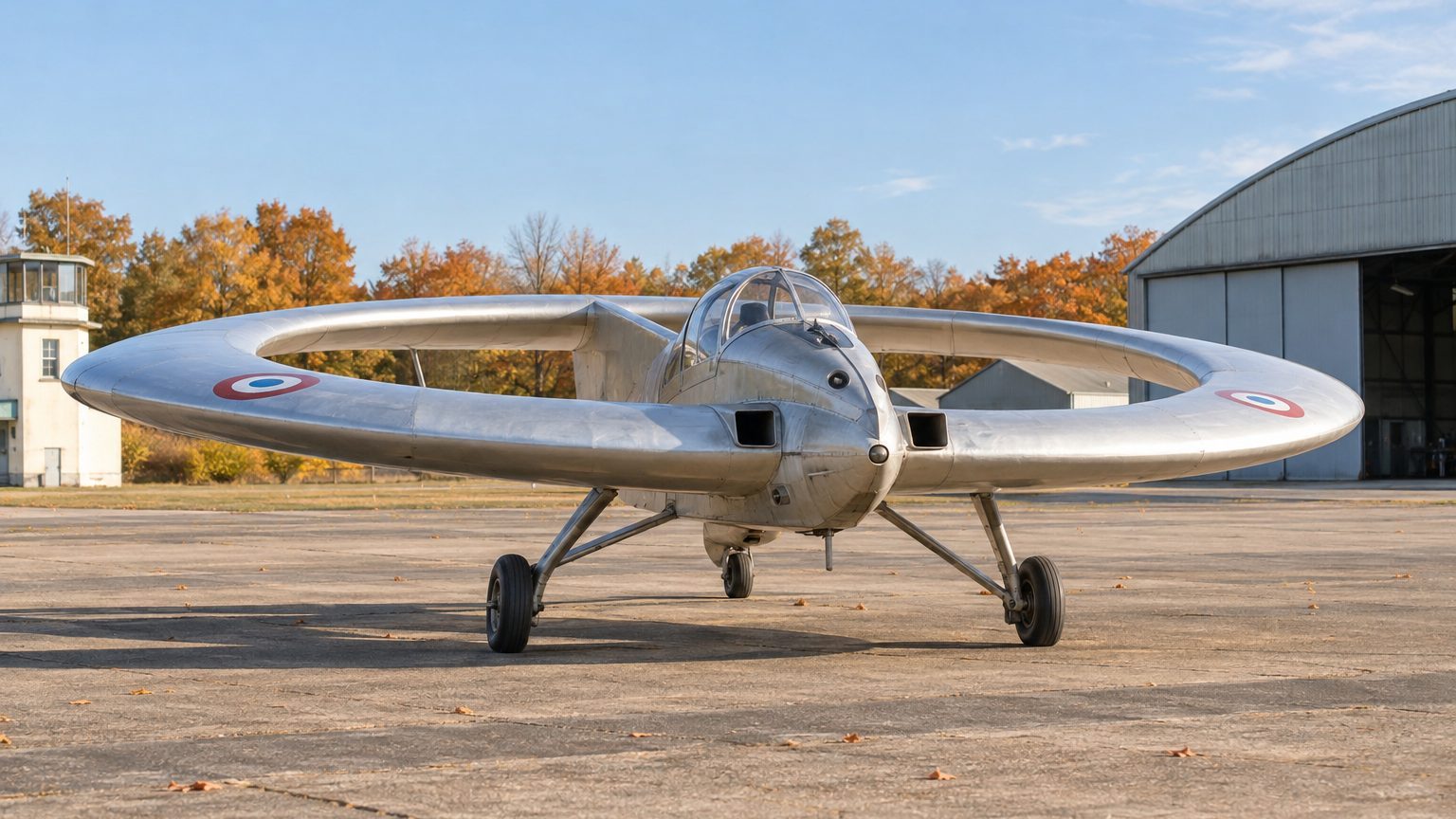
A Reactor in a Ring
The principle rests on a single image: an engine enclosed within a steel doughnut.
The idea of the annular wing came from Austrian engineer Helmut von Zborowski, who resumed his work on the ring wing that he had pursued for Heinkel. SNECMA, being a propulsion specialist, bought his patents and then entrusted the design of the fuselage to Nord Aviation. Louis Blériot and Gabriel Voisin had already experimented with the device without success on the Blériot III in 1906. The Coléoptère’s annulus measures 3.20 meters in outer diameter, with an 18 square meter lifting surface, and its thickness leaves room to store kerosene.
The C.450 continues the series of Atar Flying testbeds, those engine-testing benches without wings, of which only the third had been piloted, by Auguste Morel. The annulus adds to this base to enable the transition to horizontal flight, something the early machines could not accomplish. By comparison, 3.2 meters is barely shorter than the width of a French highway lane.
Eleven Weeks in the Melun Sky
The prototype, delivered in April 1958, did not leave the ground until a year later. The first flight, captive, occurred at Melun-Villaroche on 17 April 1959 with Auguste Morel, followed by the first free flight on 5 May. Between this free flight and the accident, roughly eleven weeks elapsed, during which nine flights were completed.
By early May, Morel managed three minutes and a half of hover.
Yet piloting remained delicate. In hover, the aircraft tended to yaw slowly around its axis, and the vertical-speed indicator proved unreliable. For takeoff and landing, steering was accomplished by a pneumatically deflected thrust of the engine, and, in horizontal flight, by four swiveling fins mounted at the base of the ring. The ejection seat, developed with Sud-Aviation, was movable to provide visibility in all configurations. A probe placed on a wheel warned the pilot when he was nearing the ground.
On July 25, 1959, the Roll That Went Wrong
That day, Morel was to attempt a transition initiation: tilt the aircraft slightly for a few seconds. At this still modest speed, the annular wing did not generate lift, and the control surfaces lacked enough authority to regain control. Lacking reliable instruments and visual cues, the machine pitched to more than 50° and slowed too much to regain altitude.
The aircraft then wobbled on all three axes and entered a spin near the ground. Morel ejected at very low altitude, with sources giving figures ranging from 15 to 150 meters, while Zone Militaire’s account mentions 500 meters.
The pilot survived, seriously injured; the prototype was destroyed.
Why Nobody Built the Second
The program came to an abrupt halt. A second unit, which had been planned for construction, was never funded. Yet the annular-wing concept had not been abandoned, and West Germany had been participating in the research program since an agreement signed in 1958. An additional budget might have allowed improvements to the instrumentation, but it never materialized.
The same problem of unreliable references haunted the competitors. The American Ryan X-13 Vertijet faced the same disorientation, the pilot lying on his back during the transition. The Coléoptère had at least one advantage over it: it could land and take off from the ground without any special infrastructure.
The C.450 was intended to serve as the basis for an operational fighter aircraft, with a combat-mission endorsement in its specification. The trials never left the experimental domain, and no derivative was ever built. The sole Coléoptère in history flew nine times, from 17 April to 25 July 1959.
Sources: aviafrance.com | migflug.com
