
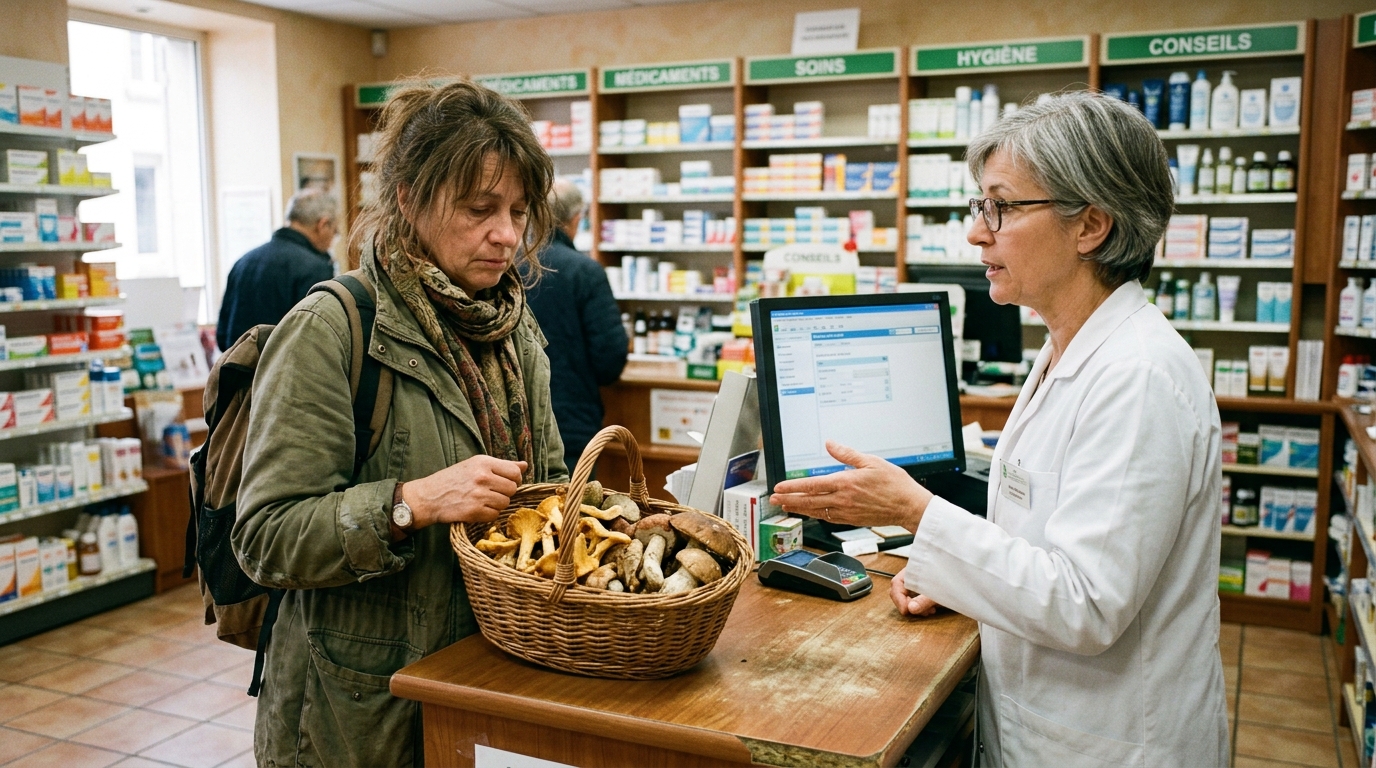
Basket in arm, hat still stained with damp soil, the forager pushes open the door of the neighborhood pharmacy, as naturally as one would go looking for a bandage. For as long as anyone can remember, or almost, this scene repeats every autumn: the white coat examines, turns over, sniffs, and then weighs between a generous porcini and a toxic look-alike. Yet this year, the answer changes. “Sorry, we don’t do that here anymore.” This sentence, increasingly heard behind the counter, leaves foragers perplexed. Who, nowadays, can truly guarantee that a mushroom gathered in the forest will end up in the skillet rather than in the emergency room?
- Mycology training has never been mandatory for all pharmacists, which explains the highly uneven levels of expertise behind the counter.
- More and more pharmacies refuse to identify mushrooms, fearing liability and due to a shortage of genuinely trained professionals.
- When in doubt, it is wiser to consult local mycological societies or a specialized pharmacy, and to contact the poison control center without delay if symptoms appear after consumption.
- The myth of the pharmacist mycologist is crumbling
- Why pharmacies close their doors to mushroom baskets
- Where to turn now for a reliable diagnosis
The myth of the pharmacist-mycologist is crumbling
The image of a pharmacist capable of recognizing any species at a glance is a hard one to shake. It hails from a time when the option of mycology held a more visible place in pharmacy studies, with herbariums, forest outings, and real botanical instruction. But this skill has never been a universal requirement of the degree. Some students delved into the subject out of passion, others barely touched it. The result: behind the same white coat lie vastly different levels of knowledge. This ambiguity, long invisible to the general public, reemerges each autumn, when popular tradition clashes with the reality of a training that never guaranteed this knowledge for everyone.
Why pharmacies close their doors to mushroom baskets
Behind this polite refusal lies a far more complex equation than a simple lack of time. Many pharmacists fear taking on their liability in case of misidentification, a risk they prefer not to assume when foraged items can be dubious or incomplete. Added to this is a demographic reality: professionals truly trained in mycology are increasingly scarce, while the pace of dispensing in pharmacies leaves little room for a meticulous examination of each basket. In some departments, such as Yonne, drought has even reduced the diversity of species available, prompting local pharmacists to reaffirm their role as watchdogs rather than absolute experts. Elsewhere, some pharmacies opt to officially specialize in mycology, which implicitly suggests that all other outlets no longer offer this service uniformly across the region.
Who to turn to now for a reliable diagnosis
Facing this gradual withdrawal, other channels are stepping in, quite literally. Local mycological societies, such as the one in Auxerre, organize guided forays and even adapt their calendars to weather conditions, waiting for rain to hope for richer harvests. Poison control centers likewise remain a valuable resource in case of doubt or after symptoms post-ingestion. Here are the preferred options for foraging without unpleasant surprises:
- Regional mycological associations and societies, often free and highly educational
- The pharmacies still specializing in mycology, to identify in advance
- Poison control centers in case of symptoms after consumption
- Identification apps, to be used with caution and never as a final validation
The main risk remains the confusion with the deadly Amanita phalloides, feared above all. Its poison silently attacks the liver, and the first symptoms may appear only six to twelve hours after the meal. The sufferer feels well for hours before suddenly collapsing, which makes this type of poisoning especially treacherous. At the slightest doubt about the condition or species of a mushroom, the rule remains simple: do not consume the harvest until it has been examined by a specialist, a trained pharmacist, or a learned society. In cases of nausea, vomiting, or neurological disturbances after a meal, promptly consult a health professional or contact the poison control center—this is an emergency, not an option.
This discreet but real shift in responsibility invites a rethink of harvesting habits. The local pharmacy remains a useful link in the prevention chain, but it is no longer, and perhaps never was, the absolute guarantee that people once attributed to it. The question remains whether this new distribution of roles between health professionals and mycology enthusiasts will reassure woodland lovers in a lasting manner.
