
The tomb of the Lady of Vix was not empty in 1953. It is not empty now either. When Inrap reopened the trench in 2019, archaeologists recovered nearly 2,000 fragments that had passed through the hands of the initial investigators, including a piece of jewelry made from black rock that researchers link to Dorset, on the south coast of England.
Sixty-six years of silence, then a sieve.
- Nearly 2,000 archaeological fragments were discovered in 2019 in the soil that had been restored but never sieved in 1953
- Schist ornaments originate from Dorset in England, revealing trans-Channel contacts around 500 BCE
- The bronze crater was complemented by recovered pieces, notably the missing lower legs of a quadriga on its warrior frieze
Soil Restored, Never Sieved
January 1953, Vix (Côte-d’Or), at the foot of Mount Lassois. René Joffroy and Maurice Moisson, in the cold, uncover the tomb of a woman lying on the cradle of a chariot, adorned with a gold torque weighing 480 grams. The bronze crater that accompanies her measures 1.64 m, weighs 208 kg and contains 1,100 liters.
The rest of the story has often been told wrongly. The soil was not abandoned in a heap to the side: Joffroy almost completely returned it to the excavation, which, by luck, preserved the context. But no one sieved it, and that is where everything went awry. Bastien Dubuis, the scientific lead of the 2019 excavation, even suggests that the pump used at the time to drain water may have sucked up tiny objects, later found in these backfills.
No one had subjected this soil to sieving.
Nearly 2,000 Fragments, a Crater Completed
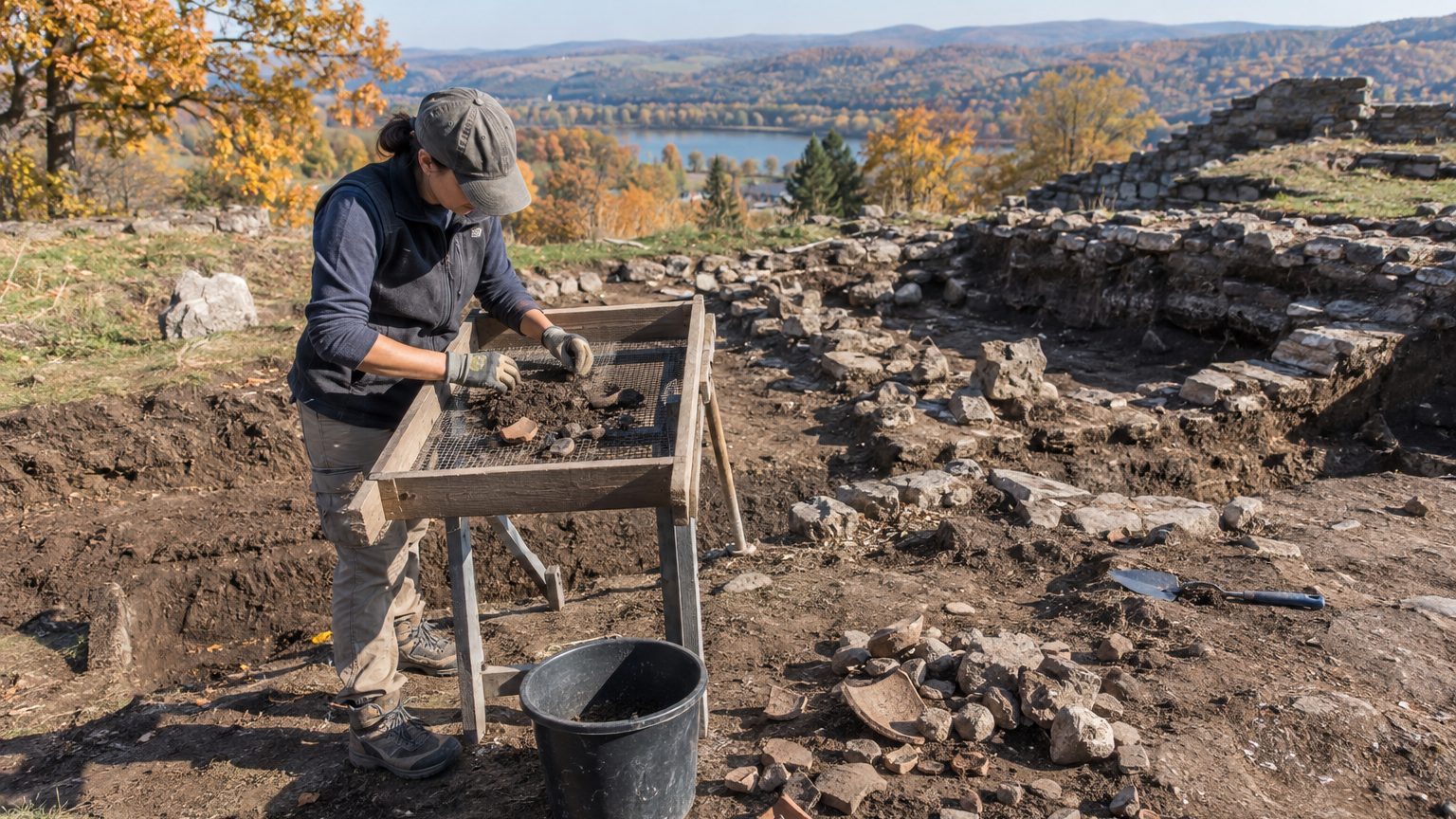
From August to November 2019, Inrap conducted the digging in collaboration with the ARTEHIS laboratory (CNRS and the University of Burgundy), whose Bruno Chaume has led the site’s research since 2002. The backfills were collected in big bags, then sieved. Bastien Dubuis recalls being astonished by the quantity: nearly 2,000 newly recovered fragments, but few complete objects, aside from a few fibulae.
The loot is not limited to crumbs. The lower parts of the missing legs of a quadriga that adorned the crater’s warrior frieze were found within the first days of cleaning. The tip of a female figure’s finger on the lid suggests that her hand pointed in a direction, rather than holding an object as previously believed. Fragments of a large Etruscan basin and fibulae decorated with coral, forgotten in 1953, complete the picture. The number of known fibulae has thus doubled.
These pieces are now on display in the Pays Châtillonnais Museum, in Châtillon-sur-Seine. The museum has requested approval from the Monuments Historiques to re-integrate some elements into the crater itself.
The Black Rock from Dorset
Among the fragments are elements of jewelry made from black rock. The tomb already contained these: bracelets made of lignite or black schist, noted in early descriptions. The new pieces have rekindled questions about their provenance, and the interview granted by Bastien Dubuis to Inrap specifically mentions these black-rock adornments among the origin paths to explore.
Dorset comes into play at this moment. According to the identification given for these fragments, the material would originate from southern England, most likely Kimmeridge shale. This is not a speculative hypothesis: county heritage records at Kimmeridge document Ferrous Age workshops producing shale bracelets.
The exact nature of the material and the object remains to be confirmed by scientific publications.
This lead is intriguing, because a Dorset shale bracelet would not be found at the foot of Mount Lassois. One would have to cross the Channel and traverse hundreds of kilometers of land and waterways. A material of this type has also been reported in Lavau’s princely tomb (Aube), where a lignite armband was worn on the left arm of the deceased, suggesting a taste shared by the region’s elites around 500 BCE.
For Bastien Dubuis, the close chronological and geographic proximity of Vix and Lavau invites cross-analysis, including analyses of the silver used in both tombs. Early results from this study have already led to revising the dating of the Lady of Vix’s burial.
Sources: christaldesaintmarc.com | artehis-cnrs.academia.edu
