
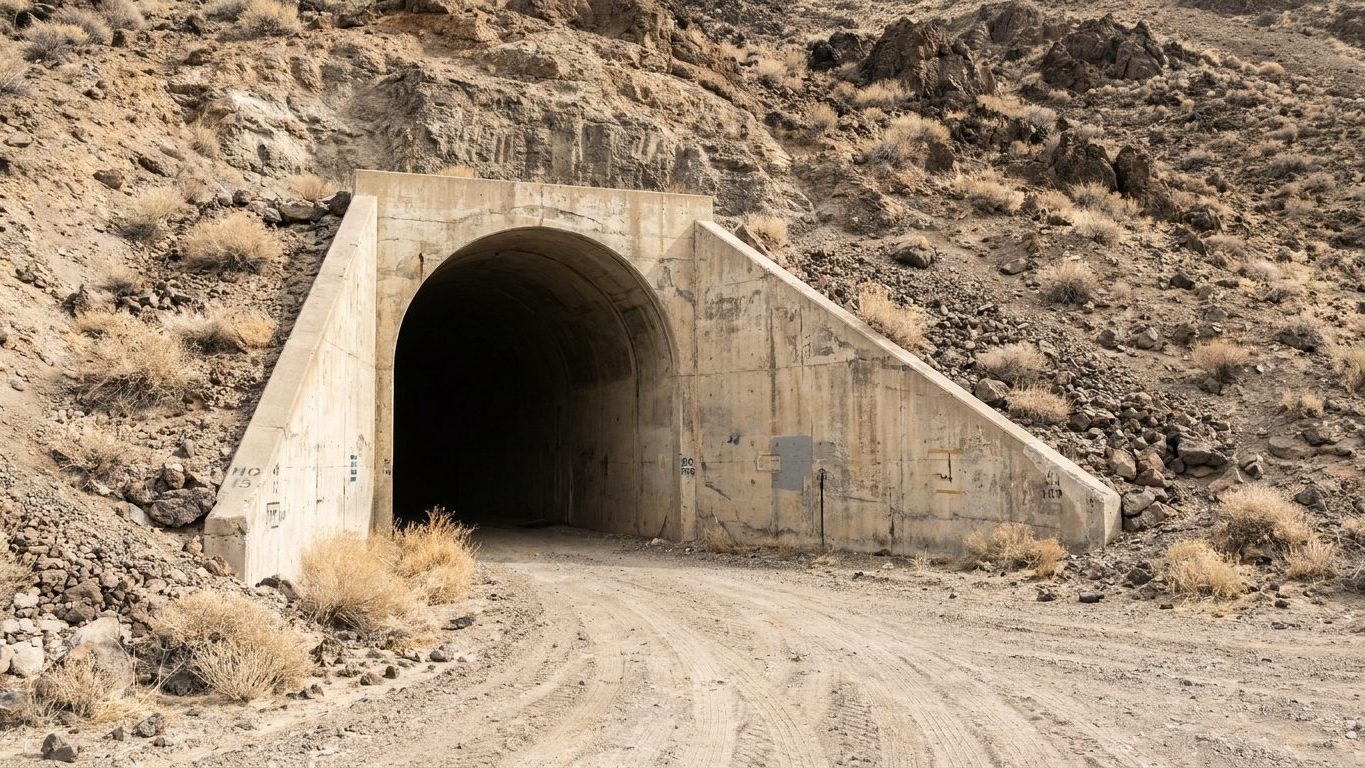
A horseshoe-shaped iron tunnel eight kilometers long, carved into a mountainside in the Nevada desert. Fifteen billion dollars of public funds poured into it over two decades. And strictly nothing inside: not a gram of spent nuclear fuel has ever been stored there. Yucca Mountain remains, even today, the largest nuclear project ever completed without ever serving a single purpose.
The story begins in 1987. The United States Congress designates that barren mountain, about 160 kilometers northwest of Las Vegas, as the sole site to bury all the country’s civilian nuclear waste for the next ten thousand years. Congress named Yucca Mountain as the home of a permanent national nuclear waste repository in 1987. The choice was not random: two other sites, in Texas and in the state of Washington, had been considered before Congress balked at the cost of their full assessments.
- An eight-kilometer exploration tunnel was excavated at Yucca Mountain between 1987 and 2010 without ever hosting nuclear waste.
- The project cost roughly $15 billion before being abandoned following a political decision in 2010.
- The 95,000 tonnes of American nuclear waste remain temporarily stored at 79 sites in 39 states, generating compensations of $11.1 billion since 1998.
Twenty years of drilling for a tunnel that will never store anything
The Department of Energy launched a titanic undertaking. A multi-hundred-ton drilling machine attacked the volcanic rock, month after month, carving a main U-shaped tunnel five miles long (eight kilometers) and 25 feet wide (7.6 meters). Secondary galleries and alcoves were added, turning the mountain into a giant laboratory where researchers tested rock strength, water movement, and the thermal behavior of future containers.
Yet the site bore grand ambitions that proved unsustainable. The repository had a legal limit of 77,000 metric tons of waste—an amount that would have required an additional 40 miles (64 kilometers) of tunnels that were never built. Corrosion-resistant alloys, rails to transport the containers, and the massive final storage infrastructure: none of that ever progressed beyond the planning stage.
Only the exploration tunnel truly exists.
What ended the project was neither geological nor technical
No major fault. No radioactive leak. No engineering report warning about rock stability. What halted Yucca Mountain was a budget vote.
In January 2010, the Obama administration announced its decision to steer the Department of Energy away from pursuing a license with the Nuclear Regulatory Commission, and to eliminate any funding for the project in the 2011 budget. The president’s campaign promise in Nevada materialized. Senator Harry Reid of Nevada, a longtime opponent, immediately welcomed the news. The political fight waged by Nevada’s elected representatives for more than twenty years ultimately toppled a federal project that had enjoyed bipartisan support in Congress.
The 2011 Government Accountability Office (GAO) report summed up the fiasco in one chilling line: halting the project restarts a long and costly process that had already exacted nearly $15 billion by 2009. Fifteen billion dollars, for a hole in a mountain. The legal drama did not end there: in 2013, an appeals court found that the Nuclear Regulatory Commission had acted contrary to federal law by suspending the license review, without reopening the case on the merits.
Since then, attempts to revive the project have followed one another without lasting success. The Trump administration proposed resuming license funding from 2017 onward, with several Republican senators pushing bills to that effect. But the Nevada opposition, led today by Senator Catherine Cortez Masto, remains as firm as it was fifteen years ago. The tunnel, for its part, has stayed shut behind a chain-link fence.
Meanwhile, the waste stayed where it was
The paradox is complete. The nation built the infrastructure meant to solve the problem, yet never used it. American nuclear waste has not moved at all since 2010.
More than 95,000 metric tonnes of spent fuel are now stored temporarily in pools or dry casks across 79 sites in 39 states, directly at the sites of the power reactors that produced them. Taxpayers foot the bill for this stalemate: compensation payments to operators for mishandling the waste have reached $11.1 billion since 1998, and could climb to as much as $44.5 billion in the decades ahead. The Yucca Mountain tunnel, meanwhile, continues to wait in the silence of the Nevada desert, inhabited only by barn owls nesting in a gallery that no one ever had the right to fill.
Sources: guides.library.unr.edu | eia.gov | republicans-energycommerce.house.gov
