
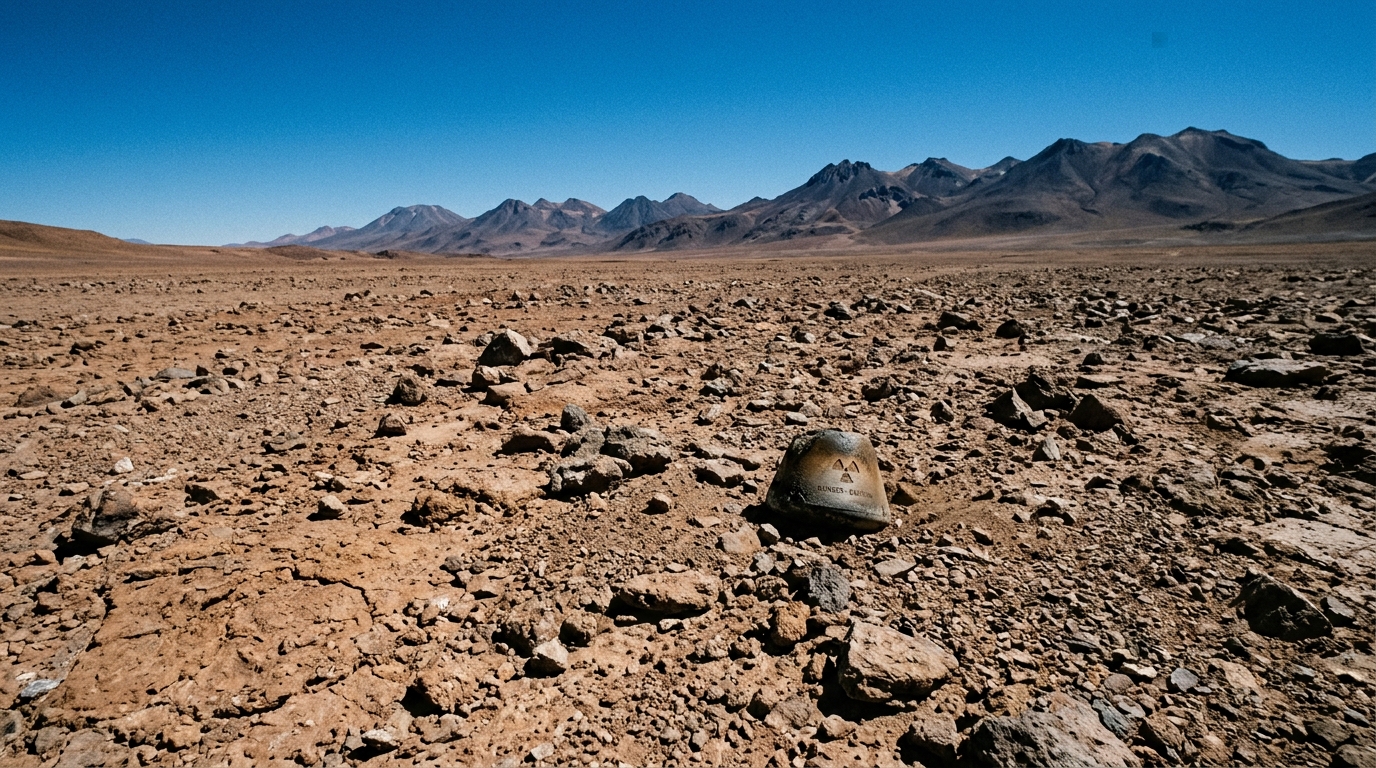
Somewhere in the Andean highlands, between Chile and Bolivia, a small amount of radioactive plutonium has slept for thirty years, eluding any expedition that has tried to locate it. This nuclear fuel, designed to withstand any test, originated from a Russian probe that never reached space. An incident that remained oddly discreet, yet whose potential consequences still provoke questions today.
- In November 1996, the Russian Mars 96 probe reentered Earth after the failure of the fourth stage of its rocket, scattering debris across the Pacific Ocean, Chile, and Bolivia.
- It carried roughly 270 grams of plutonium-238 distributed among four small generators designed to endure reentry and impact without rupturing.
- Although the drop zone was officially confirmed eleven days after the accident, no trace of the radioactive capsules has ever been found in the harsh terrain of the Andes and the Atacama Desert.
- The day Mars 96 never left Earth
- Four plutonium-238 generators lost in the Andean sky
- Why no one has ever found the faintest radioactive trace
- A nuclear mystery that still looms over the Andes today
The day Mars 96 never left Earth
In November 1996, the Russian space agency prepared to launch one of its most ambitious missions since the collapse of the Soviet Union. Named Mars 96, the probe lifted off from the iconic Baikonur cosmodrome, propelled by a Proton-K rocket. Weighing
6,180 kilograms, the craft stood among the heaviest interplanetary vessels ever sent from Earth, a concentrated showcase of technology intended to succeed the Phobos probes launched in 1988 toward the red planet.
But the dream collapsed almost immediately. The rocket’s fourth stage, tasked with propelling the probe out of Earth’s orbit, failed on its second ignition. Deprived of its final push, Mars 96 remained trapped by gravity and fell back to Earth mere hours after liftoff. The assembly disintegrated upon reentry, scattering debris along a 320-kilometer corridor above the Pacific Ocean, Chile, and Bolivia. A brutal end for a mission meant to correct the shortcomings of its predecessors, a technical promise that could never be validated.
Four plutonium-238 generators lost in the Andean sky
What makes this accident especially troubling is the nature of its payload. Mars 96 carried about 270 grams of plutonium-238, distributed across four small generators designed to supply energy and heat to the lander modules and penetrators intended to burrow into Mars’ soil. These units, straddling the line between a radioisotope thermo-electric generator and a simple heating system, were specifically engineered to survive extreme conditions: a searing reentry and a violent impact on the ground, without releasing their radioactive contents.
According to analyses conducted after the disaster, these capsules likely passed through the atmosphere intact, in a manner akin to aircraft black boxes built to withstand the harshest shocks. On the night of the crash, several witnesses in Chile reported witnessing a strange light streaking slowly across the sky, described as a bright object leaving behind a persistent glowing tail. A spectacle as fascinating as it was alarming, for it likely represented the final visible moments of a probe carrying one of the most dangerous substances known to humankind.
Why no one has ever found the faintest radioactive trace
In the days that followed the catastrophe, confusion reigned. Early estimates spoke of a harmless splashdown in the Pacific Ocean, somewhere near Australia. It was only later that a Boston Globe article advanced another hypothesis: the probe may have already disintegrated in the atmosphere, with its remnants falling to the ground in Chile and southern Bolivia. The American Space Command, responsible for tracking objects in orbit, did not officially confirm this version until eleven days later, a delay many observers at the time deemed too long.
But confirming the drop zone is one thing; locating the debris is another. The suspected region lies in one of the planet’s most hostile terrains: the Atacama Desert and the rugged foothills of the Andes mountain range. An immense, arid, hard-to-reach landscape where searching for four tiny metallic capsules is tantamount to finding a needle in a haystack. No search campaign ever succeeded in locating even a fragment, and no prior warning had been issued by Russian authorities before the craft’s fall.
A nuclear mystery that still looms over the Andes today
Thirty years after the events, a retrospective article published by The Space Review reminds us that the mystery remains unresolved. Neither Chile nor Bolivia has confirmed recovering any debris, and Mars 96’s plutonium remains, most likely, buried somewhere in the mountains. This case is not unique in the history of Soviet space exploration: in 1978, the Cosmos 954 satellite crash-landed in Canada with its own nuclear payload, contaminating part of Canadian territory. The Soviet Union, deemed responsible under international conventions, had to pay three million dollars to Canadian authorities to fund the cleanup of the area.
Nothing of the sort has ever been undertaken for Mars 96, due to the lack of a precise impact-site location. The plutonium-238 capsules, designed to stay hermetic even after a violent jolt, pose no immediate danger as long as they remain buried and intact. Yet their mere presence somewhere beneath the Andean rocks illustrates how space exploration has sometimes left behind traces more tenacious than anticipated.
From that ambitious vessel, intended to unlock Mars’ secrets, there remains only a corridor of debris scattered between sea and mountains, and a handful of radioactive grams whose exact resting place remains unknown. A mystery that, this autumn, continues to remind us that space exploration is never completely risk-free, even after it has fallen back to Earth. The question remains whether a future expedition will ever be able to pierce this thirty-year-old enigma.
