
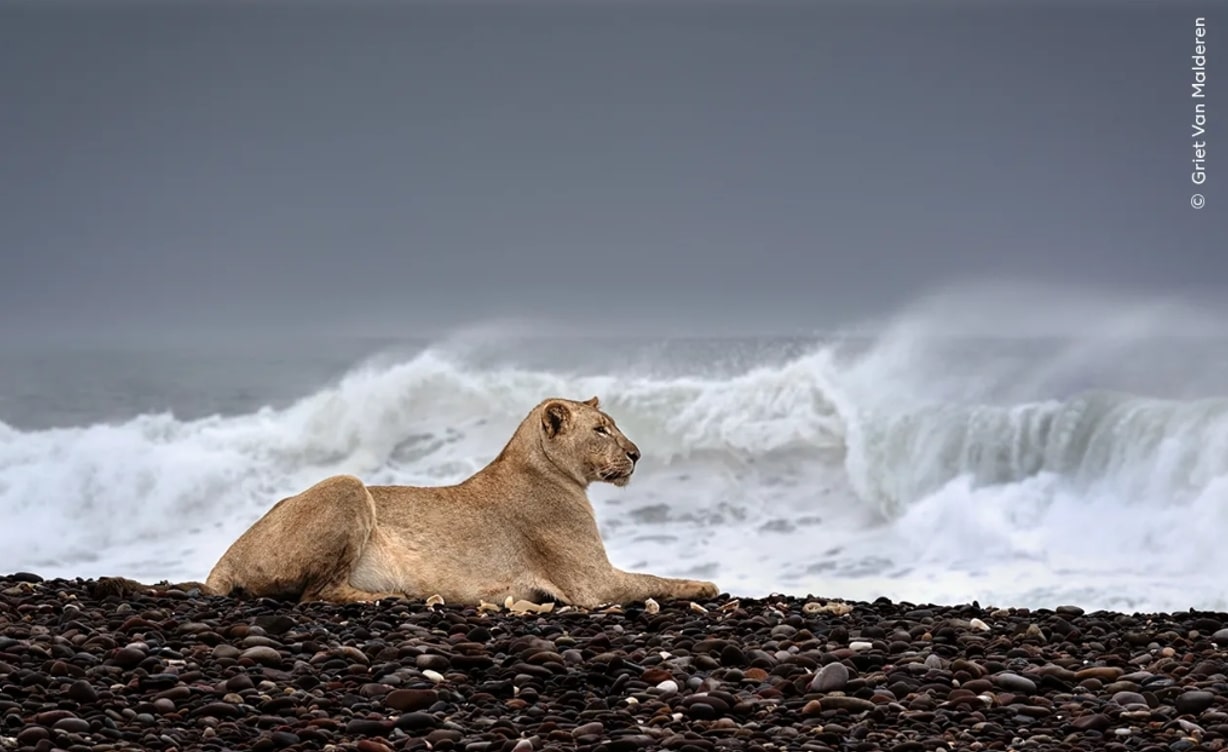
Nearly a decade ago in Namibia, a small group of lions left the savanna to head to the coast, where the climate is more pleasant and prey more abundant. The country can now boast the world’s only ‘maritime lions’. This event touches on a topic rarely covered by the media: climate-driven migration of wild animals.
The ‘Kings of the Beach’
Lions lounging on a beach. Logically unimaginable, this phenomenon is indeed happening today, as explained by the British channel BBC in an article dated October 11, 2025. In 2015, two lions from the savanna of the Namib Desert (Namibia) left their natural habitat to settle on Skeleton Coast (17,000 km²), along the Atlantic Ocean. Two years later, other individuals joined them. For now, it remains a globally unique phenomenon, the animals having earned the nickname the ‘Kings of the Beach’.
The Belgian photographer Griet Van Malderen went to meet these lions and captured striking images, notably of the lioness Gamma (see main photo). The shot was acclaimed as part of the prestigious Wildlife Photographer of the Year competition, held annually by the Natural History Museum in London, United Kingdom.
“We are so accustomed to seeing lions in the savanna or stretched out on a big rock, like in The Lion King, that it’s truly striking to see one on a beach. It’s really odd and unusual.”, said the photographer.
Maritime lions now protected
Originally, the Namib Desert lions numbered around 80. Today, about a dozen of them live on the beach, and several births have already occurred. But why did they migrate in this way? The main reason is climate change. By settling on the coast, the lions found a more comfortable climate and, above all, an abundance of prey, mainly seals and certain birds such as flamingos and cormorants.
If in a few years the desert lions have adapted brilliantly to their new environment, these felines are not new to such migrations. Indeed, some lions already lived on the Skeleton Coast in the 1980s. Unfortunately, they had no choice but to retreat into the desert to survive. Many individuals died due to a severe drought but especially due to conflicts with local farmers. Three decades later, the felines have thus found their way back to the coast.
Today, these ‘maritime lions’ are receiving close attention, as explained by Philip Stander, founder in 1997 of the Desert Lion Conservation Trust. He noted that interactions with local residents and tourists must be kept to a minimum to ensure their protection. Accordingly, rangers use fireworks and alarm-enabled virtual fences to deter the animals from inhabited areas.
