
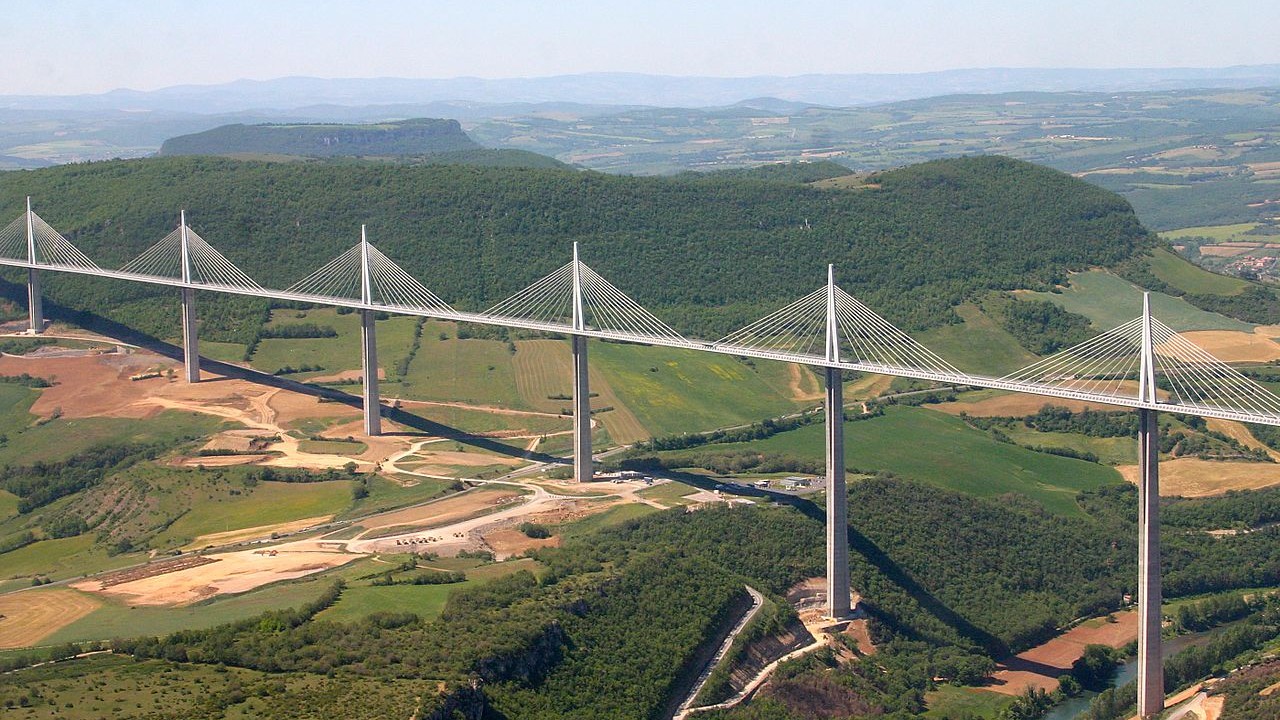
245 metres tall. This is the height of P2, the Millau Viaduct’s main support, the highest bridge pillar in the world. Between it and the deck that spans above, you could almost fit the entire Eiffel Tower: the pole crowning this pillar reaches 343 m above the ground, 13 metres higher than the Eiffel Tower itself. Twenty years after the viaduct’s inauguration, this engineering marvel remains unmatched worldwide. And what makes it even more striking? The structure is owned by the French state, yet the expenses for its construction and operation are entirely borne by the private concessionaire: the Eiffage group, which financed and built this 320‑million‑euro project within a concession lasting 78 years.
À retenir
- A pillar rises higher than the Eiffel Tower, yet hardly anyone notices.
- How France built a monument without dipping into the public budget.
- A record broken every few weeks for months: the mad dash toward the sky.
A record broken meter by meter, live
Each pillar of the viaduct was treated as an independent worksite, with twelve people alternating on two seven‑hour shifts, and pillars progressing by 4 metres every three days. For P2, this pace lasted for months, turning the construction site into a real‑time race toward the sky. On 21 February 2003, P2 surpassed 141 metres and toppled France’s national record. On 12 June, it reached 183 metres, beating the world record held by the Kochertal Viaduct in Germany. A whole country was setting records every few weeks. On 20 October 2003, it finally peaked at 245 metres.
The last four metres were poured with 200 tonnes of concrete hoisted into 3 m³ buckets by a 265‑metre‑tall crane up to the crown of the pile, which now weighs 33,000 tonnes. What this number doesn’t reveal: to reach the top of P2 from the inside, there is no lift. Just a metal ladder that takes more than two hours to climb to the summit. Civil engineering in its most raw form.
The precision of this colossal stacking depended on a decisive innovation for the era: the verticality of the piles was ensured using laser and GPS guidance. For P2 alone, the Eiffage teams carried out 62 lifts, a record in itself. P2 is hollow, which is not merely an aesthetic detail: the hollow piles were sized to resist the vertical loads of the deck, to cope with head movements under thermal expansion, and to withstand wind effects.
The concession, or how to build without touching the state budget
The State hesitated. It hesitated to invest the equivalent of two billion francs at the time, or 320 million euros, and abandoned the idea of a totally toll‑free highway in favor of tolls on the viaduct. The solution adopted in 1998 was a legal arrangement France had never used on such a scale: a complete private concession. The French State granted the Eiffage group, in exchange for toll collection, a concession of 75 years for the project. In concrete terms: Eiffage finances, builds, operates, and maintains. No payment from Bercy. No line in the public works budget.
The Millau Viaduct thus became the first motorway facility to enter the 2001 reform of motorway concessions. This model has since been copied, studied in business schools, and observed by foreign delegations. The Chinese Minister of Transport visited the viaduct on its first anniversary of service, taking an interest in both Eiffage’s technical prowess and the legal-financial structure of the project.
The counterpart of this arrangement is the toll. The contract, initially for 75 years from its December 2004 opening, entrusts a subsidiary of Eiffage with the maintenance, operation, and development of the infrastructure, in exchange for the right to collect a toll. The annual tariff adjustment relies on a contractual formula incorporating changes in the consumer price index published by INSEE. A double‑edged mechanism: motorists indirectly fund the infrastructure through their passages, while the taxpayer does not spend a single cent on its construction.
A structure designed for a century of records
The project was designed by engineer Michel Virlogeux and drawn by architect Lord Norman Foster. The Briton arrived on site just before the completion of the P2 tower. Architect Norman Foster, who signed off on the viaduct’s drawing, visited the construction site on 18 October 2003. He expressed great satisfaction and was impressed by the work accomplished. Virlogeux, for his part, had emphasized structural flexibility: the seven pylons, ranging from 77 to 245 metres in height, split into two beneath the deck at 90 metres to enhance the structure’s flexibility.
The viaduct stands as the road bridge with the highest overall pillar-pylon combination in the world, P2 reaching 343 m, and it bears the two tallest piles in the world, P2 at 245 m and P3 at 221 m. Its deck, rising 270 metres above the Tarn, was the longest span for a cable‑stayed bridge at 2,460 metres. That record was surpassed in 2013 by a Chinese bridge, but the height records of the piles remain intact.
At the completion of the seven piles, a copper tube was slid into the final layers of concrete of pile P3. It contains the names of the 537 workers who contributed to the piling and a commemorative 1.5‑euro coin minted for the launch of the euro currency. A human gesture, almost discreet, buried within 33,000 tonnes of high‑performance concrete, that no one will rediscover for many decades. The manufacturer’s warranty for the structure itself runs until 2124: the concession covers 78 years in total—3 years of construction plus 75 years of operation—and the structure’s builder’s warranty extends to 120 years. Eiffage committed to delivering something that will still be standing when our great‑grandchildren reach retirement.
Sources: legifrance.gouv.fr | legifrance.gouv.fr
