
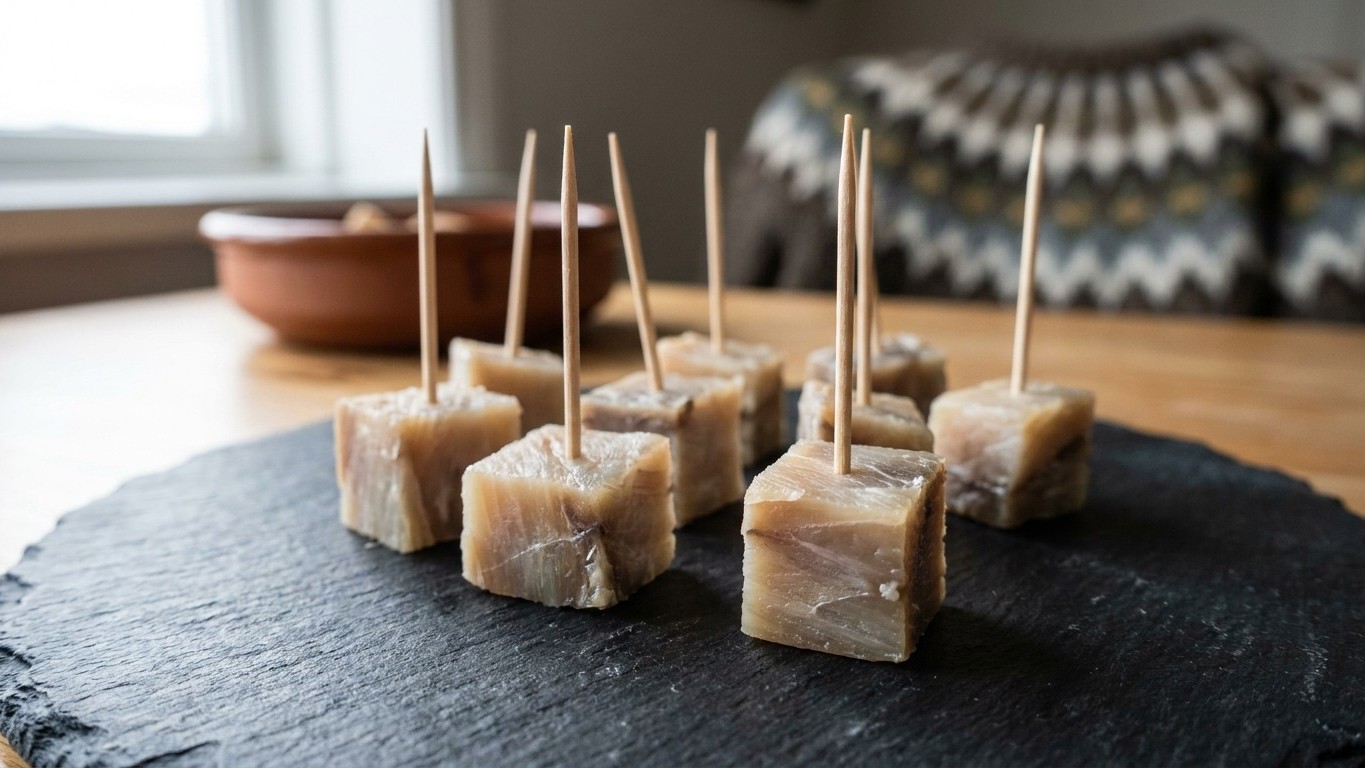
A fish that could be born during Louis XIV’s reign and die of old age today: the Greenland shark holds a record that even scientists struggle to believe. Its flesh contains a neurotoxin powerful enough to produce symptoms of severe drunkenness in anyone who chews a raw piece. And yet, Icelanders have made it their national dish, hákarl, still served today on traditional tables across the country.
Key takeaways
- A creature that spans centuries: the Greenland shark can live more than 500 years and reaches sexual maturity at a minimum age of 156 years
- A meat that must not be eaten raw: its flesh contains a neurotoxin capable of making one drunk or even fatally poisoning
- A remarkable culinary transformation: burying and prolonged air-drying convert the poison into a traditional Icelandic delicacy
A fish that has crossed centuries with barely a move
The Greenland shark (Somniosus microcephalus) swims at a speed barely exceeding 0.34 meters per second, about 1.6 kilometers per hour. A slowness that might seem almost comical if it weren’t the key to its extraordinary longevity. In 2016, a team of Danish researchers published in the journal Science a groundbreaking study in the world of marine biology: by analyzing the eye lens of 28 females accidentally caught, they established that the Greenland shark grows slowly and reaches more than 500 centimeters in total length, suggesting a lifespan far beyond that of other vertebrates, with a minimum age estimate of 272 years.
The oldest specimen in the study, a female measuring 502 centimeters, showed an age estimate of 392 ± 120 years. That animal could have witnessed the birth of Louis XIV. The margin of error is wide, but even at the lower bound, this shark far surpasses the previous animal-kingdom record holder: the bowhead whale, which tops out at 211 years. Some researchers go even further: according to Britannica, scientific data suggest these sharks could live more than 500 years.
This extreme slowness has another consequence, almost dizzying: sexual maturity. According to the Science study, sexual maturity is estimated at at least 156 ± 22 years. An American researcher not involved in the study, Michael Oellermann, described this longevity as “astonishing,” all the more so given that the oceans are dangerous environments where predators, food shortages, and diseases can strike at any moment. It wasn’t until 2024 that scientists began to understand a bit better the mechanism behind this biological exception: an international team sequenced about 92% of the animal’s genome, revealing a genome about twice as large as the human genome, with multiple copies of genes related to DNA repair and to the regulation of inflammation.
A meat saturated with uric acid and a neurotoxin close to intoxication
That covers longevity. There remains a much less glorious detail: this shark does not possess a functional urinary system like other fish. As a result, it eliminates its metabolic waste directly through its tissues. According to Wikipedia, its flesh must be boiled several times to remove trimethylamine oxide (TMAO), a neurotoxin whose effects are akin to intoxication, and it also contains a large amount of urea to regulate buoyancy, which has earned this shark the nickname “pee shark.”
This famous TMAO is not harmless. According to available technical explanations, this toxicity stems from the trimethylamine oxide present in the tissues, which helps the fish stabilize its enzymes and structural proteins against the debilitating effects of extreme cold and the high pressure of the water. A perfect adaptation to life in the Arctic’s icy depths, but a nightmare for anyone who would consume it raw. The symptoms reported in humans resemble severe alcohol intoxication, and the same source notes that these neurotoxins can even incapacitate sled dogs. So this is not just a local legend: raw, unprocessed meat presents a real risk, including the possibility of fatal poisoning at high doses.
HáKarl, or how to turn poison into national pride
Facing this problem, Icelanders developed a technique inherited from Viking times. The shark meat is first buried in the ground for several weeks, then hung to air-dry for months. According to the most detailed descriptions of the process, this preparation involves burying the shark meat in the ground to let it age for about 6 to 8 weeks, extending to several months depending on the season, then drying it in a shed for two to four months. Another version of the method, more focused on extended drying, specifies that the dish, called hákarl or kæstur hákarl, is prepared by suspending the meat for four to five months, which eliminates the undesirable effects of the neurotoxins.
The result of this long process? A meat with an ammonia-like, strong odor that leaves no one indifferent. The late American chef and television host Anthony Bourdain, renowned for sampling the planet’s most improbable delicacies, called hákarl the most terrible dish he had ever eaten. A harsh judgment, but it has never prevented Icelanders from proudly serving it at grand occasions, particularly during Þorrablót, the traditional winter festival. Even today, hákarl is found cut into small cubes, skewered on toothpicks, in Reykjavik’s tourist restaurants as well as in Icelandic households deeply attached to tradition.
What stands out, in the end, is the complete paradox of this animal: a predator that takes a century and a half to reach adulthood, whose fresh flesh could sicken or, worse, and whose existence human ingenuity has turned into a celebrated culinary specialty. The Greenland shark remains listed as a near-threatened species by the IUCN, its slow reproductive rate making it particularly vulnerable to incidental captures in North Atlantic fisheries. A useful reminder: behind every traditional dish as astonishing as this one lies a broader history of survival, far from mere culinary folklore.
Sources: fr.mahnazmezon.com | science.org
