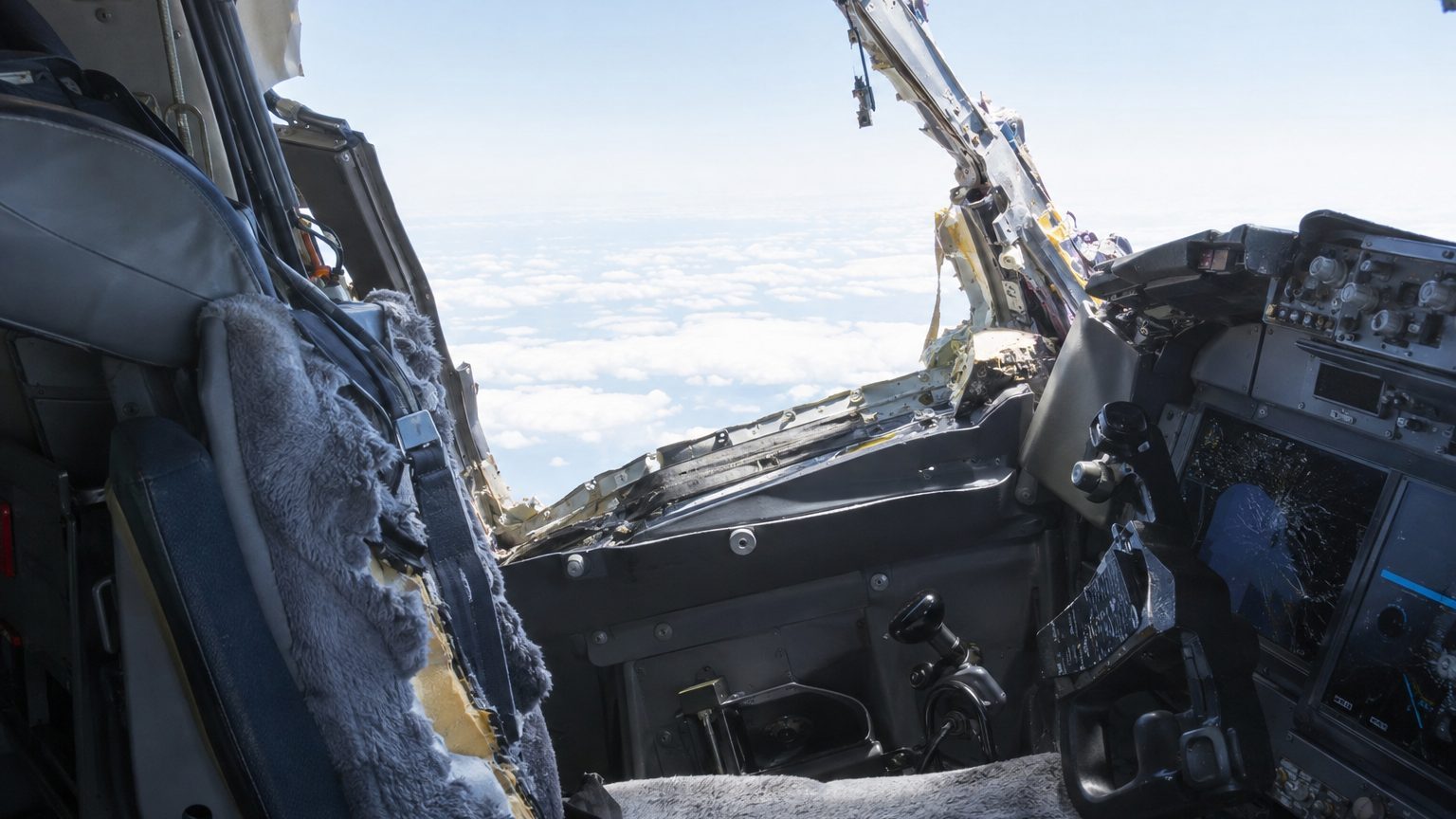
June 1990: British Airways Captain Sucked Out of Cockpit Mid-Flight — A Millimeter-Scale Failure
September 26, 2026
A sharp crack, like an explosion. Then the void, brutal, at the front of the cockpit. In a matter of seconds, the cabin air surges outward, taking with it anything not secured—papers, cups, and above all the man at the controls. The captain is sucked toward the gaping opening, the upper half of his body outside the aircraft, as the icy chill of altitude floods into the cabin.
A member of the crew hurries forward and grabs his legs. He will not let go. Throughout the emergency descent, amid the roar of wind and engines, he holds on, relieved by a colleague when his arms tire. The co-pilot, left alone at the controls, must manage the aircraft without frontal visibility and without certainty that the captain is still alive.
Key takeaways
The cockpit’s front windshield detached in flight due to explosive depressurization.
Fasteners that were undersized by a few tenths of a millimeter reduced the panel’s resistance.
The captain survived thanks to an aircrew that held onto his legs throughout the emergency descent.
What explosive depressurization does
At cruising altitude, the interior pressure inside a commercial airliner is maintained artificially much higher than the outside pressure, which drops dramatically as the aircraft climbs. The difference can amount to several hundred kilograms of force per square meter of fuselage. As long as the structure remains sealed, this gap poses no problem: it is precisely what allows passengers to breathe normally during cruise.
The danger arises when a breach opens suddenly. The interior air, compressed, rushes outward in an instant, creating an air rush of explosive-like intensity. This is what is called explosive depressurization: any unsecured object, including a person not properly strapped in, can be sucked toward the opening.
The drop in temperature accompanies the phenomenon. At cruise altitude, outside air sits at profoundly negative values, and this cold mass violently invades the cabin. Added to this is the thinning of oxygen, which forces the crew to quickly don a mask, when they can still do so.
The cockpit windshield that failed
In this accident that occurred in June 1990 on a British Boeing, the cockpit’s front windshield detached in flight. The pane, supposed to withstand substantial pressure differentials, was literally expelled from its frame, opening a breach directly opposite the captain’s seat.
The investigation quickly determined that this panel had been replaced shortly before the flight. A maintenance operation that seems routine—thousands of times each year on commercial fleets. But the screws used to fix the pane to its frame were not all of the diameter required by the technical documentation.
The gap wasn’t visible to the naked eye. Only a few tenths of a millimeter separated the installed screws from those that should have been used. A difference so minute that it escaped visual inspection, and yet enough to condemn the entire assembly.
Why a tenth of a millimeter becomes fatal at altitude
A cockpit window is not simply laid on its frame. It is held in place by a series of fastenings arranged all around, each calculated to bear a particular portion of the force generated by the pressure difference. The system works as a whole: remove even one link of the correct size, and the load shifts to the others.
Screws that are slightly too thin do not offer the same contact area or shear resistance as those specified by the manufacturer. On the ground, the difference goes unnoticed. At altitude, when the interior pressure pushes the panel outward with substantial force, each undersized fastener works beyond its true capacity.
It is the accumulation of these micro-failures that eventually gave way all at once. An imperceptible deviation during quality control turned, once pressure was applied, into a complete structural failure. The safety margin, meant to absorb normal manufacturing tolerances, had been eroded, fastener by fastener, until it vanished.
A survival against all odds
The captain survived. Despite prolonged exposure to extreme cold and the blast of relative wind on his half-out body, he lived thanks to the crew’s perseverance, who kept him in place until landing. No fatalities were reported in this accident, an outcome that few would have dared to predict the moment the windshield failed.
The accident left a lasting mark on maintenance procedures in commercial aviation. It highlighted the need for cross-checks when replacing critical components like windshields, and the importance of verifying not only the presence of fasteners, but their exact compliance with the manufacturer’s specifications. A tenth of a millimeter, invisible on the tarmac, had been enough to turn a routine flight into a narrowly avoided catastrophe.
Sindre Halvorsen
I write about space exploration, frontier science and the technologies that are quietly shaping the future. From Norway, I follow the missions, discoveries and ideas that connect life on Earth with what lies beyond it. My goal is to make complex subjects clear, useful and worth paying attention to.