
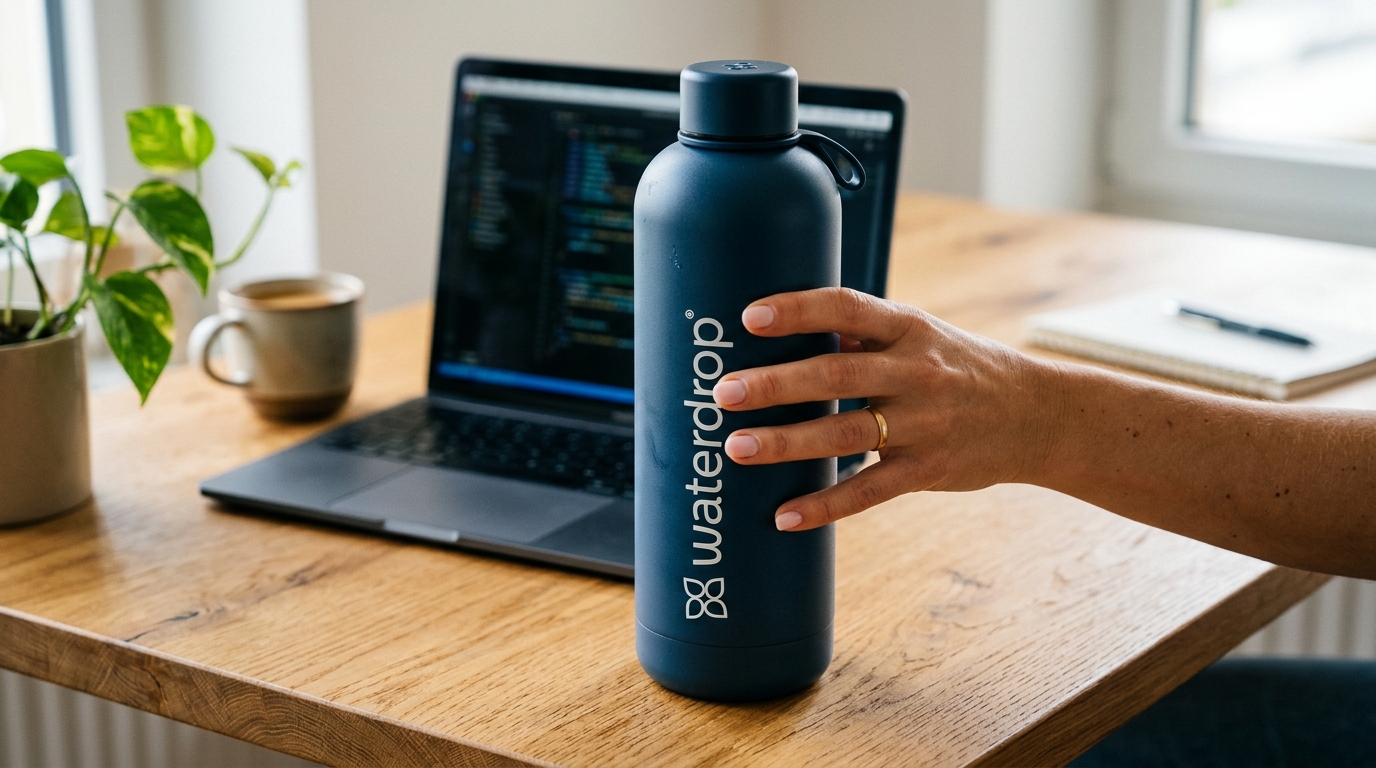
Every morning the same injunction resounds: drink 1.5 liters of water a day, under penalty of dehydration or poor health. This figure, hammered for decades, appears on bottles, in magazines, and in medical advice. It has come to be treated as an almost sacred truth, on par with the five servings of fruits and vegetables per day. Yet nephrologists are now questioning this universal rule, and the reasons for this reversal deserve attention. For behind this familiar benchmark lies a history far less scientific than one might imagine.
- The 1.5-liter water rule rests on no validated scientific study and stems from a partial reading of an American document from 1945.
- This figure ignores water already provided by food (fruits, vegetables, soups, yogurts), estimated at about 0.5 liter per day.
- Water needs vary with age, physical activity, and temperature; it’s wiser to rely on urine color and thirst than on a fixed number.
- The myth of 1.5 liters, analyzed by specialists
- Water from foods, the great forgotten in recommendations
- How much should you really drink according to experts
The 1.5-Liter Myth, Analyzed by Experts
The reasoning seems logical at first glance: the body eliminates about two liters of water each day, and dietary intake provides roughly 0.5 liter. It would therefore be only a matter of compensating the 1.5 liters missing with beverages. But this calculation, as tempting as it is, rests on no universal biological basis. International studies conducted on thousands of people across four continents have recently highlighted that the famous rule of eight glasses of water daily has never been validated by a single rigorous clinical study. In other words, this rounded figure, convenient to remember, leans more toward an urban legend than a medical recommendation. Its origin would even trace back to a partial reading of an American official document from 1945, where the information had been truncated along the way, completely changing the meaning of the initial advice.
Water in foods, the great forgotten in guidelines
The blind spot of this rule lies in one sentence: this number has never had solid scientific backing and ignores the water contained in foods. Another explanatory path points to an American recommendation that equated every calorie consumed to a milliliter of water, roughly 1,900 milliliters for 1,900 calories eaten. The problem is that this estimate already included the water present in foods, such as fruits, vegetables, soups, or yogurt. Yet this precision was lost along the way, and the public remembered only the part “you must drink.” Result: generations have believed they needed to swallow an extra two liters of water, without accounting for what their plate already offers. This isn’t for lack of warning: an article flagging this medical myth existed nearly twenty years ago, without substantially changing collective habits.
How much should you really drink according to experts
If the magical number collapses, that doesn’t mean you should shun the carafe altogether. Actual needs vary with age, physical activity, outside temperature, and the composition of each person’s diet. The classic calculation of 1.5 liters would apply to a theoretical, average individual in typical conditions with an average diet, which, as we can agree, does not describe anyone in particular. Specialists emphasize that there is no universal threshold carved in stone, but rather signals to watch for:
- The color of your urine, which should stay pale
- The sensation of thirst, often more reliable than a fixed figure
- Context: heat, physical exertion, or fever increasing needs
In periods of high heat, the body naturally demands more, while in autumn or winter, needs tend to decrease slightly. Hydration remains essential, but it is best adjusted to each person’s daily life rather than bound to a single formula.
The myth of 1.5 liters per day no longer holds much ground, but it leaves behind a useful lesson: it is better to listen to your body than to follow a rule etched on a bottle label. And if the real question isn’t “how much to drink,” but “how to know yourself better”?
