
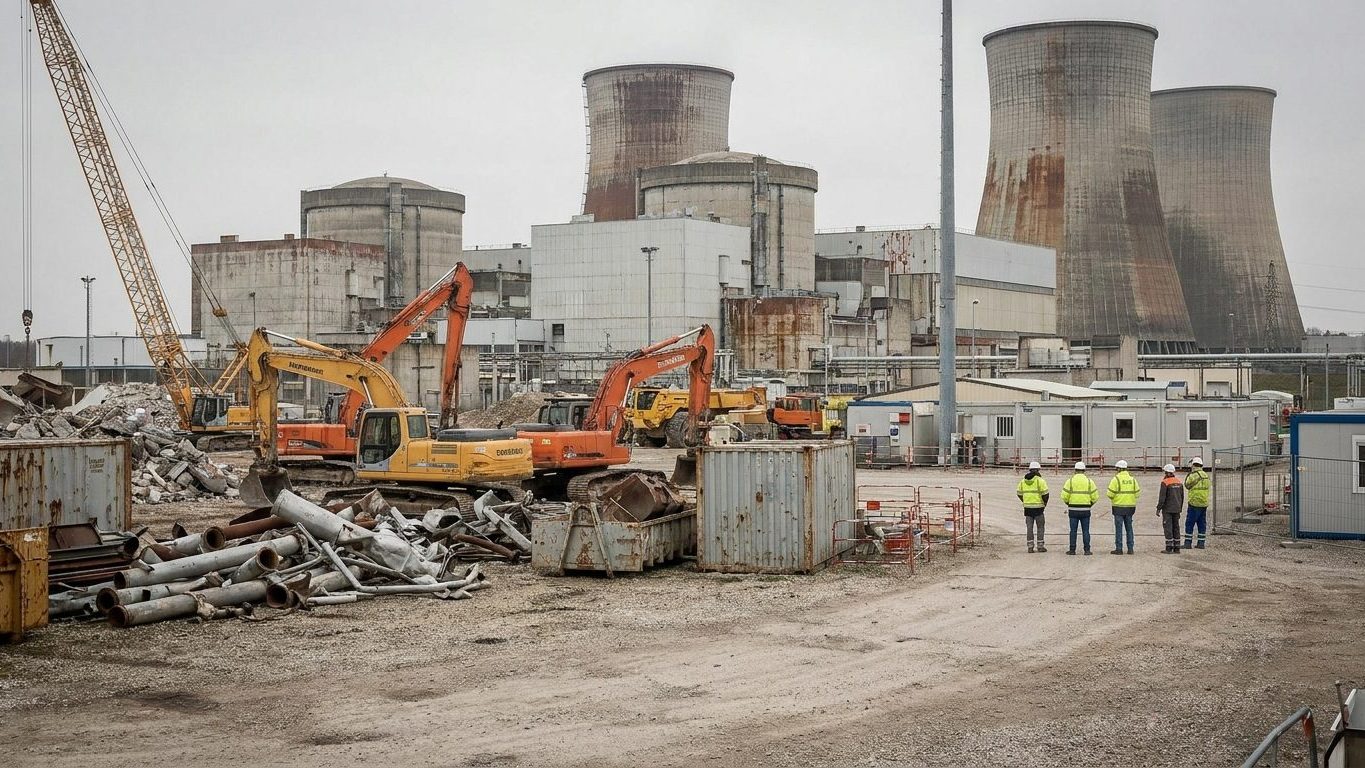
Fessenheim is no longer a power plant. It has become a construction site. A site housing 405,000 tonnes of materials that the state opened in 2020 and that will not be closed again before 2048.
- The two Fessenheim reactors were shut down in February and June 2020 after 43 years of operation.
- Dismantling will generate 405,000 tonnes of materials, of which 95% are non-radioactive and reusable on site.
- The project will not be fully completed until 2048, employing 300 to 400 people per year at a cost of around €700 million per reactor.
Two dates, one abrupt shutdown
Reactor n°1 halted on February 22, 2020. The second followed four months later, on June 30, 2020.
Forty-three years of operation were brought to a sudden stop.
The closure stemmed from the protocol signed between the State and EDF on September 27, 2019. The State committed to compensating the company for this early shutdown, through an payment close to €400 million spread over the four years following the plant’s shutdown. This initial payment included post-operation expenses as well as the costs of dismantling and personnel reconversion.
A 405,000-tonne project
The dismantling of Fessenheim poses a premier-level logistical challenge: operations will generate roughly 405,000 tonnes of materials, of which 95% are non-radioactive. The bulk of this consists of concrete that will be reused on site as fill material.
The remaining 5%, about 20,000 tonnes, will require specialized treatment, tailored to their level of radioactivity.
This preparatory phase allowed the removal of 99.9% of the site’s radioactivity, notably through the evacuation of all spent nuclear fuel to Orano’s reprocessing plant in La Hague, completed in the summer of 2022. Waste, sorted by type and activity level, will first be stored in the old machine hall, which has been cleared of its turbines for this purpose. They will then be shipped to the National Agency for Radioactive Waste Management sites in the Aube. According to Johann Maisonneuve, head of the deconstruction project, the two Alsatian units are the first modern reactors to be dismantled in France, unlike earlier operations on older prototypes such as Chooz A.
The deadline: not before 2041, officially set at 2048
The dismantling authorization decree was signed on May 1, 2026, six years after the plant’s permanent shutdown. The project will not be completed before 2041.
The dismantling decree sets an end date no later than 2048.
A showcase site for the French nuclear industry
This project will engage 300 to 400 people per year to handle all materials. The cost stands at around €700 million per reactor. About €30 million worth of equipment has already been redeployed to other sites in the French nuclear fleet, with turbines from Fessenheim now producing electricity at Dampierre in the Loiret or at Gravelines in the Nord. EDF also plans to create a technocentre, a recycling plant for very slightly radioactive metals resulting from dismantling nuclear installations, on a plot adjoining the site.
The stated objective is to shrink the duration of similar operations to about fifteen years and the cost to €500 million per reactor, in a decisively aggressive commercial outlook. EDF is now eyeing international markets for nuclear dismantling, as dozens of reactors will need to be dismantled in the coming decades in Europe and the United States.
Fessenheim thus serves as a real-world laboratory. What the State closed in a few months in 2020 will take two generations to erase from the Alsace landscape.
Sources: assemblee-nationale.fr | watson.ch | france3-regions.franceinfo.fr
