
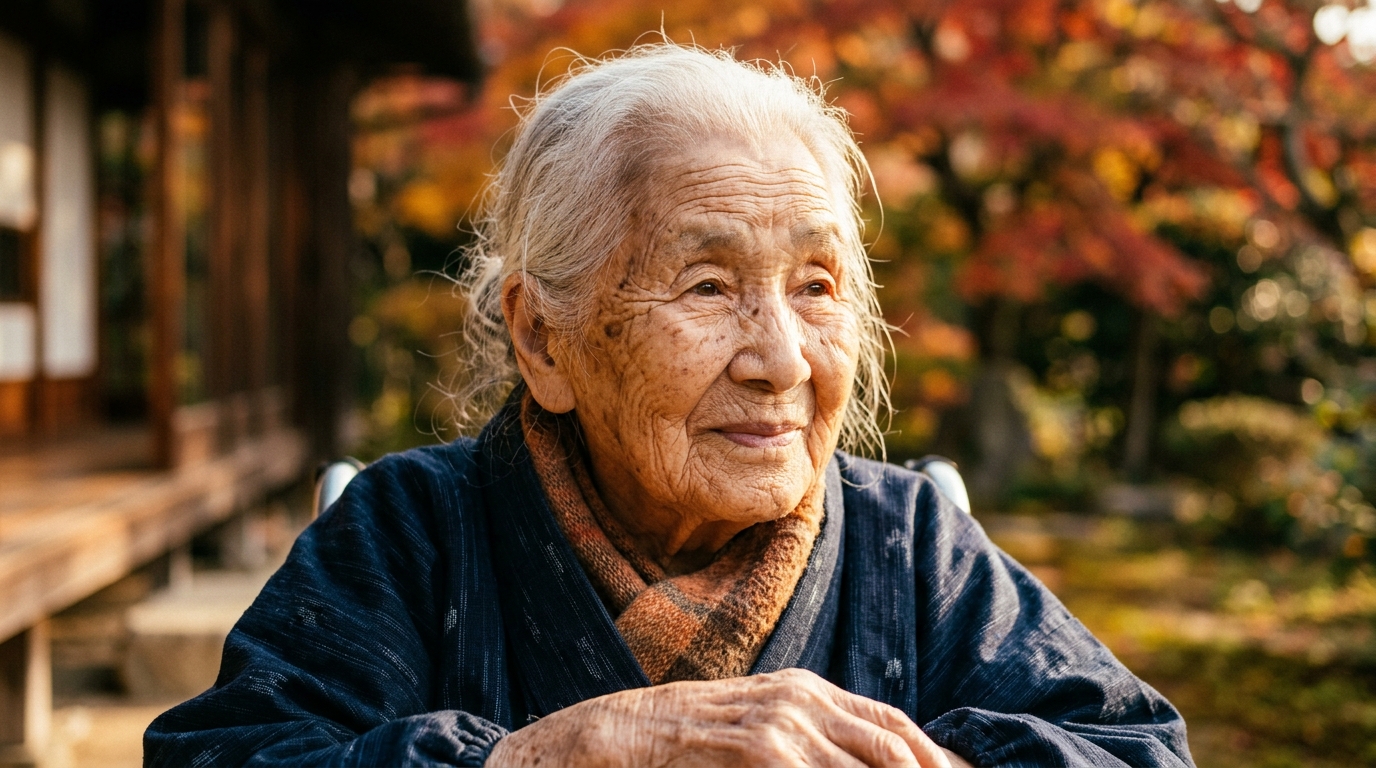
We often imagine that crossing the 100-year threshold is a statistical rarity, a bit like winning the genetic lottery. Yet in Japan, this feat is becoming almost routine. The Japanese Ministry of Health, Labour and Welfare has just published figures that are dizzying: for the very first time in its history, the archipelago counts more than 100,000 centenarians. A news item that lands as the country celebrates its traditional Day of the Elderly during this back-to-school period, and that invites reflection on the secrets behind this extraordinary longevity.
- Japan now counts 107,677 centenarians, up from just 153 in 1963, i.e., more than a 700-fold increase over sixty years.
- Women account for more than 87% of centenarians, with 94,298 women against 13,379 men.
- Each new centenarian receives a congratulatory letter and a gift from the Prime Minister, a tradition celebrated on September 15 during the Day of the Elderly.
- Japan reaches an unprecedented milestone: more than 100,000 centenarians recorded
- From 153 to 107,677: the incredible demographic ascent of the Land of the Rising Sun
- Why Japanese women dominate the exclusive club of centenarians
- A letter from the Prime Minister and a gift: the tradition that celebrates every new centenarian
- 54,294 new centenarians in one year: what this acceleration reveals about Japanese society
- A record that raises questions about Japan’s future in the face of an aging population
- The secret of such longevity: heredity, diet or lifestyle?
Japan reaches an unprecedented milestone: More than 100,000 centenarians recorded
The data compiled up to early September 2026 are unequivocal: Japan now counts 107,677 centenarians, 7,914 more than the previous year. It is an absolute record since such censuses began. This symbolic threshold of 100,000 people, never before reached, illustrates how profoundly Japanese society has changed its face in just a few decades.
This information comes from resident registers transmitted by prefectures, designated cities, and special-status municipalities, a rigorous administrative system that allows the ministry to closely monitor the evolution of this very particular population, those who have just blown out their hundredth birthday.
From 153 to 107,677: the incredible demographic ascent of the Land of the Rising Sun
To gauge the scale of the phenomenon, one only needs to trace the history. In 1963, Japan counted only 153 centenarians across the country. A handful of individuals, almost a local curiosity. Then the curve began to climb inexorably: more than 1,000 centenarians in 1981, the symbolic threshold of 10,000 surpassed in 1998, and more than 50,000 by 2012.
In a little over sixty years, the number of centenarians has thus multiplied by more than 700. This rapid rise, which has accelerated in recent years, sketches a demographic trajectory unique in the world, one that few countries can claim with such consistency.
Why Japanese women dominate the exclusive club of centenarians
One detail immediately stands out when looking at the gender distribution: of the 107,677 centenarians counted, 94,298 are women versus only 13,379 men. In other words, more than 87% of Japanese centenarians are women, a sizable gap that confirms a trend observed for years across the archipelago.
This female overrepresentation among centenarians is particularly pronounced in Japan. It recalls that extreme longevity remains, even today, a largely female phenomenon, and this statistical observation invites questions about the multiple factors—biological as well as social—that could explain such an imbalance.
A letter from the Prime Minister and a gift: the tradition that celebrates every new centenarian
In Japan, reaching 100 years is not only a personal milestone; it is also an event recognized at the highest levels of government. Since 1963, the Japanese Prime Minister personally sends a congratulatory letter accompanied by a commemorative gift to each person who reaches this milestone. This tradition, anchored in the Act on Welfare for the Elderly, is celebrated every September 15, on the occasion of the Day of the Elderly, or Rōjin no Hi.
The stated objective is twofold: to honor longevity and thank these citizens for their contribution to society, while raising awareness across the entire population about the well-being of the elderly. Eligible are all people who have reached or are due to reach 100 years old during the fiscal year, provided they are still alive on the symbolic date of September 15.
54,294 new centenarians in one year: what this acceleration reveals about Japanese society
For the 2026 fiscal year alone, 54,294 people have received, or will receive, the famous letter from the Prime Minister, i.e., 1,984 more than the previous year. This figure translates a concrete reality: every year, tens of thousands of Japanese cross the 100-year threshold, fueling a dynamic that continues to grow.
This acceleration is not a mere statistical accident. It testifies to a profound structural evolution of Japanese society, where life expectancy continues to progress year after year, lifting ever higher the number of people belonging to this very exclusive centenarian club.
A record that raises questions about Japan’s future in the face of population aging
If this record is celebrated as a collective achievement, it also raises, in the background, the question of the massive aging of the Japanese population. A country where the number of centenarians has been multiplied by more than 700 in sixty years is a country whose age pyramid is undergoing radical transformation, with all the implications that involves for society and intergenerational solidarity.
This record illustrates the scale of the demographic aging observed in Japan.
The secret of such longevity: heredity, diet or lifestyle?
In the face of such dizzying figures, one natural question arises: what explains such a demographic anomaly? Researchers who have studied the subject agree on one key point: genetics would play only a limited role. It is mainly lifestyle habits that would make the difference.
The traditional Japanese diet, the washoku, tops the explanations most documented. Less heavy in red meat and dairy than Western diets, it emphasizes fish, rice, soy in all its forms (tofu, miso, edamame) and a wide variety of vegetables, all typically prepared with vegetable fats. Meals also follow regular schedules, which would help stabilize metabolism over the long term.
The Japanese health system is also cited as a determining factor. Ranked among the world’s most efficient by the Bloomberg Efficient Health Care index, it rests on universal health coverage, enabling frequent medical visits and early detection of chronic diseases.
There remains an important nuance, noted by several researchers: this record longevity is neither immutable nor strictly genetic. Between 1970 and 1990, Japan’s mortality rate did not differ markedly from the OECD average. It is precisely the gradual evolution of living conditions, access to care, and dietary habits that allowed Japan to widen this gap over the decades — a useful reminder that the current centenarians’ exceptional longevity is, above all, the product of a relatively recent social transformation rather than an ancestral secret.
Behind these impressive figures lies a human reality: tens of thousands of life stories, marked by a century of history traversed with remarkable resilience. Between national pride and the challenges to come, this new record invites close examination of how Japan will continue in the years ahead to combine exceptional longevity with adapting its society to this unprecedented demographic reality.
