
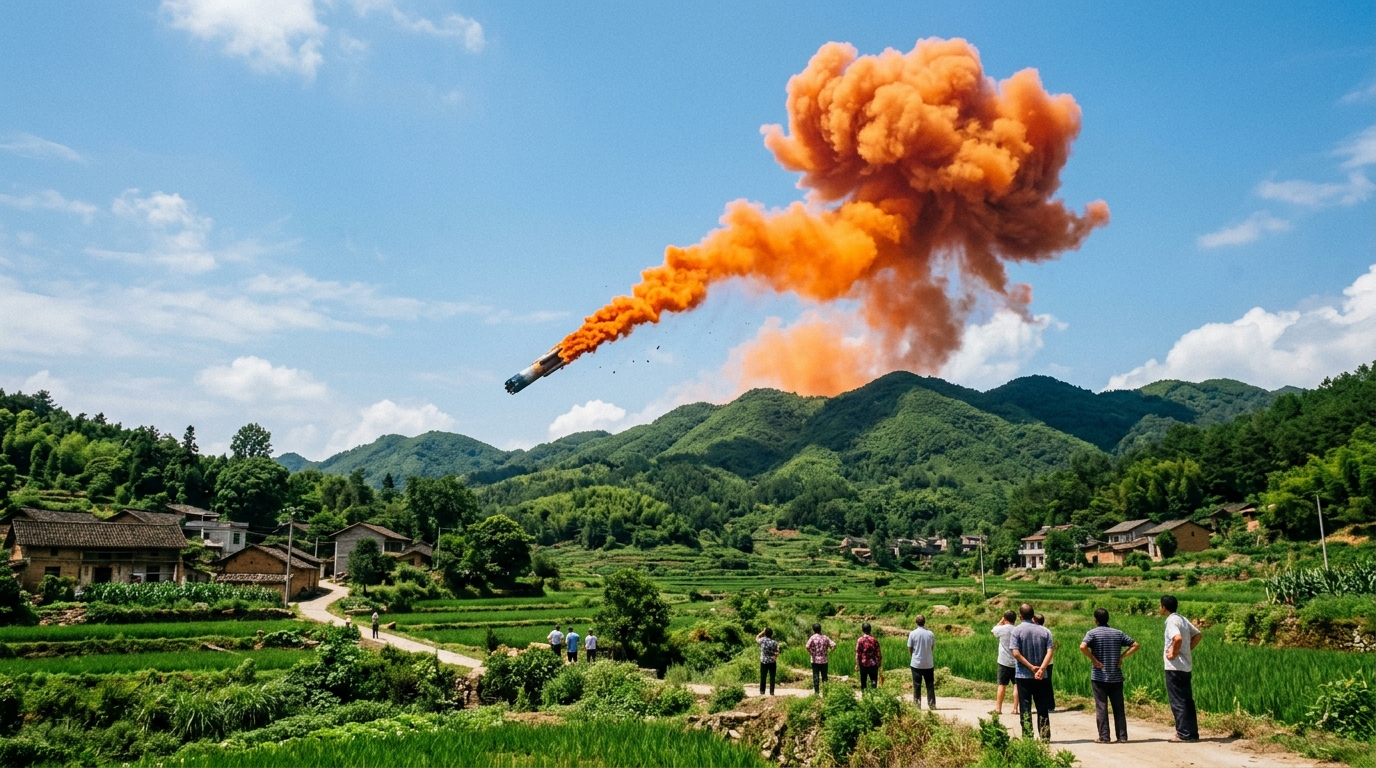
An ominous rumble rends the sky, and an amber plume slowly unfurls above the rooftops of a Chinese village. This sight, as impressive as it is unsettling, has repeated itself in the distant countryside across the Middle Kingdom over recent years. As autumn settles in and attention shifts to the planet’s grand space calendars, another phenomenon, far less celebratory, continues to play out away from Western media spotlights. For behind every successful Long March rocket launch lies a reality Beijing would rather keep out of the limelight: a toxic fuel that literally falls back onto its own citizens.
- Long March 2, 3 and 4 rockets use toxic propellants inherited from the Cold War era (UDMH and nitrogen tetroxide), with fallout near inhabited areas triggering evacuations, as observed in 2023 in Hunan and recently in Guizhou.
- This risk is amplified by inland placement of China’s launch bases on continental terrain, unlike other space powers that favor coastal sites to direct debris into the sea.
- Since the 2000s, China has been developing more powerful and less toxic launchers, but older models remain widely used for cost and industrial availability reasons.
- A fuel from the Cold War that has never disappeared
- When debris falls near homes: stories of evacuations and orange vapors
- Why Beijing persists in using a technology the rest of the world has abandoned
- What these launches reveal about China’s space conquest’s industrial and human choices
When a Chinese launcher climbs into the sky, entire villages hold their breath. It isn’t the fear of the noise that unsettles them, but what will fall on their rooftops. For decades, Long March 2, 3 and 4 rockets have launched from bases located squarely in the country’s interior, and their spent stages crash regularly near inhabited areas. Their fuel, highly toxic, turns each launch into a quiet, looming threat hovering above residents.
A Fuel from the Cold War That Never Disappeared
To understand what is at stake above these Chinese farmlands and villages, one must go back to the very origins of the propulsion technology in use. The Long March 2, 3 and 4 rockets operate with storables propellants, a technical choice inherited directly from the Cold War era. These fuels have the advantage of remaining usable in tanks for extended periods without degradation, unlike cryogenic propellants that require intricate cooling systems. Two substances are involved here: UDMH, employed as the reductant, and the nitrogen tetroxide (NTO), which serves as the oxidizer.
UDMH has long been favored because it stays liquid at lower temperatures than pure hydrazine, reducing in-flight explosion risks. A logical choice on paper, but one with substantial health costs in case of leaks. Nitrogen tetroxide, meanwhile, is an especially corrosive compound: contact with skin, eyes, or lungs can literally destroy tissue and cause lasting lung damage. In other words, this is not merely exhaust gas or a cloud of dust breathed by villagers near fallout zones, but a chemical vapor capable of causing serious injuries.
When Debris Falls Near Homes: Evacuations and Orange Vapors
The phenomenon is far from anecdotal. A widely circulated online video captured the first stage of a rocket crashing close to a village in the Guizhou province, near the Xichang launch base. In the footage, a thick orange plume billows from the debris as terrified residents scatter. Filmed on a phone and shared broadly on Chinese social networks—sometimes afterward censored—this scene starkly exposes what most people do not imagine about space exploration: the rapid evacuation of entire hamlets.
This episode is far from isolated. In 2023, the booster of a Long March 3B had already crashed near a dwelling in Hunan province, in the country’s south-east. These recurring incidents can be traced largely to a geographic choice that diverges markedly from that of other spacefaring nations. Unlike the United States, Europe, or even Russia, which generally place launch facilities on coastlines to ensure spent stages fall into the sea, several Chinese sites lie inland. An arrangement born of strategic and historic considerations, but which inherently raises the risk of debris landing near populated areas.
Why Beijing Persists in Using a Technology That the Rest of the World Has Abandoned
The question is worth asking: why continue with such hazardous propellants when other solutions have existed for a long time? The answer largely hinges on economic and industrial factors. The United States, through NASA, progressively left this type of hypergolic fuel behind due to its toxicity, preferring safer technologies even if they require higher development costs. China, by contrast, chose the opposite path for decades: maintaining a fleet of proven, cheaper-to-produce launchers, even at the expense of local health consequences.
That said, nitrogen tetroxide is not unique to China. The Proton launcher from Russia, for instance, still uses this compound today, proving that this hypergolic technology is not exclusive to China. What truly distinguishes the Chinese situation is the fusion of a toxic fuel with inland, densely populated launch sites. The Long March 2 family, derived directly from a former intercontinental ballistic missile, remains by far the most-used launcher in Beijing’s arsenal, with more than 120 launches recorded by mid-2020. Such a high usage rate logically multiplies exposure opportunities for populations living near fallout zones.
What These Launches Reveal About China’s Space Conquest: Industrial and Human Choices
Beyond chemistry and geography, these recurring episodes sketch, in the negative, a certain philosophy underpinning China’s space program, one that favored racing the clock with more launches over a comprehensive overhaul of existing infrastructure. It isn’t total blindness: since the early 2000s, China has actively developed more powerful and, crucially, less toxic launchers than the Long March 2, 3, and 4 generations, signaling a clear aim to eventually break away from dependence on these dangerous storables.
Yet the transition takes time, and the older rockets remain widely in service for cost and industrial-readiness reasons. As their retirement proceeds, rural residents living near debris zones continue to bear an unintended price of national space ambition. A price measured not in yuan or miles into space, but in real health risks for people who never chose to participate in this venture.
This contrast between the spectacular, widely publicized images of triumphal liftoffs and the far more prosaic reality experienced by certain villagers encapsulates the tensions that currently stalk China’s space program—the world’s second-largest economy’s quest for modernization pitted against local health and safety concerns. The lingering question is whether the ongoing modernization of China’s launcher fleet will, in the years to come, finally push these orange clouds away from the daily lives of rural communities.
