
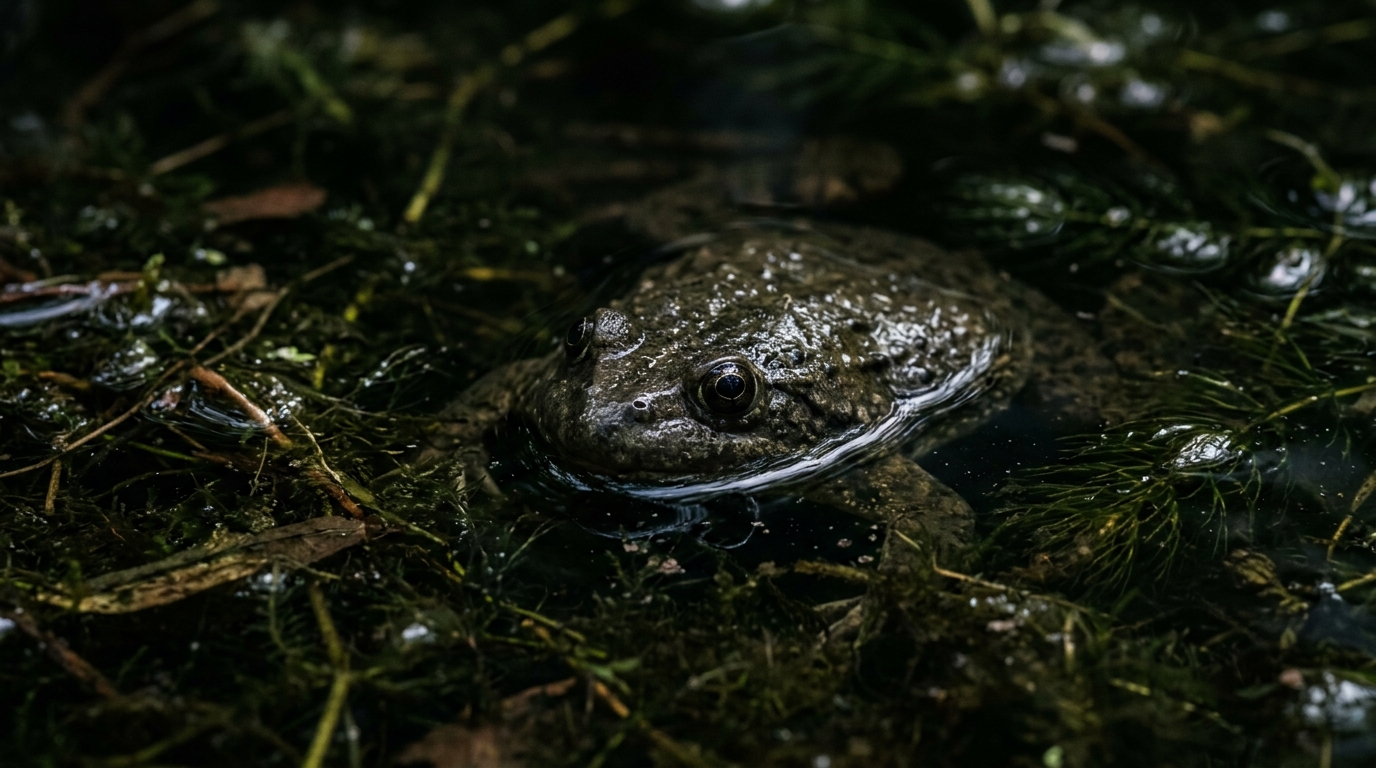
Picture the scene: in a medical analysis laboratory somewhere in France, a nurse withdraws a small amount of urine into a tiny bottle. Not toward a test strip as is common today, but toward an aquarium where a live frog swims freely. The liquid is injected under its skin, they wait through the night, and if eggs appear at the bottom of the tank, the verdict comes back: the patient is pregnant. This protocol, as astonishing as it may seem now, truly existed and left a lasting imprint on our rivers. For this little frog from South Africa, imported by thousands to equip laboratories, France never really let go of it. It settled in quietly and continues to thrive today in certain western rivers of the country.
- The smooth Xenopus (Xenopus laevis), used in laboratories for the Hogben pregnancy test up until the 1970s, was released into nature without impact assessments after the rise of modern immunological tests
- For seventy years, this frog quietly established itself in the rivers of Maine-et-Loire and Deux-Sèvres, where it still thrives
- Classified as an invasive species, it acts as a super-predator and transmits chytridiomycosis to local amphibians, making total eradication today impossible despite trapping campaigns
- The pregnancy test that required a living frog
- Released into nature, forgotten by all
- Seventy years of silent colonization
- A tolerated invader, between scientific curiosity and ecological threat
The pregnancy test that required a living frog
The story begins in the 1920s in South Africa, where British biologist Lancelot Hogben took a keen interest in a local amphibian named Xenopus laevis, commonly known as the African clawed frog or the smooth Xenopus. This researcher notes that the animal reacts dramatically to certain human hormones. The principle is as straightforward as it is ingenious: a female Xenopus is injected with the urine of the woman whose pregnancy status is sought, and if the pregnancy-related hormone hCG is present, the female will lay eggs within just a few hours, typically between 12 and 24 hours.
This famous Hogben test quickly established itself as the reference method for diagnosing pregnancy. By the late 1930s, Britain adopted it on a large scale, before these frogs were exported to the four corners of the globe, notably to the United States, where entire colonies were raised solely for diagnostic purposes. Reliable and fast for its era, this technique would reign supreme for decades, with some hospitals still using it into the 1970s, before chemical tests and the immunochemical strips we know today definitively replaced it.
Released into nature, forgotten by all
That is the part of the history we often encounter in medical texts. But what happened next is far less known, and that is precisely the focus of this article. When modern immunological tests rendered frog use utterly obsolete, no one seriously wondered what would become of the colonies that still populated laboratories, clinics, and hospitals in France. Rather than managing this population properly, many institutions chose simply to get rid of them by releasing the animals into the surrounding environment.
Without a proper impact assessment, without regard for the ecological consequences of such a decision, dozens, and even hundreds, of smooth Xenopus were released into the ponds and rivers of western France. A decision made with near-total indifference, at a time when the notion of invasive species had not yet captured scientists’ minds as it does today. This frog, used to the warm African swamps of Sub-Saharan Africa, would prove to be far more resilient and adaptable than anyone anticipated.
Seventy years of silent colonization
Since these releases, often inadvertent or at least uncontrolled, the smooth Xenopus has quietly fashioned a home in French waterways. Well-established populations are now documented, notably in Maine-et-Loire and Deux-Sèvres, where the species has acclimated perfectly to the local climate. Far from withering away as one might expect for an animal from another continent, it has instead taken root for the long term, gradually colonizing new water bodies across the decades.
What stands out in this tale is the discreet manner in which this colonization occurred. For nearly seventy years, this frog lived and multiplied in our rivers without most French people having the slightest idea. No dramatic invasion, no publicly celebrated spread—just a quiet presence, year after year, generation after generation, until naturalists finally rang alarm bells at the scale of the phenomenon.
An invader tolerated, between scientific curiosity and ecological threat
Today, the smooth Xenopus is officially classified as an invasive species in France, and there are plenty of reasons to worry. Devoid of a tongue but equipped with sharp claws on its hind legs, this frog behaves like a true super-predator in the ecosystems it conquers. Insects, tadpoles, small fish, other amphibians—nothing escapes its voracious appetite, which profoundly disrupts the natural balances of the ponds and rivers it settles in.
Even more troubling, this species is a recognized vector of chytridiomycosis, a devastating fungal disease that wipes out local amphibian populations. A healthy carrier of this microscopic fungus, it spreads the disease without suffering the consequences, worsening its ecological impact far beyond simple predation. In light of these proven risks, European regulations have tightened: the species can no longer be imported, bred, transported, commercialized, or intentionally released into the wild anywhere within the European Union, with the exception of pets already owned by private individuals.
On the ground, trapping campaigns are regularly organized in Maine-et-Loire and Deux-Sèvres to try to curb the animal’s spread. But despite these constant efforts, total eradication now seems beyond reach. The frog has settled in too well, too quietly, for too long to expect to make it disappear entirely from our waterways.
Thus unfolds the little-known story of a small South African frog that became, almost by accident, one of the oldest and most discreet inhabitants of our western rivers. A forgotten scientific legacy transformed into a genuine ecological challenge. At a time when the discourse around invasive species often focuses on recent arrivals, perhaps it is worth remembering that some of them have swum among us for longer than we think, silent witnesses to an era when medicine took paths now regarded as peculiar.
