
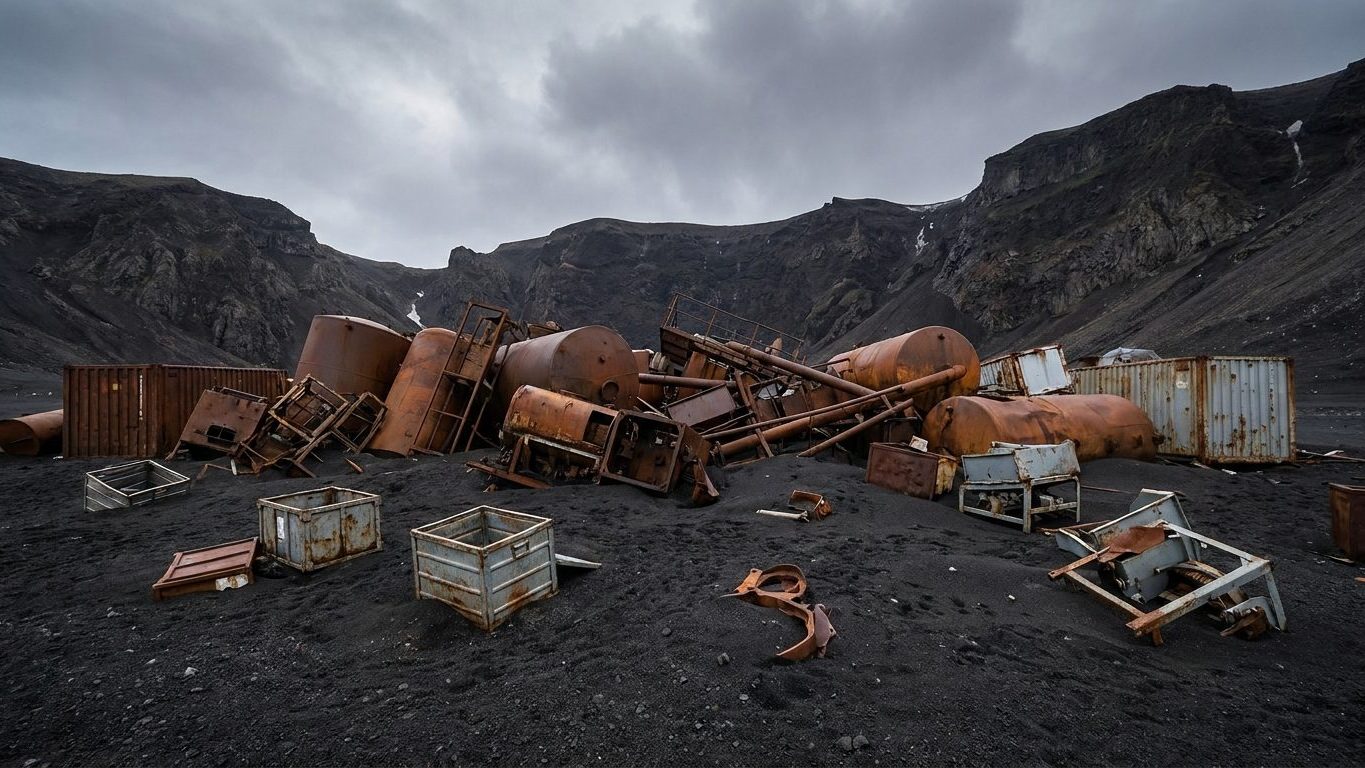
Deep inside the crater of an active Antarctic volcano, the tanks of a whaling station and the continent’s largest cemetery have rusted since 1931. The place is Whalers Bay, on Deception Island in the South Shetland Islands. A crescent-shaped beach of black ash, enclosed by the walls of a still-active caldera, holds the remnants of nineteen years of Norwegian whaling industry.
Nothing has ever been removed.
- Whalers Bay whaling station closed in 1931 after the profitability of whale-oil trade collapsed
- The site houses thirty-five graves, formerly the largest cemetery on the Antarctic continent
- Listed as a historic site, the place has been kept intact for ninety-five years without restoration or demolition
A factory built at the bottom of a volcano
In 1911, the Norwegian company Aktieselskabet Hektor obtained a license from the Falkland Islands Dependencies government to establish a land-based station on the island. In 1912, it erected a plant on roughly 500 acres of volcanic scree, designed to extract whale oil more efficiently from the carcasses brought in by ships. The company eventually employed around 150 people, responsible for butchering and boiling the carcasses harvested by the factory ships anchored in the bay. In the best seasons, as many as thirteen whalers could operate at once from this natural anchorage, sheltered from storms by the very ring of the volcano.
The venture came to an abrupt halt in April 1931. Advances in on-board processing aboard factory ships, combined with a collapse in the price of whale oil, made the onshore facilities unprofitable, and Hektor closed its doors for good.
Neither ice nor war emptied the station: it was the market that collapsed.
The Cemetery That Eruptions Tried to Swallow
Behind the remnants of the factory lies Whalers Bay Cemetery. It counted thirty-five graves, plus a memorial dedicated to ten men lost at sea, of whom only one body could be recovered. It was, before the eruptions, the largest cemetery on the Antarctic continent, according to a note published by Polar Record from Cambridge University Press.
Deception Island is not a static landscape. It forms the caldera of an active volcano, which severely damaged the scientific installations on site in 1967 and again in 1969.
Two eruptions, in four years, were enough to alter the face of the beach. A mudflow ripped through the Biscoe House, used by the British research base housed in the former station buildings, and tore away its central façade. The nearby airplane hangar, however, remained standing. To this day, the heat from the subsurface volcano warms certain areas of the island, and steam escapes from pockets in the black sand of the bay.
The cemetery, for its part, would have been partly buried.
A site that cannot be looted nor cleaned
The whole site has been designated Historic Site and Monument No. 71, following a joint proposal by Chile and Norway to the Antarctic Treaty Consultative Meeting. This status encompasses not only the traces of pre-1912 Chilean whaling but also the Hektor station and the British Base B buildings, established during the austral summer of 1943-44 as part of Operation Tabarin, within a section of the abandoned whaling station itself.
Protection works both ways. Whalers Bay is a registered historic site where entering the old buildings is prohibited and dangerous.
The governments agreed to leave the ruins as they are—without restoration or demolition—so that they stand as testimony to the whaling era and the volcanic power of the place. The result: the tanks have rusted for ninety-five years without a single touch of human hands. More than 15,000 visitors disembark here each year on a beach where industrial history meets seals and Papuan penguins. The austral-season rotations resume in the coming weeks, bringing the first ships back toward Neptune’s Bellows, the narrow passage that grants access to the caldera.
In 2002, a wooden cross found at the neighboring Argentine station was identified as that of the Norwegian whaler Peder Knapstad; it was reinforced and replanted at Whalers Bay, the only grave in the cemetery with a readable name among the thirty-five unknowns.
Sources : ats.aq | deceptionisland.aq
