
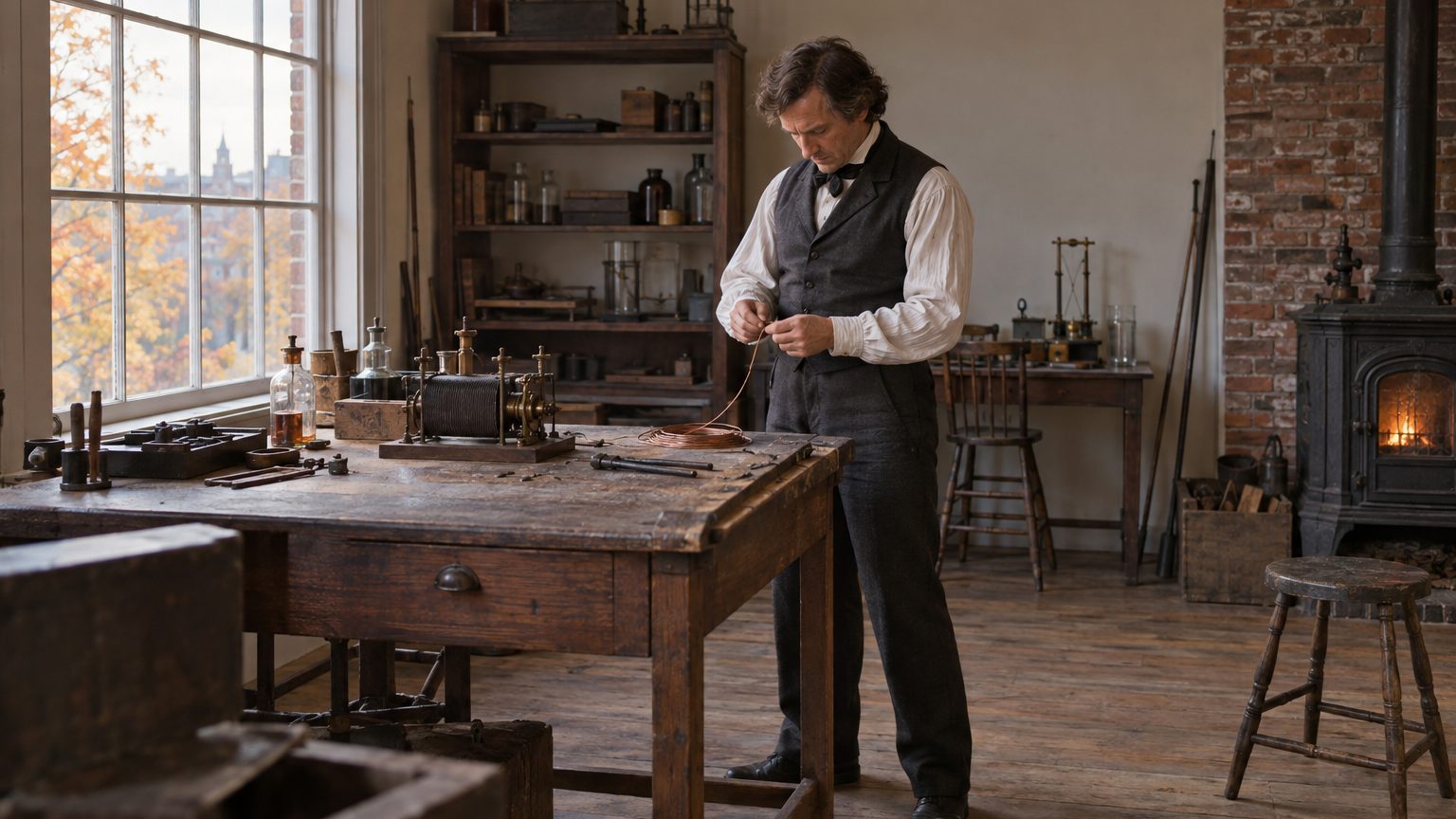
In 1849, Walter Hunt, a mechanic based in New York, twisted a piece of metal wire to settle a debt of 15 dollars. He literally sold off a device that we still use today: the safety pin. The American patent US 6,281 lies at the heart of the story, and it was issued on April 10, 1849. It describes a single wire shaped into a spring on one end and a clasp on the other.
- Walter Hunt filed the patent for the safety pin on April 10, 1849.
- He sold his rights to settle a debt of 15 dollars.
- The sale price is said to have been 400 dollars, according to a widely circulated account not confirmed by the Hall of Fame.
One Wire, Two Ideas
Hunt’s design hinges on two ideas. According to the National Inventors Hall of Fame, a clasp covers the point to keep it from opening, while a circular loop at the bend acts as a spring. Various accounts describe a brass wire of about eight inches, just over 20 centimeters, though those details vary by source. The patent title, however, is known: it is a refinement in the manufacture of “dress-pins,” clothing pins.
A point, a spring, a clasp—everything in a single wire.
Before him, a straight pin held fabrics in place but also snagged carpets, garments, and fingers. Hunt solved the problem without adding anything to the wire—simply by bending it differently. The result: a protected tip that can be pulled from fabric and replaced without losing it.
15 dollars of debt, a patent sold
According to the Hall of Fame, the idea struck Hunt while he was twisting an ordinary piece of wire and thinking about a $15 debt. He then sold the rights to his patent and paid off his debt, with money to spare.
As for the price, the circulating figure is $400, paid to W. R. Grace according to the commonly cited account that Wikipedia repeats. Some biographies give the same amount and company, but the Hall of Fame entry does not mention it: better read as conditional. If that figure is correct, the $15 debt would represent 3.75% of the total, about $1 for every $27. Hunt would thus have walked away with $385.
Hunt did not reap a large share of the wealth his invention created.
A prolific inventor, a hurried seller
Born in 1796 in Martinsburg, in Lewis County (New York), the eldest of 13 siblings, Hunt was no weekend amateur. Holding a masonry diploma, he worked as a farmer in Lowville, where he designed more efficient machines for local mills, before filing his first patent in 1826.
Once in New York, he obtained patents for a rope-making machine, a fountain pen, and a repeating rifle. According to Wikipedia, about two dozen of his inventions remain in use today in forms very close to the originals he patented.
In 1833, he invented the first functional sewing machine. The public received it well, but Hunt never secured a patent and declined to take the financial risk of mass-producing it. Sixteen years later, with the safety pin, he did the opposite: he patented first, then sold. Wikipedia notes that he ceded most of his rights at low prices, with no future royalties.
According to some biographies, Elias Howe may have patented a closely related sewing machine design and become a millionaire after a lawsuit with Isaac Singer. Hunt, by contrast, died in 1859, according to these accounts, having extracted little from his transfers.
What the safety pin tells today
The pin is everywhere: in a sewing drawer, a first-aid kit, the bottom of a bag. It is used to re-hem a deflated edge, to fasten a race bib, or to repair a garment whose button has fallen off. The Hall of Fame notes that the improved design by Hunt is still in use. The institution inducted the inventor into its pantheon in 2006, recalling that he designed the pin almost as we know it today. Few objects from 1849 can claim as much.
Every transfer agreement boils down to one line: a lump sum or royalties. Hunt chose the lump sum, and others have earned millions with his pin. A lump sum pays once; a royalty pays on every unit sold. For today’s inventor, the question before signing is simple: how much will each unit sold bring in?
One caveat: the $400 figure belongs to the common narrative, not to the Hall of Fame entry, which only mentions a debt repaid with money that was more than needed. The patent itself, however, is accessible: US 6,281, April 10, 1849.
Sources: invent.org | threads.com
