
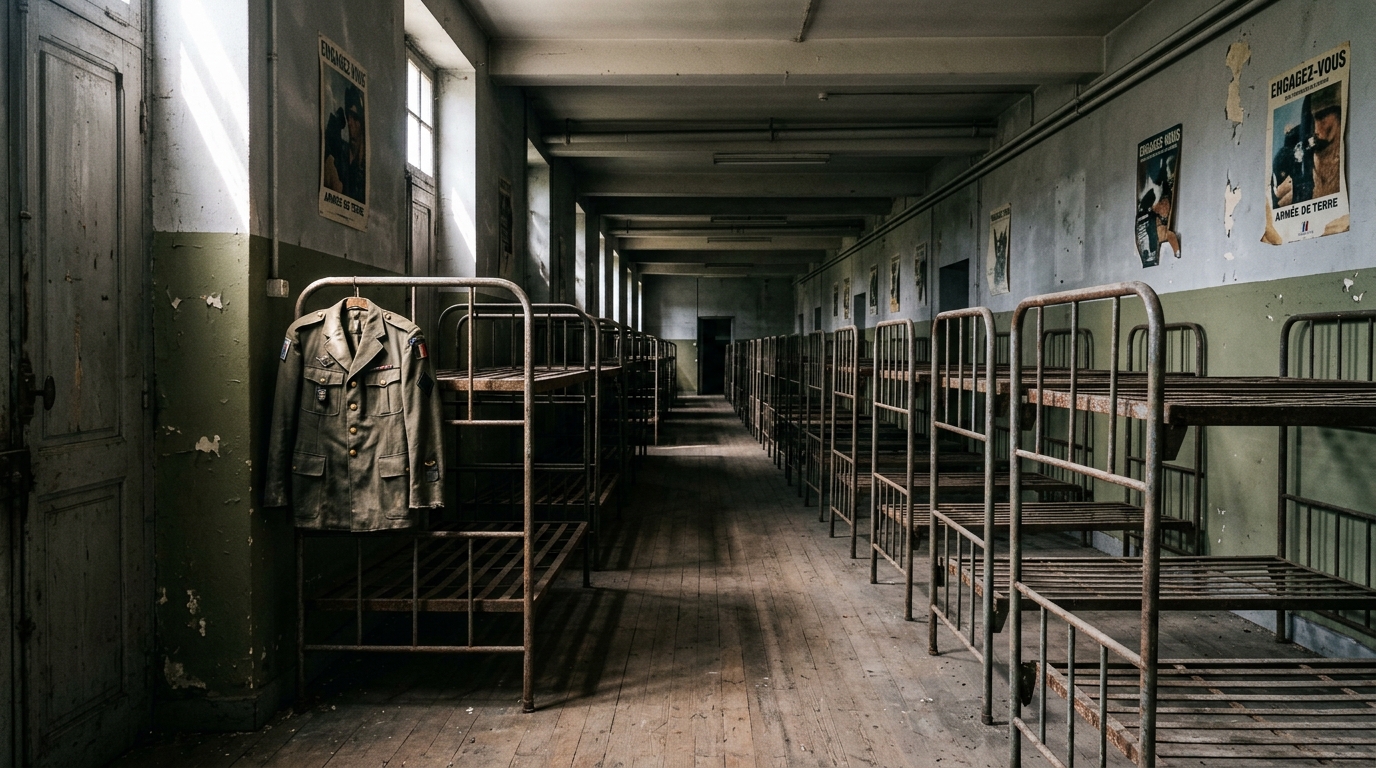
Imagine for a moment a barracks crowded to capacity one day, then nearly empty four years later. This is essentially what happened in France at the very end of the twentieth century, when more than 201,000 conscripts simply vanished from the military landscape. No war, no catastrophe, just a political decision that profoundly changed the face of the French armed forces. This story, still little known by many, deserves a closer look, especially now that a new voluntary military service is poised to come into being.
- The Law No. 97-1019 of October 28, 1997 organized the gradual suspension of conscription, accelerated in 2001 with the release of the last conscripts on November 30, 2001
- The 201,498 conscripts represented about 40% of the 499,334 military personnel, partly replaced by 57,000 enlisted posts and 20,000 volunteers
- Conscription is only suspended and not abolished, while a new voluntary military service is to be launched by the summer of 2026 with a target of 50,000 volunteers per year by 2035
- The day France turned its back on its mass army
- Why Jacques Chirac sacrificed 201,000 conscripts in four years
- Express professionalization: how the army survived the demographic shock
- From the mandatory barracks to the chosen profession: what France really gained
The day France turned its back on its mass army
It all begins with a televised address, the kind of moment one remembers because it upends a habit that had lasted for generations. On that day, Jacques Chirac announces what few had imagined possible: the end of compulsory military service, that rite of passage which sent tens of thousands of young men into the ranks each year. The announcement precedes the law’s formal enactment, but it already marks a major psychological turning point for the whole country.
The Law No. 97-1019 of October 28, 1997 would then seal this choice in legal stone. It sets up a gradual suspension rather than a abrupt rupture, with the obligation maintained until December 31, 2002 for youths born before January 1, 1979. A shrewd compromise, which allows the military institution to absorb the shock without collapsing overnight.
Why Jacques Chirac sacrificed 201,000 conscripts in four years
The numbers are dizzying when set side by side. At the moment of suspension, the 201,498 conscripts accounted for around 40% of the total military personnel, then estimated at nearly 499,334 people. In other words, four soldiers out of ten wore the uniform not out of vocation but by legal obligation. A model that seemed outdated in light of the new strategic challenges of the century’s end.
The reform translated into the elimination of 201,500 contingent posts, partially offset by the creation of 57,000 enlisted positions and 20,000 volunteer posts. A rebalancing aimed at professionalizing the army rather than hollowing it out. Yet the trajectory was clear: the military programming law for 1997-2002 anticipated an active force of conscripts below 30,000 as of 2001, and in 2000, only 27,171 young Frenchmen were inducted, whether conscripts or volunteers. The drop was vertiginous, almost brutal for those who still lived conscription on a daily basis.
Express professionalization: how the army survived the demographic shock
The initial timetable planned a gradual transition until 2002, but the Council of Ministers decided, in June 2001, to accelerate the move. Result: the last conscripts of the contingent were released on November 30, 2001, more than a year ahead of the official deadline. This rush was not without upheaval. The final cohorts voiced palpable discontent, with a noticeable rise in insubordination and petitions gathering tens of thousands of signatures. Indeed, it was hard to accept being among the last to wear a uniform already recognized as belonging to a past era.
Despite this acceleration, total military numbers stabilized by December 31, 2002 at around a base of about 350,000 active-duty personnel. The French army thus weathered this demographic shock by betting entirely on voluntarism and professionalization rather than compulsion. A gamble that paid off in the long run, even if it required a complete rethink of recruitment and training methods.
From the mandatory barracks to the chosen profession: what France really gained
It should be recalled: conscription was never abolished, only suspended. This legal nuance is not trivial, because it means the system could theoretically be reactivated by the same legislative procedure if circumstances ever demanded it again. A kind of administrative Damocles sword, tucked away in a drawer but never truly discarded.
This history resonates even more now, since a new voluntary military service, clearly distinct from the old conscription, is to be launched by the summer of 2026 for 18- to 25-year-olds. The stated goal is ambitious: ramp up to 50,000 volunteers per year by 2035. A partial return to the idea of civic engagement, but this time chosen and not endured, far from the coercive logic that prevailed before 1997.
What stands out, in hindsight, is the speed of this historical shift. In just four years, France moved from a mass army sustained by conscription to a professional army that is tighter, yet more specialized. A paradigm shift that redefined the French relationship to national defense, and which continues today to fuel debates about youth engagement.
One question still buzzing in people’s minds, almost thirty years after this turning point: is compulsory military service definitively a thing of the past, or could it reemerge someday in a new form, adapted to the challenges of our era?
