
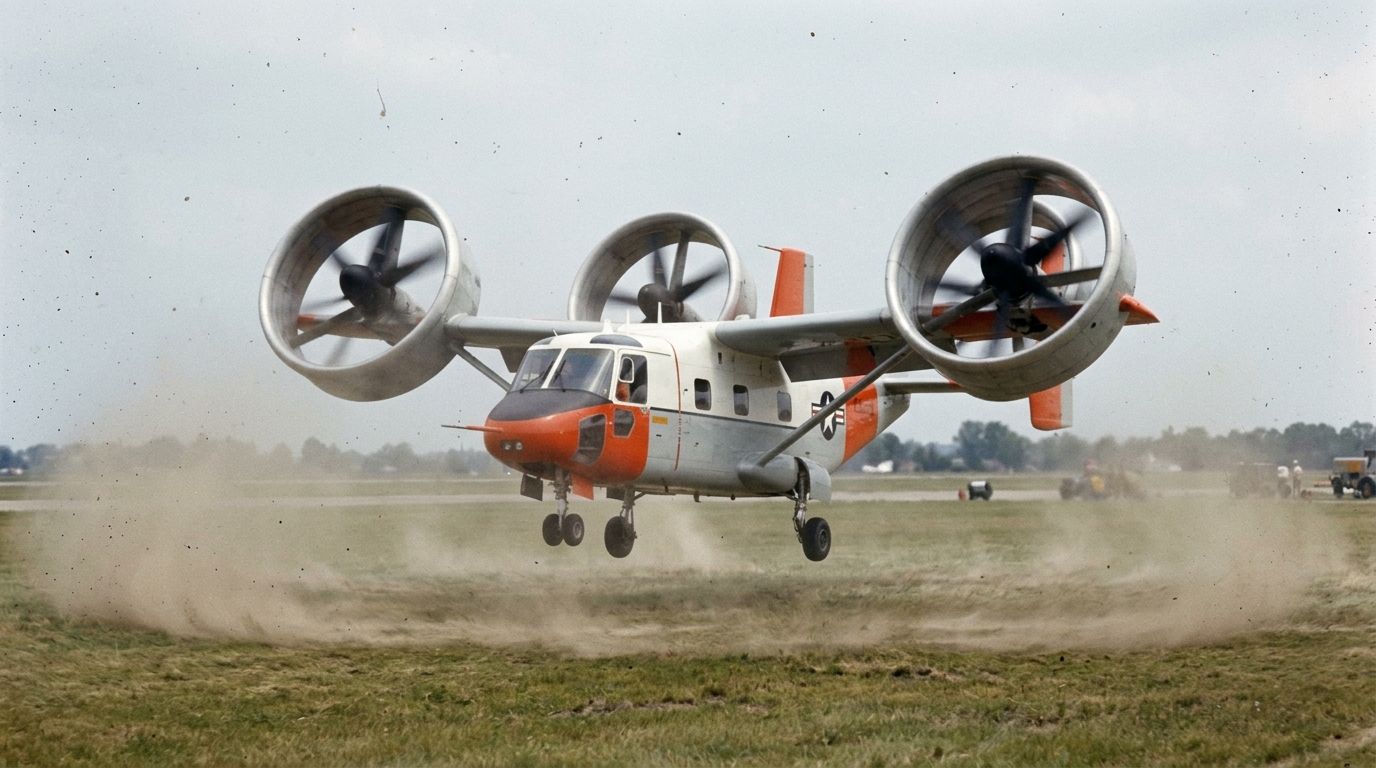
Imagine a plane that can lift off the ground like a helicopter, then surge horizontally like a fighter, before landing again without a single meter of runway. This isn’t a futuristic concept fresh from a modern airshow: it is a reality that took flight several decades ago, at a moment when the Cold War pushed American engineers to rethink the rules of military flight. The Bell X-22A could have become one of the keystones of aviation of tomorrow. It never did, and the reason for its failure had nothing to do with technical shortfalls.
- The Bell X-22A logged 228 flights and more than 400 vertical takeoffs/landings without any major accident on its second prototype.
- The program was abandoned because the aircraft only reached 507 km/h in cruise flight, versus the 525 km/h required by the military specification.
- The data gathered contributed to the development of the V-22 Osprey, and the second prototype has been on display at the Buffalo Innovation Center since 1998.
- Four shrouded, three-bladed propellers, an idea ahead of its time
- Two prototypes, hundreds of flights, zero major accidents
- The invisible adversary that doomed the program
- From toolbox to museum: what the X-22A left to modern aviation
Four shrouded, three-bladed propellers, an idea ahead of its time
Hard to confuse the Bell X-22A with any other aircraft. Its silhouette rested on four shrouded three-bladed propellers, mounted at the tips of its wings, capable of rotating to switch from a vertical to a horizontal orientation. This architecture allowed the plane to take off like a helicopter, tilt gradually into cruise flight, then return to a vertical stance for landing without needing an open runway. A tremendously ingenious concept for its era, designed to grant the U.S. Army unprecedented operational flexibility.
Under the hood, four General Electric YT58-GE-8D turboprops each produced 945 kilowatts, about 1,250 horsepower, driving the shrouded propellers with enough power to lift the aircraft into the air without a taxiing phase. The very first flight occurred in March 1966, and from that inaugural day the aircraft completed four vertical takeoffs followed by smooth landings. On the fourth test, it climbed to 7.60 meters in height, a feat that confirmed the concept’s viability from the outset.
Two prototypes, hundreds of flights, zero major accidents
Yet the program was far from a smooth ride. A few months after this successful first flight, in August 1966, the first prototype crashed due to the rupture of a blade pitch control mechanism. According to one of the program’s test pilots, this component was the only link in the entire control chain lacking redundancy, a rare weakness on a machine this sophisticated. The incident could have sounded the death knell for the project, but the engineers demonstrated military ingenuity: the wreckage was cannibalized to assemble a second unit, which flew for the first time in January 1967.
That second aircraft would become the real hero of the story. Until the end of testing conducted jointly by the U.S. Army, Navy, and Air Force in 1971, it accumulated 228 flights in 125 hours, with more than 400 vertical takeoffs and landings, more than 200 short takeoffs and landings, and over 250 transitions between flight modes. An impressive record, with no major accidents reported during that period. The X-22A had proven, flight after flight, that the tilting, shrouded-propeller configuration worked.
The invisible adversary that doomed the program
Here lies the heart of the puzzle. The Bell X-22A was regarded at the time as the best V/STOL aircraft ever designed, a category encompassing planes capable of vertical or very short takeoffs and landings. Neither a crash nor chronic engine failures terminated the venture. What grounded the machine was a number: 507 km/h, the cruising speed reached in flight, versus the 525 km/h demanded by the military specification. A gap of barely 18 km/h was enough to tilt the fate of a program that was technically complete.
This detail perfectly illustrates the administrative and budgetary logic that governs major military programs. An aircraft can fly hundreds of times without a single incident, demonstrate remarkable operational qualities, and yet be abandoned because it fails to tick every box on a rigid specification. The program officially ended in 1988 for lack of funding, after only two airframes had been built. No production orders ever followed these seemingly conclusive tests.
From toolbox to museum: what the X-22A left to modern aviation
The story of the X-22A does not stop with the cancellation of its military program. On the contrary, the aircraft continued to serve as a flying testbed for many years, notably being transferred to the Cornell Aeronautical Laboratory to pursue research on variable-stability systems and to contribute to the development of a heads-up display, or HUD, intended to equip the AV-8 Harrier II. Its final flight, out of roughly 500 sorties over its career, occurred in October 1984, eighteen years after its first flight.
The data collected during all those testing years did not go to waste with the ultimate end of the program. They fed further research on tiltrotor technologies and fly-by-wire flight controls, efforts that benefited programs far better known to the public, such as the V-22 Osprey, the helicopter-airplane hybrid now used by the U.S. military. The second X-22A, the only survivor of this saga, is today housed at the Buffalo Innovation Center in New York State, formerly known as the Niagara Aerospace Museum, where it has welcomed visitors since 1998.
The Bell X-22A story encapsulates a paradox that runs through the whole history of experimental aviation: technical success does not guarantee the survival of a program. A machine can be visionary and reliable, yet vanish from sight simply because it did not meet a figure set on a decades-old administrative document. As vertical-takeoff aircraft reemerge on the scene, particularly in urban mobility, it’s hard not to reflect on this forgotten pioneer, who understood it all long before everyone else.
