
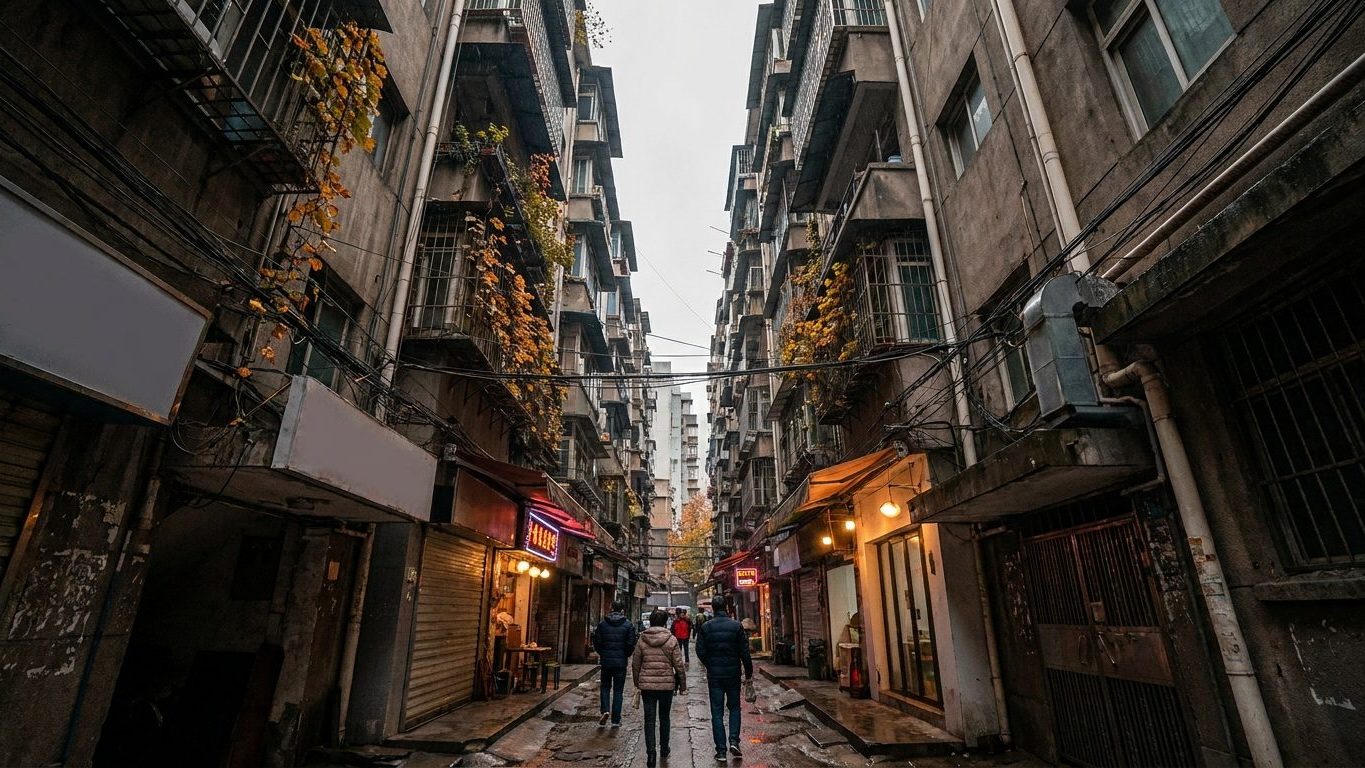
Here, the sun never touches the ground. Between facades pressed against one another, pale from humidity and bristling with improvised pipes, cables, and satellite dishes, daylight ends several floors up. In the depths of the alleys, people move by flashlight, even at noon.
This block has never had an owner, nor a plan.
Seen from above, the whole complex looks like a single tentacled building, a gray block pierced by recesses and tiny courtyards that leave no air or light through. Under the ground and along the walls run miles of hand-laid piping, joined floor by floor as needs arise, with no master diagram. One can imagine, looking up into these closed-sky corridors, generations of bricolage layered on top of one another.
- The enclave developed in a legal vacuum between Chinese sovereignty and British control, with no urban planning rules or official cadastre
- Residents stacked floor upon floor without a plan, creating alleys so narrow that daylight never touched the ground
- A density of 33,000 people per hectare yielded informal mutual-aid networks and neighborly solidarity born of circumstance
- Demolition began in 1993 to make way for a public park whose paths still trace the routes of the old venelles
A legal vacuum inherited from old treaties
The story of this enclave begins with a territorial agreement that was poorly closed. When the United Kingdom took control of Hong Kong and its surroundings, a small perimeter remained under Chinese sovereignty by the force of old treaties—some administrative residue at the heart of the British territory. Beijing claimed the zone on paper, but did not maintain any daily presence there. London, for its part, considered the area as belonging to another authority and refrained from applying its own urban rules.
The result is neither conquest nor voluntary abandonment, but a half-measure that no one truly wanted to shoulder. For decades, no urban planning service, no municipal police, no cadastre set limits on what could be built or how it could be built. This void did not arise from a project: it simply settled in, year after year, through the weariness of two administrations that kept passing the buck.
In the absence of rules, the inhabitants invented their own.
A city within the city, organized in its own way
Each family adds a floor on top of the neighbor’s, supported by the adjacent structure, until the whole thing stands as a stack of concrete shacks. The streets, originally simple passages between low houses, end up compressed between walls of several stories, so tight that an adult can sometimes touch the two façades with outstretched arms. Daylight no longer reaches the ground: life unfolds under artificial light, among shop neon signs and bare bulbs hanging from makeshift electrical wires.
Doctors and dentists without credentials recognized by the authorities run practices there, often trained on the job or arriving with know-how learned elsewhere, lacking access to the standard qualification circuits. Textile workshops, artisanal food productions, and small stalls coexist with improvised schools, funded and run by the residents themselves when no institution takes charge.
Everything here operates according to its own rules.
It isn’t the chaos that outsiders sometimes imagine. Mutual-aid networks form among neighbors, informal arrangements manage water supply, electricity drawn by any means, and the upkeep of common areas that no official will ever inspect. The population density here surpasses anything seen elsewhere on the planet: just over one hectare houses up to 33,000 people, stacked up against the levels they occupy. This forced closeness shapes a makeshift solidarity, made of daily compromises more than written rules, where everyone learns to live with the neighbor’s space.
Demolition, relocation and the park renaissance
At the turn of the 1990s, local authorities and the Chinese government eventually agree on the enclave’s fate: it must disappear. The residents are gradually relocated to complexes built for the occasion, with compensation and allocations of social housing negotiated case by case, as each person’s administrative situation differs after decades without an official registry.
The demolition begins in 1993, a colossal project intended to dismantle a block never imagined to be taken apart. Cranes tear down floor after floor what generations had piled by hand, without a plan or permit. In a matter of months, the single building that seemed indestructible nearly disappears from the urban landscape, leaving bare a ground that no one had seen in a long time.
The land remains vacant, between the surrounding towers.
A park is laid out on the exact footprint of the former enclave, roughly respecting its original tracings. Ponds, pavilions, and gardens replace the dark alleyways; today one walks there in the open air, under a sky that the former inhabitants would not have recognized in the same place. A few vestiges, stones and original elements, have been preserved and integrated into the decor as discreet markers of a site that vanished.
The contrast is total: where air and light were lacking on every floor, there now stretch open lawns and shaded walkways, frequented by families from the neighboring district. The layout of the paths still follows, in places, the routes of the old venelles, the last visible echo of a place where more than 33,000 people had learned to live without daylight, on barely one hectare of ground.
Sources: lalibre.be | review.gale.com
