
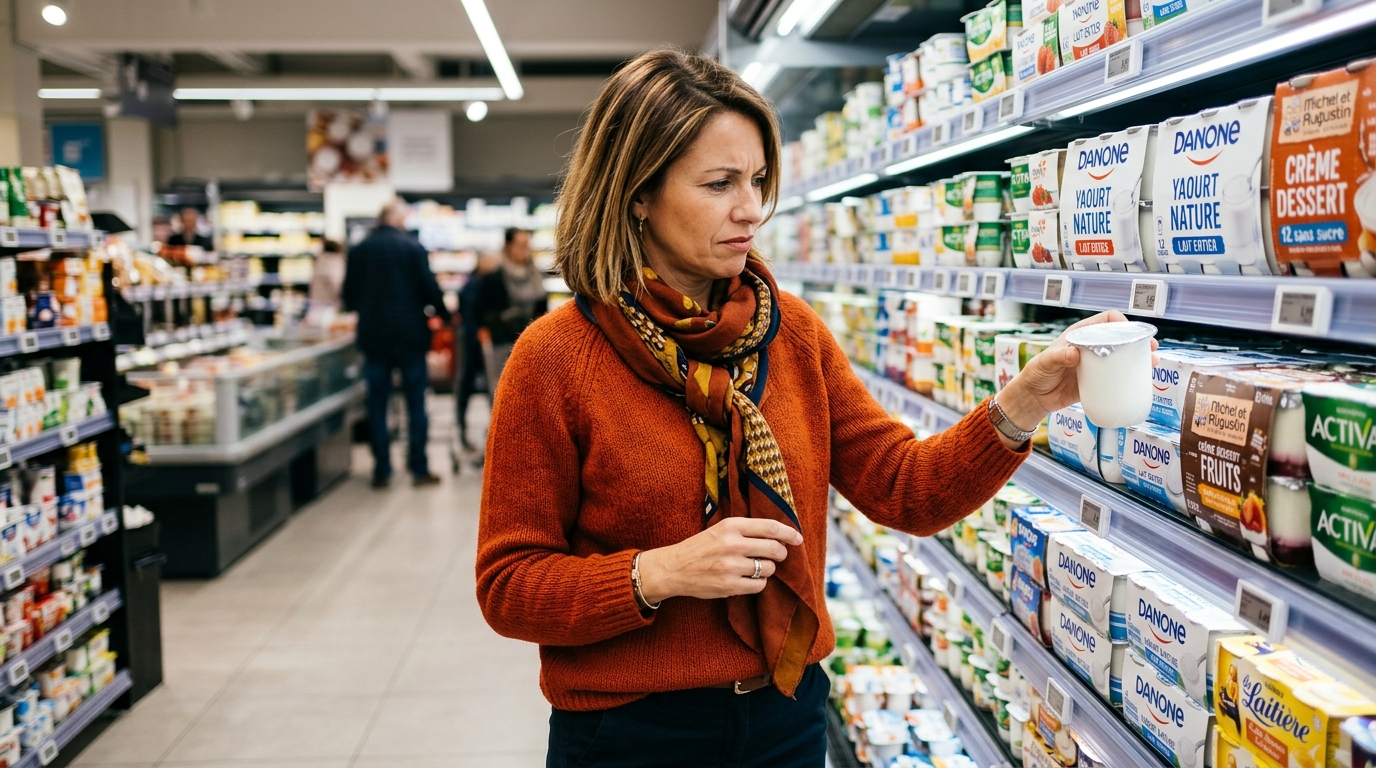
A strawberry yogurt pot, light, fat-free, almost too good to be true. That is precisely what catches the eye of 60 Million Consumers in its September 2026 investigation: this everyday product, almost a morning ritual for millions of French people, would hide a composition far less glossy than its label suggests. Between marketing promises and the reality of the ingredients, the gap could surprise many a hurried shopper at the moment of shopping.
- The Danone Light & Free strawberry yogurt contains only 7.5% fruit, the rest being made up of an unspecified aroma and black carrot concentrate to intensify the color.
- It contains two synthetic sweeteners, acesulfame-K and sucralose, likely to disrupt the intestinal microbiota.
- An Inserm, INRAE, Sorbonne Paris North University and CNAM study links high consumption of sweeteners such as aspartame and acesulfame-K to an increased cancer risk.
- This “healthy” yogurt invading our fridges hides a deceptive composition
- Sucralose and acesulfame-K: these sweeteners that worry
- Cancer and metabolic disorders: what the investigation really reveals
- Lightened yogurts, hidden flavors: how to take back control of your plate
This ‘healthy’ yogurt that fills our fridges hides a deceptive composition
The product under scrutiny is none other than the 0% fat Light & Free strawberry yogurt from Danone, a staple in many French refrigerators for years. On paper, the promise is appealing: lightness, fruity indulgence, zero fat. Yet, a closer look reveals that the actual strawberry content does not exceed 7.5 %. The rest? An unspecified aroma on the packaging, thus very likely artificial, along with a black carrot concentrate, used not for nutritional value but to strengthen and even out the pink color that evokes the fruit. A visual sleight of hand that creates the illusion of a fruitier product than it truly is.
Sucralose and acesulfame-K: these sweeteners that worry
Behind the creamy texture and the sugary taste of this yogurt hide two calorie-free synthetic sweeteners: acesulfame-K, about 200 times sweeter than ordinary sugar, and sucralose, capable of reaching up to 600 times the sweetness. These substances, designed to replace sugar without adding calories, would not be without consequences for the body. The investigation shows that these additives could disrupt the balance of the gut microbiota, this bacterial ecosystem essential for digestion and immunity. A disruption that, in the long run, could promote certain metabolic disorders, far from the “risk-free” image these lightened products typically convey.
Cancer and metabolic disorders: what the investigation really reveals
The most troubling aspect of this inquiry concerns the link between synthetic sweeteners and cancer risk. A large-scale prospective study conducted by researchers at Inserm, INRAE, Sorbonne Paris North University and CNAM shows that the heaviest consumers of sweeteners, notably aspartame and acesulfame-K, would have a higher risk of developing cancer of any kind compared to those who do not consume them at all. This should cast serious doubt on these “0%” products long promoted as weight-loss allies without a price. In trying to dodge sugar calories, one may be swapping one problem for another, with consequences that affect both the balance of the microbiota and long-term metabolic health. In light of this finding, the magazine straightforwardly recommends avoiding this specific yogurt.
Lightened yogurts, hidden flavors: how to take back control of your plate
Good news: it is entirely possible to take back command of what you put in your bowl in the morning. The simplest reflex remains to flip the pot and carefully read the ingredient list, especially for fruit-flavored yogurts. A few points of vigilance help to see more clearly:
- Verify the actual percentage of fruit stated
- Spot the mention “aroma” without specifics, often a synonym for artificial flavoring
- Be wary of natural colorants used to intensify a hue
- Avoid synthetic sweeteners such as sucralose or acesulfame-K
Other fruit-flavored yogurts on the market would also contain problematic preservatives and synthetic flavors, though the investigation does not specify exactly which ones. This urges a general caution beyond the single product highlighted.
A simple yogurt pot can thus reveal a lot about the discreet trade-offs between marketing and actual composition. Next time a chilled dairy aisle tries to seduce with a “0%” promise, a quick glance at the label might not be a bad idea.
