
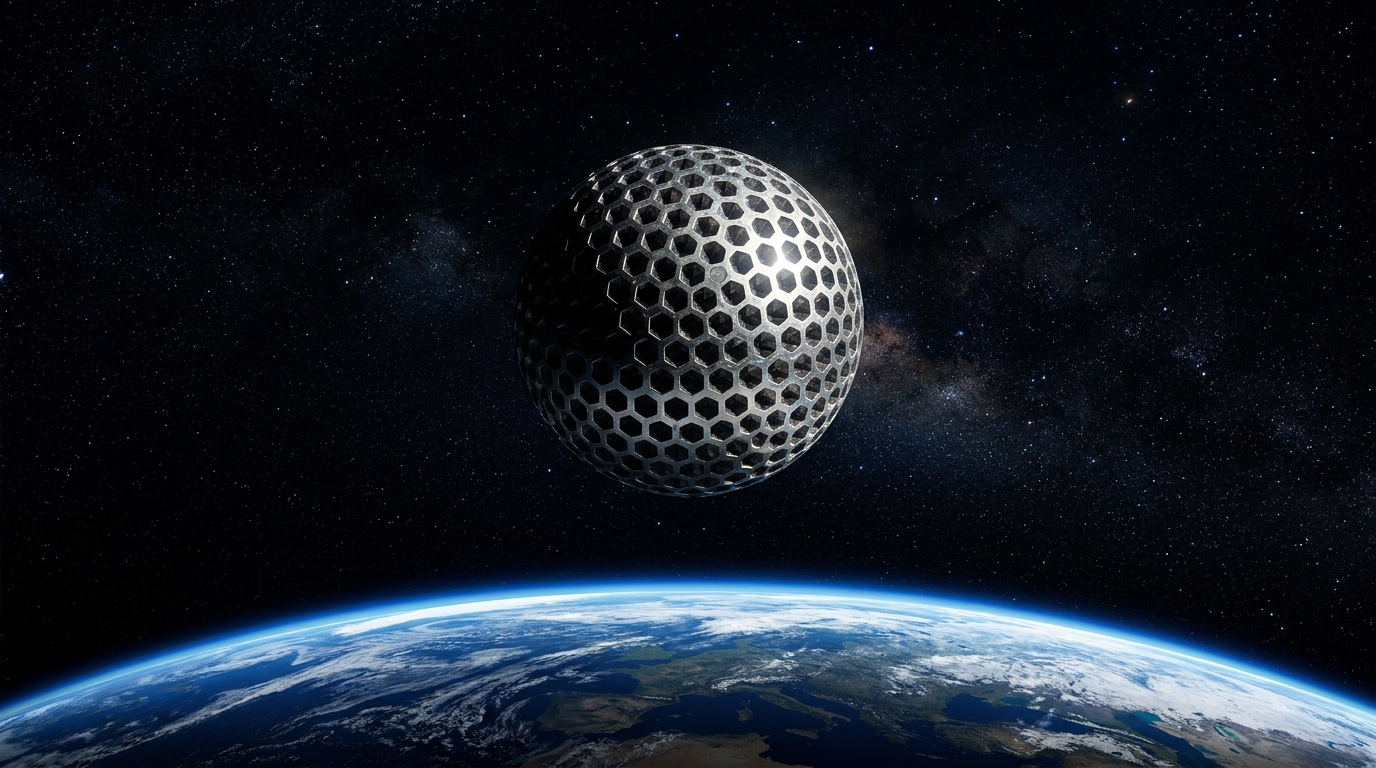
Imagine an object capable of traversing millions of years without ever breaking down, without ever receiving a single update, without ever crossing the hand of a technician. This isn’t science fiction: this object exists, it circles above our heads right now, and it will keep doing so long after our civilization has vanished. Its name may not mean much to most of us, yet LAGEOS 1 is probably one of the most astonishing artifacts humanity has ever launched into space. Not a spy satellite, not a cutting-edge scientific probe, not a crewed station, it is a simple metal sphere, almost rudimentary in its design, but endowed with a longevity that defies comprehension.
- Launched in 1976, LAGEOS 1 is a brass-aluminum sphere with no electronics or propulsion, equipped with 426 cube-corner retroreflectors for satellite laser ranging.
- Its orbit at about 5,900 kilometers altitude, with virtually no atmospheric drag, could allow it to remain in place for roughly 8.4 million years.
- The satellite contains two plates designed with Carl Sagan representing the positions of the continents in the past, the present, and a distant future.
- A nearly indestructible sphere built to defy time
- Why NASA aimed so far into the future
- A message for humanity of tomorrow, literally engraved inside
- What LAGEOS 1 reveals about our place in cosmic time
An Almost Indestructible Sphere Built to Defy Time
Launched on May 4, 1976 from Vandenberg Air Force Base in California aboard a Delta rocket, LAGEOS 1 is not a showcase of technological splendour. Its design skirts radical simplicity: no sensors, no electronics, no moving parts, and not a single propulsion system to adjust its trajectory. The object is essentially a dense brass core enveloped by an aluminum shell, measuring a mere 60 centimeters in diameter and weighing 406.965 kilograms at launch.
What makes this sphere so remarkable are the 426 cube‑corner retroreflectors spread across its surface. These tiny optical mirrors bounce laser beams sent from Earth back with extraordinary precision—a technique known as satellite laser ranging. With this method, scientists can measure distances to the millimetre, tracking minute movements of our planet: continental drift, deformation from earthquakes, or variations in Earth’s rotation. LAGEOS 1 was indeed the first spacecraft ever dedicated entirely to this technology, delivering data of unparalleled purity for its time.
Why NASA Aimed So Far into the Future
Positioned in a relatively stable medium Earth orbit at approximately 5,900 kilometers altitude, LAGEOS 1 moves through a region where atmospheric drag is almost nonexistent. It is precisely this absence of resistance that accounts for its extraordinary longevity. With no electronics to age, no fuel to expend, and no atmosphere to slow it down, the satellite simply keeps spinning, again and again, with little to perturb its trajectory in a meaningful way.
According to NASA’s initial estimates, this orbit could keep LAGEOS 1 in place for about 8.4 million years before residual drag finally brings it down. It is a number that can unsettle the imagination when you consider that the scientific mission of the object has already lasted more than 50 years, a record of longevity for a space object still tracked today. It should be noted, however, that this duration remains an approximate estimate, not a precisely scheduled landing date: NASA itself acknowledges that projecting geological phenomena over millions of years is more a matter of scale than exact calendrical prediction.
A Message for Humanity of Tomorrow, Literally Engraved Inside
This is perhaps the most captivating facet of the story. Realizing that LAGEOS 1 would survive not only its scientific mission but likely humanity itself, NASA decided to tuck a message intended for a distant future inside the craft. To design this plaque, the agency enlisted none other than Carl Sagan, the astrophysicist and popularizer renowned for rendering the universe approachable to the general public.
Two identical copies of this plaque were placed inside the satellite, so access would literally require breaking the sphere. Its content is as staggering as its platform: it depicts the positions of the continents at three distinct moments—the distant past, our present, and a hypothetical future around 8.4 million years from now, a span after which plate tectonics will have dramatically redrawn the world map. A time‑capsule message, designed for civilizations that do not yet exist, or perhaps for potential visitors from elsewhere.
What LAGEOS 1 Reveals About Our Place in Cosmic Time
It is hard not to feel a shiver when contemplating the scale of what this small metallic object represents. We tend to conceive our creations within the bounds of a human lifetime, at most a generation. A bridge endures for a few centuries, a pyramid for thousands of years, but 8.4 million years vastly surpasses our collective capacity for imagination. To give a sense of magnitude, this duration is roughly 1.3 times the span from the emergence of the first hominids to our present era.
Thus LAGEOS 1 becomes, almost by accident, one of the most enduring artefacts humanity has ever forged—more lasting than any terrestrial monument. And while its initial message was scientific and geodetic in nature, it gradually assumed a philosophical dimension: a silent beacon, circling the Earth, a mute witness to everything that will have changed on our planet long after we have vanished.
In an age when we talk a great deal about next‑generation satellites and interconnected constellations, there is something unsettling in recalling that a simple metal ball—born in the heat of the Cold War and free of a single electronic chip—will continue its quiet voyage long after these modern technologies have themselves faded away. LAGEOS 1 reminds us, in its own way, that our presence on this planet is but a fleeting moment in the cosmic timeline, and that sometimes the simplest objects traverse the ages most effectively.
