
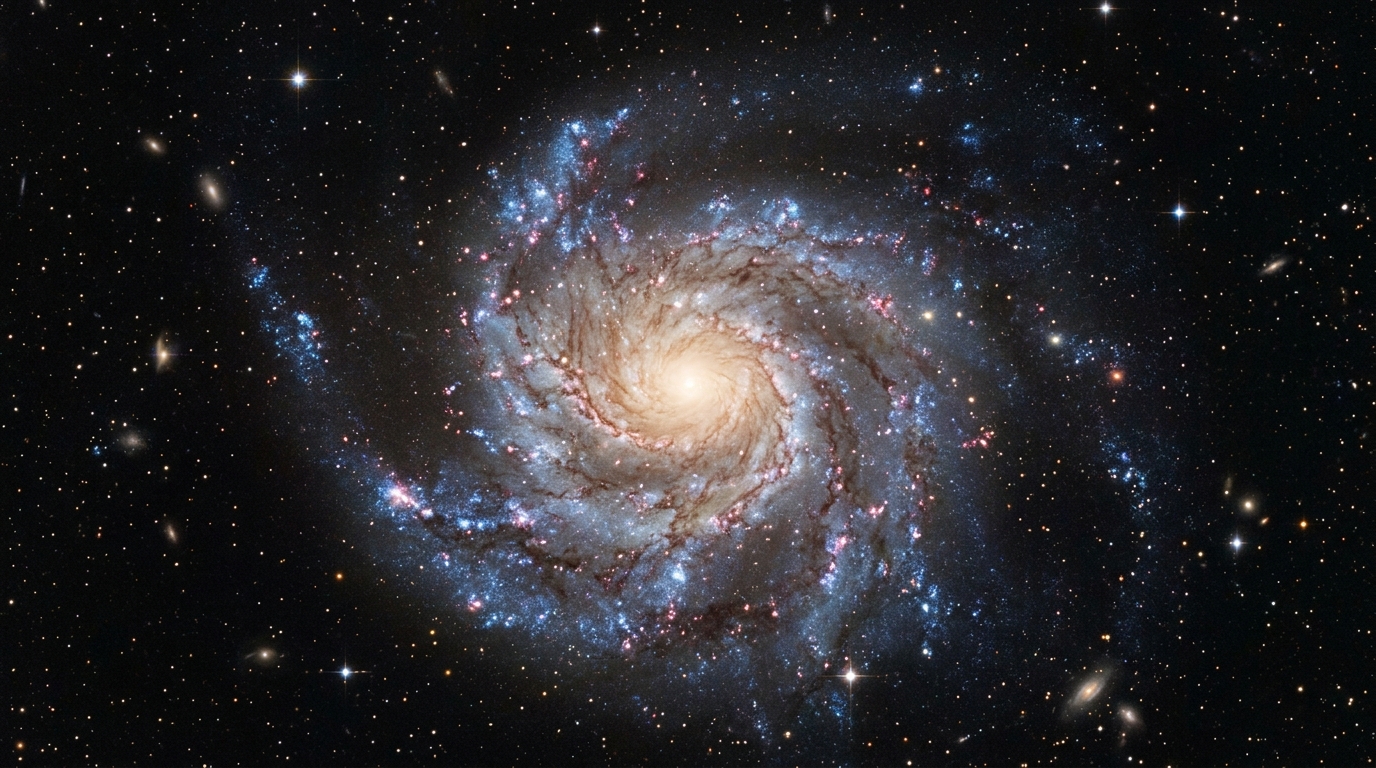
A galaxy spinning at hundreds of kilometers per second should, logically, tear itself apart and fling its stars into the void. Yet it holds together, as if an invisible hand were keeping the whole system in check. This phantom mass, no one has ever seen directly, would account for nearly 27% of the entire Universe.
――――――――――――――――――――
What you will learn:
- Why the rotation speeds of galaxies starkly contradict the matter observed through telescopes
- How the scorching gas in clusters betrays a hidden mass about six times larger than the visible matter
- What this invisible matter would imply for Einstein’s theory of gravity if it were never found
――――――――――――――――――――
These galaxies spinning too fast for their own good
Imagine a carousel whirring at full tilt. The faster it goes, the more the riders on the edge are pressed outward, ready to be thrown off. In a galaxy, the stars take on the role of those riders. And yet, the ones far from the center move at an utterly anomalous pace.
By the laws of gravity, those peripheral stars should slow down as we move away from the galactic core, where matter is most concentrated. Yet that is not what we observe. They orbit nearly as quickly as the stars near the center. With only the visible matter at hand, such a galaxy should literally tear itself apart.
The conclusion is inescapable: something is holding the whole system together. An invisible mass, whose gravity prevents the fast-moving stars from escaping into the void. This missing mass emits no light, cannot be seen by any instrument. We only perceive it through its effects.
The hot gas of clusters reveals a phantom mass
This finding is not a novelty. As far back as the 1930s, a Swiss astronomer noticed an oddity while observing the motion of galaxies within a cluster. To explain those motions, he needed about one hundred times more mass than what he could actually see. He imagined an invisible mass acting through gravity to keep the cluster coherent. His intuition proved correct.
In a cluster of galaxies, the bulk of the visible matter is not stars, but extremely hot gas that emits X-rays. This gas constitutes the dominant form of ordinary matter. Yet even when summing all of this up, the accounting still falls short. Dark matter remains dominant, roughly six times the visible matter.
In other words, the speeds of galaxies and the hot gas in clusters demand a total mass far in excess of what we can observe. The gas, heated to millions of degrees, betrays the presence of a colossal gravitational well. Without a hidden mass to confine it, it would have dispersed long ago.
A matter we measure everywhere but never see
Here lies the paradox. Dark matter would account for 27% of the Universe, yet it remains unseen. The reason is simple: unlike ordinary matter, it does not absorb, reflect, or emit any light. Our telescopes, however powerful, stay blind to it.
So how do we track it? Through a spectacular phenomenon: gravitational lensing. Mass curves space, and hence the path of light that travels through it. By measuring this distortion, researchers infer the total mass of an object. Yet, when we account only for ordinary matter, reproducing the observed distortion becomes impossible. An extra mass is missing.
Three‑dimensional mappings of clusters reveal further surprises. Dark matter is not distributed as a neat ball: it is stretched, elongated like a rugby ball rather than spherical. Recent observations have even identified a galaxy with a luminosity equivalent to only six million suns, one of the richest in dark matter ever identified within a cluster.
What the invisible teaches us about the entire Universe
The search for this phantom matter still raises enigmas. Early this year, researchers highlighted a probable mini-halo, whose central object would concentrate 19% of the total mass, i.e., around 1.8 million solar masses. This object could be a black hole or a very dense cluster of stars. Such a scenario seems highly improbable within the standard models of dark matter.
That is where the subject becomes truly fascinating. Models described as cold or warm dark matter struggle to explain such a structure. There is an alternative possibility: dark matter capable of interacting with itself. In this scenario, the collapse of a core could lead to black hole formation. Nothing is settled yet, but each new observation sharpens the picture.
The stakes go far beyond mere curiosity. If we could never detect this matter directly, we might need to confront the unthinkable: reconsider Einstein’s theory of gravity itself. A cornerstone of modern physics could then tremble.
Galaxies spinning too fast, scorching gas that cannot be confined, light bent by seemingly empty space: all of these clues converge on the same conclusion. A vast portion of the cosmos still eludes us, lurking in the shadows. The vertiginous question remains: what if, in the pursuit of this invisible mass, we discover that our understanding of gravity has been incomplete from the very start?
