
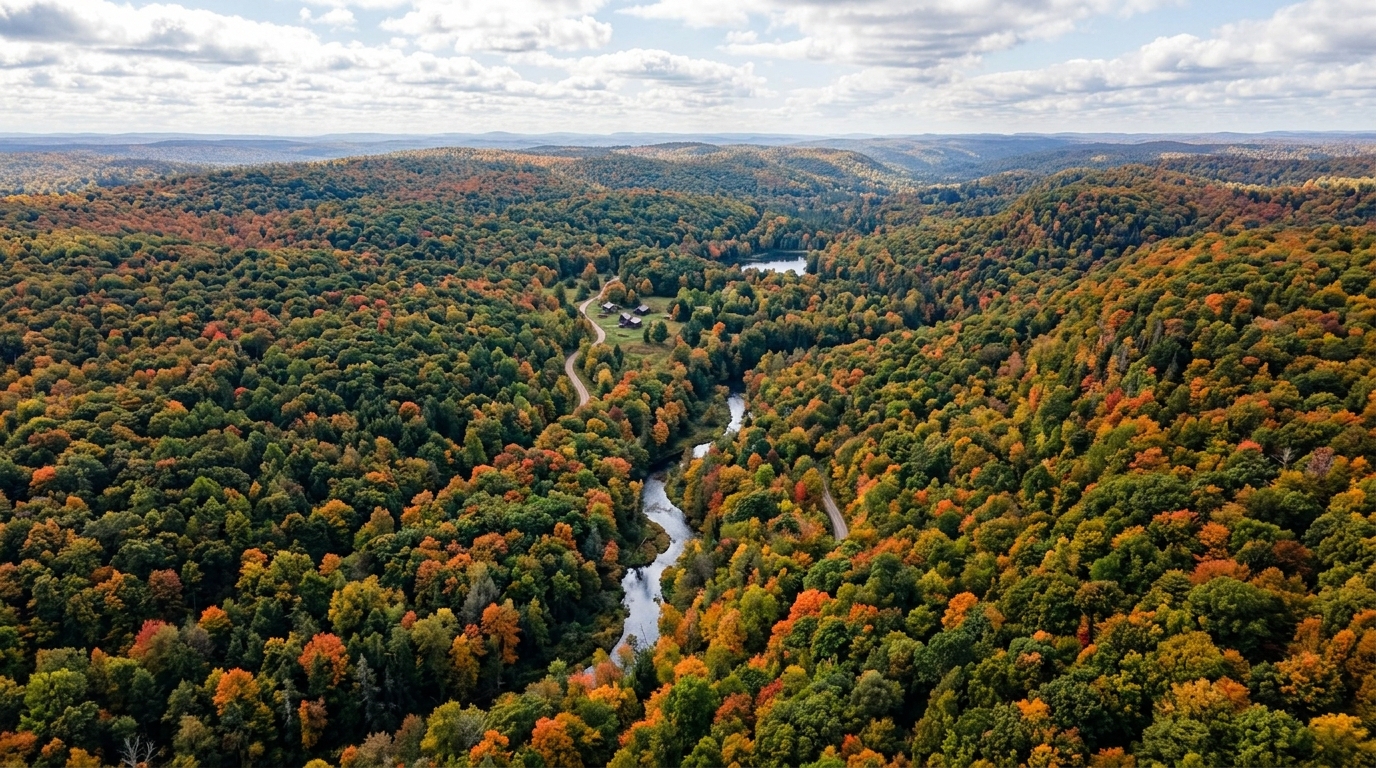
What if nature is playing a trick on us? Since the 1980s, our planet has donned a verdant cloak of unprecedented breadth: the equivalent of two entire continents of extra vegetation. Satellites, those silent sentinels watching the Earth from space, leave no doubt: the globe is greening at a pace never before observed. At first glance, the news is encouraging. One can easily imagine denser forests, lusher meadows, a planet coming back to life. Yet behind this reassuring spectacle lies a much more unsettling truth. For those who have measured this phenomenon with precision all arrive at the same chilling conclusion: this surge in greenness will not save us from climate warming. Here’s why.
Two Continents of Leaves Emerge in Forty Years
The finding is striking. By observing the Earth’s surface from orbit, instruments have recorded a steady advance in vegetation cover over recent decades. This greening, as specialists call it, is not spread evenly. It concentrates in well-identified regions: the central-west United States, equatorial Africa, central Europe, southern Brazil, and the northern part of Australia. There, foliage and grasslands are gaining ground at a sustained pace.
How can we explain this planetary re-greening? The answer largely hinges on a paradox that science is progressively uncovering. The main culprit behind this phenomenon is none other than the gas we emit in large quantities into the atmosphere: carbon dioxide. In other words, the agent of warming also, at first glance, appears to be acting as a gardener.
The Fertilizing Effect of CO₂: the Hidden Fuel Behind the Greening
To understand, we must revisit a mechanism we all learned about in school: photosynthesis. Plants literally feed on CO₂. They capture it from the air, transform it with sunlight, and use it to build their tissues. The more carbon dioxide available, the faster and more vigorously certain vegetation grows. This is what scientists call the fertilization effect. Imagine a vast, invisible fertilizer dispersed across the planet: that is essentially the role played by the excess atmospheric CO₂.
This phenomenon has indeed boosted photosynthesis on a global scale. On paper, it might look like good news: more plants means more carbon drawn from the atmosphere. But this is where the reasoning begins to crack. Because what vegetation removes from the atmosphere remains, alas, minuscule compared to what we pour into it.
A Sink That Absorbs Billions of Tonnes, and Still Falls Short
The numbers tell an inexorable story. Over the recent decade, the Earth’s major natural reservoirs—forests, soils, and oceans combined—absorbed about 22.4 billion tonnes of CO₂ per year. A monumental task. Yet, in the same period, human activities emitted nearly 41.4 billion tonnes annually. Do the math: roughly 19 billion tonnes each year remain in excess, accumulating in the atmosphere and thickening the heat-trapping blanket.
These natural reservoirs, which scientists call carbon sinks, are nonetheless our best allies. They alone capture roughly half of the carbon we emit: about a quarter by the oceans, a fifth by land surfaces. Without them, the situation would already be far worse. Yet, as precious as they are, they carry a load that is weighed down by a leaky hull. The greening, as spectacular as seen from space, is simply not enough to offset our emissions.
When Vegetation Stops Helping: the Tipping Point That Alarms
The worst may lie ahead. For this terrestrial sink, meant to support us, is beginning to show worrying signs of fatigue. Recently, continental ecosystems are believed to have lost more than half of their capacity to absorb CO₂. The causes are now well documented: droughts that gnaw at the Amazon and the enormous fires that ravage Canada and Siberia. In one particularly dramatic year, flames reduced more than 400 million hectares to ash, releasing 6.5 billion tonnes of CO₂ into the atmosphere alone.
The high latitudes are at the forefront. The forests of the northern hemisphere, which alone account for more than half of global absorption, are steadily losing their storage capacity. Europe, too, is seeing the trend: our forests and soils are absorbing less carbon than expected, directly threatening the continent’s climate targets. All of this unfolds within a worrying context: Earth today is accumulating more energy than at any point since measurements began, a mismatch whose recent heat records are the direct consequence.
The planet’s greening is therefore not the lifeline we hoped to see. It does increase CO₂ uptake, but it cannot offset the flood of greenhouse gases we emit, and it could even turn against us as forests and soils become depleted. In this summer season of intensifying heatwaves, this paradox sounds like a warning: nature does its part, with impressive generosity, but it cannot fix what we break on our own. The real question is no longer whether the Earth greens, but how much longer it can keep offering a hand before it releases it. And if, in the end, the only truly decisive lever remains in our own hands?
