
A French aircraft carrier bound for India to be dismantled there, only to be sent back home in disgrace: an episode few know in detail. The Clemenceau, the pride of the Navy, sparked a diplomatic and judicial crisis over what it truly carried within its hull.
- Sent in December 2005 to India’s Alang shipyard for low-cost asbestos removal, the Clemenceau faced objections from Indian courts and, subsequently, the French Conseil d’État, which deemed it waste and forced its repatriation.
- This reversal cost the French state €11.404 million, including compensation paid to the company after the contract was terminated.
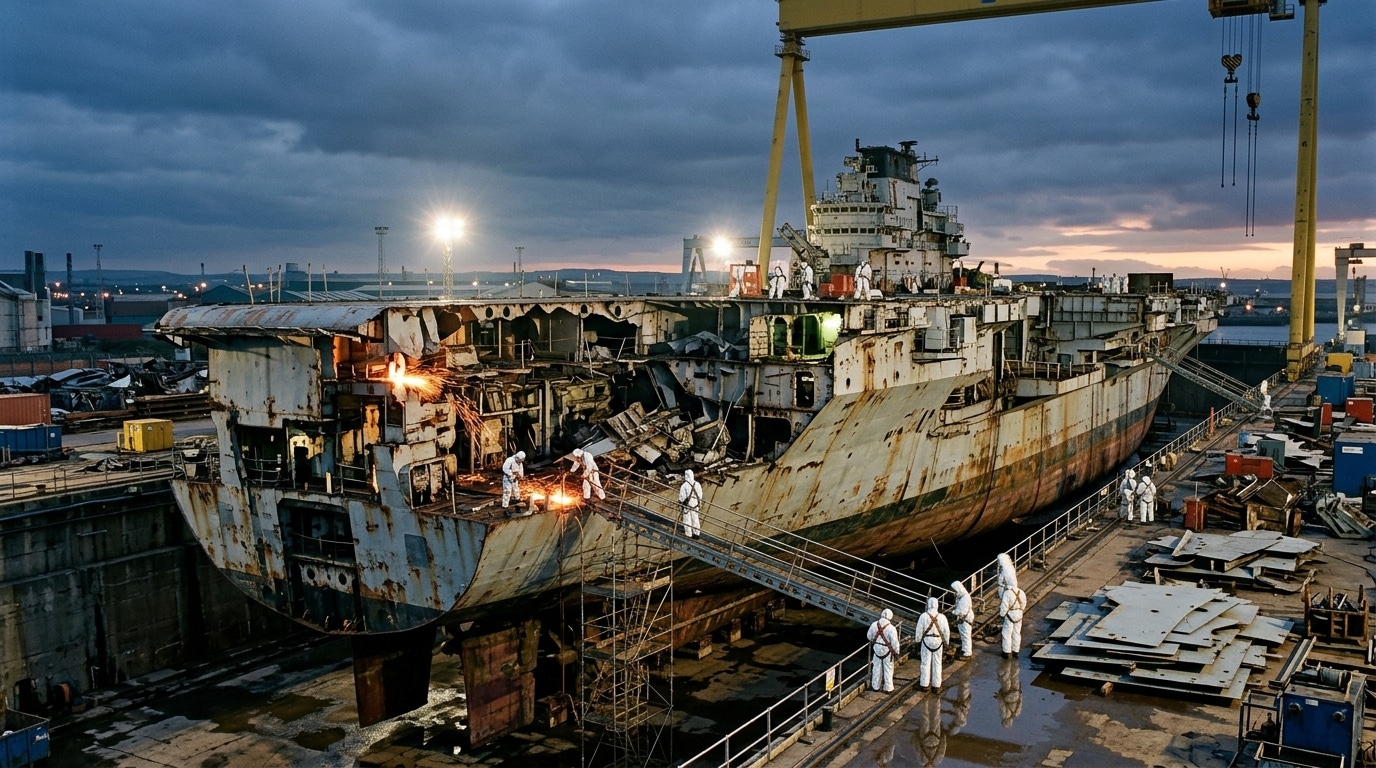
- The ship was ultimately dismantled in the United Kingdom, at Hartlepool, where the work, completed in late 2010, suffered almost ten months of delays after the discovery of an additional asbestos coating.
- A legendary aircraft carrier turned into a floating time bomb
- The diplomatic snub that forced France to repatriate its own ship
- Hartlepool, the British cemetery where the Clemenceau finally breathed its last
What drives a country to abruptly recall a 265-meter-long ship that had already embarked on a weeks-long journey? The answer lies in a single word that everyone dreads in the world of old naval construction: asbestos. A look back at a case that spotlighted the less flattering side of naval dismantling.
A legendary aircraft carrier turned into a floating time bomb
The Clemenceau was no ordinary vessel. Commissioned in the 1960s, this aircraft carrier stood for decades as a symbol of French naval air power. Decommissioned on October 1, 1997, it eventually rusted away in Toulon harbor, waiting for its fate to be decided.
The problem was that ships built in that era were saturated with asbestos. It could be found everywhere: in machine insulation, in bulkheads, in fire-protection systems. A miracle material at the time, it has since become a well-documented health nightmare.
Dismantling such a ship under health and safety standards is extremely costly. It is precisely for this reason that the choice fell on India, and more specifically the Alang yard, renowned for offering unbeatable rates. A choice that would soon prove explosively costly on the diplomatic front.
The diplomatic snub that forced France to repatriate its own ship
On December 31, 2005, the Clemenceau left Toulon under hull number Q790, bound for India. The voyage, entrusted to Ship Decommissioning Industries (SDI), carried a cost of €2.1 million, of which €1.5 million was for crossing the Suez Canal.
Yet the affair quickly became a fiasco. Environmental organizations denounced the massive presence of asbestos and toxic substances in the hull, destined for an Indian yard notorious for dreadful working conditions and reckless handling of hazardous waste.
On January 6, 2006, the Indian Supreme Court ruled: it temporarily barred the ship from entering the Alang port. A sharp rebuke to French diplomacy, which saw its aircraft carrier turned away like a mere unwanted cargo.
The coup de grâce arrived on February 15, 2006. The Conseil d’État officially suspended the transfer to India, ruling that the Clemenceau constituted nothing more than waste within the meaning of current law. France had no choice but to repatriate its own ship, in a costly and humiliating operation.
The bill for this U-turn proved steep. After terminating the contract with SDI, the French state paid a total of €11.404 million in reimbursements, including €1.878 million in fixed compensation paid to the company.
Hartlepool, the British cemetery where the Clemenceau finally breathed its last
It took more than two years to find an appropriate solution. On July 1, 2008, the French Ministry of Defence finally announced that dismantling would be entrusted to Able Ship Recycling, based on the banks of the Tees in the United Kingdom.
This choice was not improvised. The British Environment Agency had given its green light, as had the DRIRE in Brittany and the interministerial committee for the export of war materials. A much more rigorous administrative path than before, proof that the lesson had stuck.
The ship eventually arrived at the Graythorp yard near Hartlepool on February 8, 2009. The actual cutting only began on November 18 of the same year, after thorough preparation of the operations.
And that is where the story took on a nearly symbolic turn. Able UK uncovered during preparatory work an unidentified asbestos coating, the very same material that had sparked the initial scandal. This setback significantly delayed the project, which had been expected to last only a year.
In the end, the dismantling faced nearly ten months of delay beyond the original schedule. The Clemenceau finally went silent at the end of 2010, being methodically cut up along the banks of the Tees, far from the controversies that had accompanied its first abortive voyage.
Its twin ship, the Foch, met a markedly different end. Sold to the Brazilian Navy in November 2000 under the name São Paulo, it was withdrawn from service in 2017 before being scuttled at sea on February 3, 2023, ending its journey beneath the ocean rather than at a demolition yard.
Two twin aircraft carriers, two radically different destinies, and a common thread running through them: what to do with these steel giants once their missions are complete? The Clemenceau affair at least helped to articulate the problem clearly, forcing states to seriously rethink how they manage their most toxic naval waste.
👉 A small gesture for Space Group? Follow us on Google, add us to your bookmarks, and find us on Google News so you never miss a discovery.
