
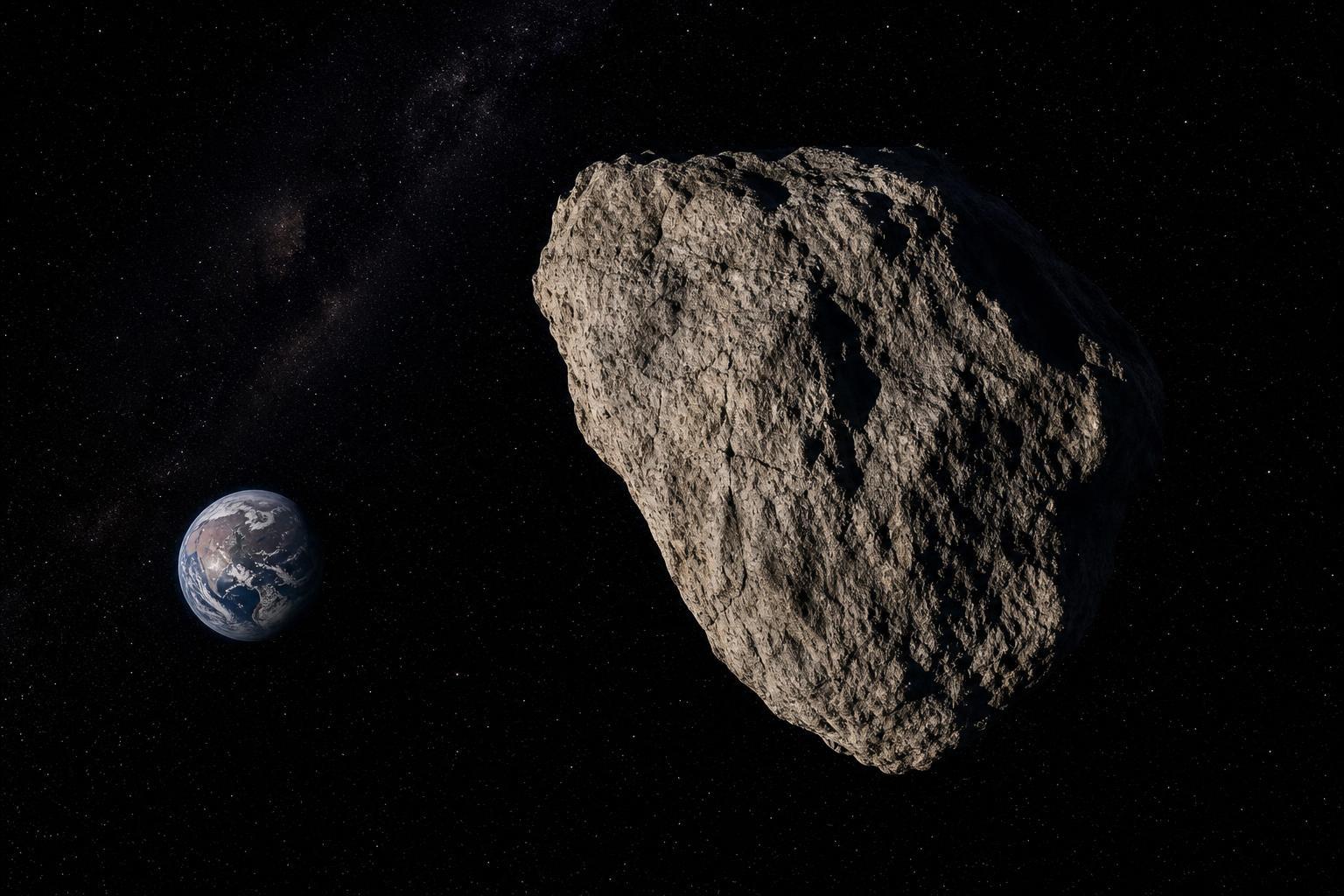
A stadium-scale space rock is on a safe, swift approach, and the buzz is deserved. Expect a brief, brisk visit, not a doomsday drama. “Think of it as a cosmic, neighborly hello,” as many sky-watchers like to say. Here’s what matters about how close, and when to pay attention.
What “stadium-size” really means
In asteroid talk, “stadium-size” typically means a diameter of a few hundred meters. That’s roughly the footprint of a large football, or soccer stadium. Objects in this class can be big enough to command careful tracking, yet still small compared with the true giants of the asteroid belt.
A rock around 200–400 meters wide reflects sunlight weakly and moves fast, so it’s often a dim, telescopic target. Scientists estimate size by how bright it looks and how much light its surface may reflect—two numbers that carry uncertainty, especially for newly measured visitors.
How close is “close” in space terms
Astronomers measure flyby distance in lunar, or “LD,” meaning one Moon–Earth gap. One LD is about 384,400, kilometers (roughly 239,000 miles). A “close” pass can still be several LD away—well outside the realm of satellites, and far beyond Earth’s atmosphere.
For context, geostationary spacecraft orbit at about 35,786 kilometers (22,236 miles)—that’s around 0.09 LD. Most flybys like this happen at multiple LD, not inside the satellite belt. “Close” can sound alarming, but in astronomy it often means comfortable, measurable distance with no risk at all.
When you see numbers like 4–10 LD, think: many times the Moon’s distance, and a zero on the impact-risk scoreboard. Even at 1–2 LD, it’s still a huge buffer—space is big, and the aim is safely wide.
When to look, and how the timing works
Closest approach is reported in UTC, a universal time standard. Your local moment depends on time, zone and longitude. The object can brighten or fade quickly as its angle to the Sun changes, so “best” viewing may not be exactly at the listed minute of closest approach.
Expect the asteroid to zip along against the stars, covering degrees per hour, faster than typical deep-sky targets. That speed makes it thrilling, but also tricky for backyard tracking. In many cases the target is too faint for naked-eye viewing, requiring binoculars or a small telescope and a good chart.
Will it hit? The safety picture
Near-Earth Object teams constantly refine orbits with radar and optical data. If an object is forecast to pass “close,” it means the math shows a clean miss. “Close is a measurement, not a threat,” is a phrase you’ll hear from careful communicators.
For a stadium-size body, impact probabilities are scrutinized early and often; if anything changes, it is publicly updated. The vast majority of such flybys are non-events in terms of danger, and rich events in terms of science.
Why scientists love these passes
A fast, safe pass is a golden chance to sharpen an asteroid’s orbit, measure its size, and infer its shape and spin. Radar can sketch surfaces, spot companions, and reveal weird geometries like peanut-like contact binaries.
Each pass helps improve long-term predictions, catalogs, and defense planning. It also fuels research on asteroid composition, which matters for both planetary safety and future space resources. “Every flyby is a lesson, written in moving light.”
How to follow it like a pro
If you want exact “how close” and “when” for your location, use trusted tools and keep your plan simple:
- Check official ephemerides from reputable centers (NASA CNEOS, JPL’s Small-Body Database, or ESA’s NEO Coordination resources) for the precise closest-approach time, distance in LD, and predicted brightness.
- Convert the UTC timestamp to your local time, and note whether your best window is before dawn or after sunset.
- Download a star chart or use a planetarium app (enable real-time asteroid tracking) to plot the object’s path by hour.
- Use tripod-stabilized binoculars or a small telescope with a wide-field eyepiece; start with low magnification to keep the motion in view.
- If imaging, use short exposures or a tracking mount; the target will streak if your settings are too long.
What “close” will feel like from Earth
For most people, this event will be a story you read, not a spectacle you see with the unaided eye. Under dark skies, with modest optics, you might catch a faint, moving point sliding past background stars. That humble dot is a world, with its own history, paying a fleeting visit to our neighborhood.
So take a breath, mark the window, and enjoy a safe cosmic cameo. It’s a reminder that our planet is part of a busy, shared solar system—and that “close,” in space, is both a scientific term and a human thrill.
