
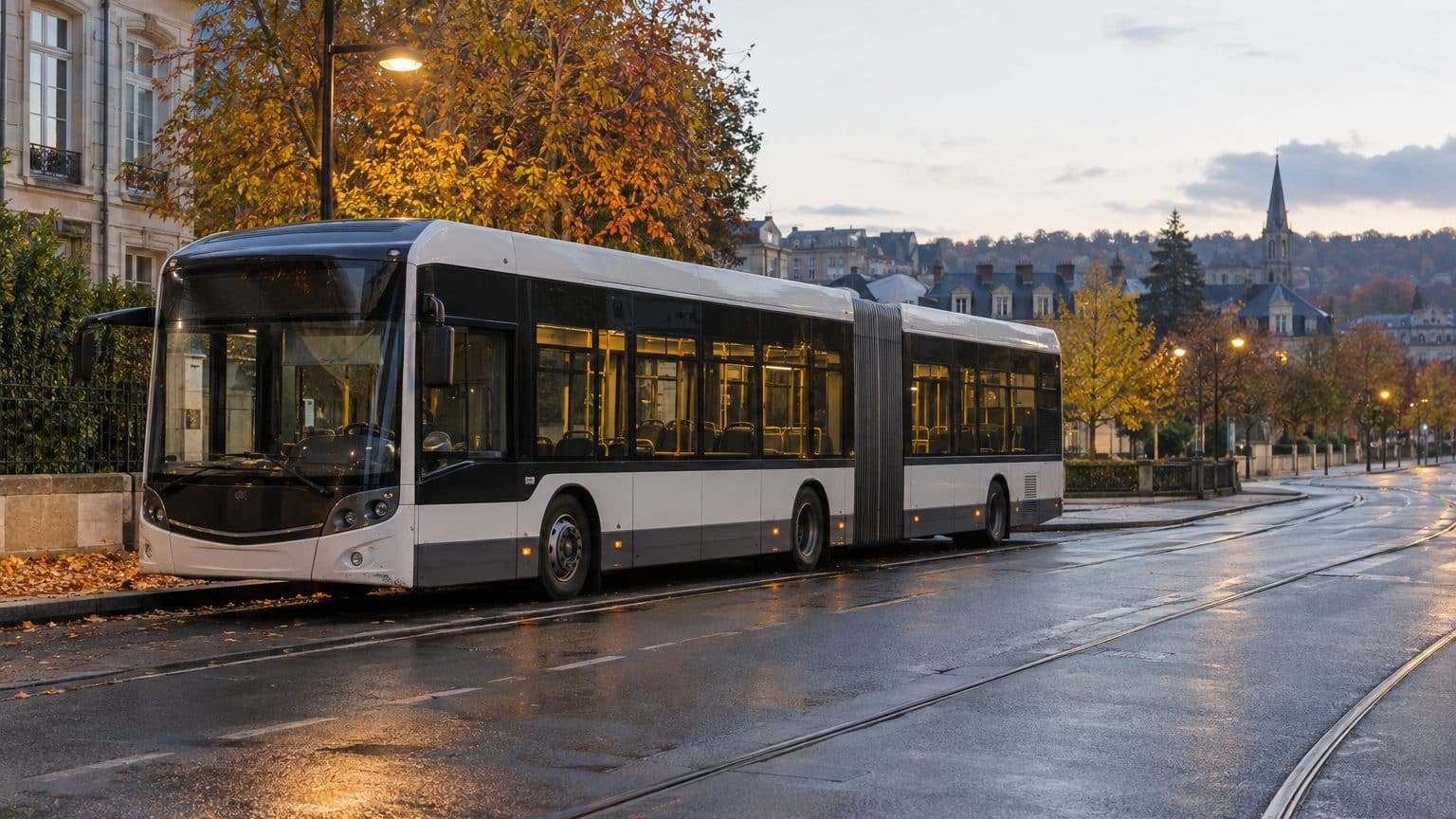
On December 31, 2017, at 8:00 p.m., Caen’s last rubber-tired tram car returns to the depot. It marks the end of 15 years of operation, even though the system had been planned to run until 2032 on a 15.7-kilometer line that had cost around €215 million. The following day, 42 articulated buses take over.
Workers begin removing the guide rail on January 3, 2018.
- Caen’s last TVR tram car returns to the depot on December 31, 2017, after 15 years of operation.
- The system, built for about €215 million, was planned to last until 2032.
- Its replacement by a steel-wheeled tram cost around €262 million, far more than the initial construction.
A single central rail, 24 trains, 34 stations
In November 2002, Caen opened a “reserved-track transport” system designed by Bombardier, the TVR. The vehicles run on rubber tires but follow a single central guide rail that directs them, and they collect their power via a pantograph, like a conventional tram. The network comprises 24 trams and 34 stations over a 15.7-kilometer length.
The city had previously operated a tramway, from 1901 to 1937. The TVR thus marked a return after 65 years of absence, and it lasted only 15 years.
On paper, the TVR occupied a singular niche: regulations registered it as an electrically driven bus, while the Caen residents called it “the tram.” The project was valued at around €215 million, a figure that ranged between €190 and €240 million depending on assessments. Spread over the line length, this equates to nearly €14 million per kilometer. With 34 stations, it comes to roughly €6 million per station.
A string of breakdowns, then a verdict of failure
From launch and for years thereafter, malfunctions, service suspensions, and delays were very common. The trams sometimes came off the guide rail, noise joined the complaints, and ruts formed in the roadway. The failure rate remained high throughout this period.
A tramway structures the mobility of an urban area, and its failures are immediately visible: a vehicle out of its guidance can suspend service on the affected segment. The roadway, for its part, bears the mark of the trams’ passage in the form of grooves.
At the start of the 2010s, the failure was acknowledged.
The urban area then compared several options, including another rubber-tired guided system and a high-capacity bus, before opting for a steel-wheeled tram. This decision dates to the early 2010s, several years before the TVR’s closure. Operations, however, continued to the end: the cornerstone of the maintenance center for the future tram was laid on December 12, 2017, 19 days before the final run. The system itself had a programmed end of life in 2032, i.e., 15 years later.
18 months of buses, then steel rails
The switch happened in two stages on the night of December 31, 2017. Between 8 p.m. and 12:30 a.m., buses already replaced the TVR, then substitute service began on January 1, 2018 with 42 articulated buses.
For about 18 months, these buses carried the service while the old system was removed and the new one built. The ratio is striking: 42 vehicles to replace 24 trams, almost two buses per tram. The project reused the existing platform, which explains why work began with removing the guide rail.
To operate these lines, the network bought used buses and rented a number of others. Travelers could follow the vehicles in real time via a mobile app.
The steel-wheeled tram opened in 2019, using Alstom Citadis rolling stock. It largely retraced the TVR’s route, but now comprises 3 lines where the previous system had 2, served by 26 trams. The stated objective was 64,000 passengers per day, compared with 42,000 with the TVR, i.e., about 50% more. Maintenance and storage take place on a new site at Fleury-sur-Orne, south of Caen.
What the replacement cost
The replacement is estimated at around €245 million, excluding indemnities, and €262 million including them. The TVR, by contrast, cost about €215 million to build.
Replacing proved more expensive than building, even at the higher end of the range.
Annualized, the figure provides a useful order of magnitude. Spreading the initial investment over 15 years of operation yields about €14 million per year of service. If it had lasted until 2032, i.e., 30 years, it would have fallen to around €7 million. These figures exclude operating, maintenance, and inflation costs between 2002 and 2019.
Part of the trams was sold to Nancy, which operated the same system. The Nancy TVR lasted 23 years, eight more than Caen’s, before giving way to a trolleybus line.
The choice of steel wheels rests on a simple reasoning: the technology is widespread, whereas the TVR had been adopted by only two cities, Caen and Nancy. Spare parts, manufacturers, and expertise exist in abundance, limiting the risk of ending up with equipment that no one else uses. The new tram is also marketed as having a service life well beyond that of the TVR.
By adding the €215 million for construction and the €262 million for replacement, the total comes to around €477 million to service a route largely identical. The comparison remains imperfect: the 2019 network has 3 lines versus 2 for the TVR, and the initial cost ranges from €190 to €240 million depending on assessments.
👉 A small gesture for Space Group? Follow us on Google, add us to your bookmarks, and find us on Google News so you don’t miss a discovery.
Sources: railpassion.fr | transbus.org | fr.wikipedia.org
