
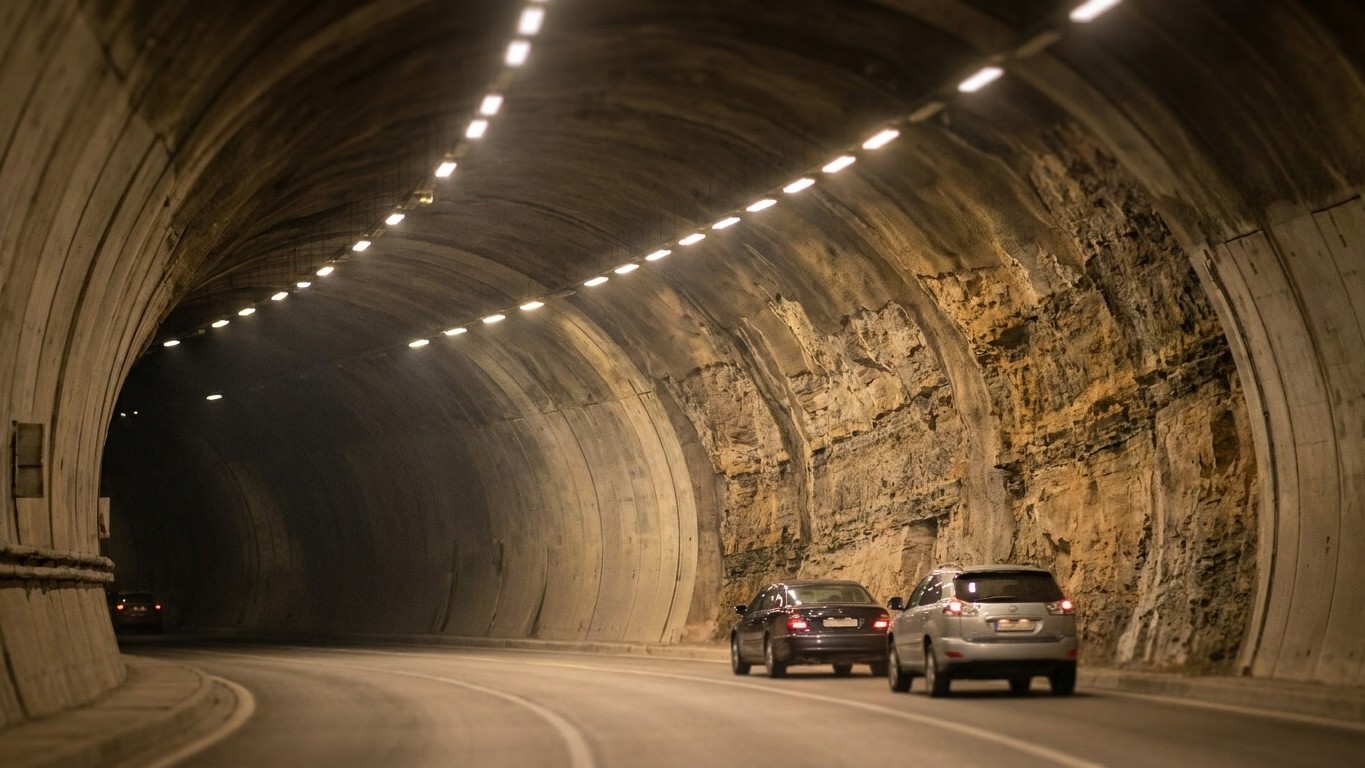
A 3.3-kilometer tunnel, two tubes, two decades of work, and a cost overrun that can make one’s head spin: beneath Toulon, the state spent twenty years carving out a passage that other cities would have finished in five. The first tube opened in September 2002, the second in March 2014, and between the two, the bill swelled far beyond one billion euros. Here is the story of an extraordinary project, mixing geological collapses with endless financial negotiations.
Key takeaways
- A devastating collapse in 1996 of the first tube already cast the project into chaos
- The Toulon subsoil kept delivering surprises for the second tube, with repeated stops for geotechnical reasons
- Why was the initial €186 million bill multiplied by five?
A cursed route from the very first dig
It all begins in 1987. A ministerial decision selects the Toulon tunnel project, drawn up with an initial budget of 1.223 billion francs, scarcely more than 186 million euros at the time. Four years later, the declaration of public utility is issued on April 17, 1991, and work on the northern tube begins in January 1993. On paper, nothing foretold the ordeal to come.
But the Toulon subsoil had other plans. The tunnel collapsed in March 1996, when the F2 front gave way as it opened into the “fossil valley,” blocking the site and creating a surface landslide. An engineer from Moniteur des travaux publics, who followed the project on site, summed up the mood of the era: “the traumatic sight of the Toulon tunnel collapse haunts the project.” The teams did not resume concrete work until June 1997, and the project then accrued more than three years of delay. A fire would further complicate matters in 2000, before the safety committee for road tunnels, convened after the Mont-Blanc disaster in 1999, ordered additional safety work. Nine years behind schedule from the initial promise: the first tube finally opened to traffic in September 2002.
The second tube, a geological remake
Logic would seem to dictate that, after such an episode, the second tube would benefit from the lessons learned. Michel Vauzelle, then president of the PACA region, publicly questioned the project, calling for an independent expert review and wondering about “this drift, given that the experience of the first tube should have allowed for a better cost assessment and improved management.” But the Toulon subsoil was far from finished surprising engineers.
The construction of the south tube, begun in 2007, likewise ran into geotechnical accidents. In 2009, cracks appeared in a downtown building: the project owner, the Dreal Paca, decided in August 2009 to halt the work, still haunted by the 1996 collapse in the same area. These repeated stoppages postponed a commissioning initially planned for mid-2013. The second tube finally opened on March 19, 2014, at five o’clock in the morning, eight years after construction began and twelve years after the first tube. Twenty years separate the first dig in 1993 from the complete opening of the structure.
From a billion francs to a billion euros
The timetable was not the only casualty of this subterranean venture. As noted, the initial budget hovered around 186 million euros. Even with the first tube, the bill exploded: the total envelope reached 351.5 million euros, including 18 million for safety enhancements following Mont-Blanc. The second tube fared no better. In 2011, an overrun of 134 million euros was identified, the funding of which was entrusted to the Escota company, in exchange for an extension of its motorway concession, approved by a favorable ruling of the Conseil d’État. Other estimates published at the same time suggested an even higher overrun, with an additional 161 million euros cited by the State’s own services, the project owner, pushing the second tube alone well beyond 450 million euros.
In the end, the second infrastructure, 3.3 kilometers long, required seven years of work and cost around 455 million euros. Adding together the two tubes, the studies, the safety reinforcements, and the roadworks tied to widening the A57, the Toulon tunnel’s overall bill clearly crossed the symbolic one-billion-euro mark by the time the second tube opened. This sum was financed according to a steady cost-sharing arrangement among the State, the Regional Council, the General Council, and the Toulon Provence Méditerranée metropolitan area—therefore largely by public money at both local and national levels.
What the Court of Accounts says, and the traffic that kept rising
The financial mechanism used to absorb the second-tube overrun—compensating unplanned works with an extension of the concession—is far from trivial. In its July 2013 report on the State’s relations with highway concession companies, the Court of Accounts delivered a harsh assessment of such arrangements: it noted that the State had agreed, at the concession companies’ request, to have them carry out works not covered by the concession agreement in exchange for compensation, with these negotiations repeatedly placing public authorities in a weak position. The financial court also highlighted a broader system in which investments are offset by toll increases, a practice that had become the norm rather than the exception, with “plan contracts” deemed not transparent. The Toulon tunnel, partly financed through this mechanism, provides a concrete illustration of what the Court condemned in substance at the time.
The question of traffic remained, the variable that should justify such a hefty bill. Yet traffic forecasts shifted year after year. Even before the second tube opened, the relevant highway stretch already exceeded 100,000 vehicles per day, prompting plans to widen the A57 to three lanes in each direction to accommodate the flow. The tunnel alone, in its initial single-tube configuration, was already moving about 35,000 vehicles per day—a saturation level that had justified from the outset the construction of a second tube. Twenty years after the first shovel hit the ground, the Toulon underground remains one of the busiest corridors on the Var coast, free for drivers but whose cost has been footed multiple times by local authorities and the State even before the last truck rolled through.
Sources : side.developpement-durable.gouv.fr | senat.fr | pascal-francis.inist.fr
