
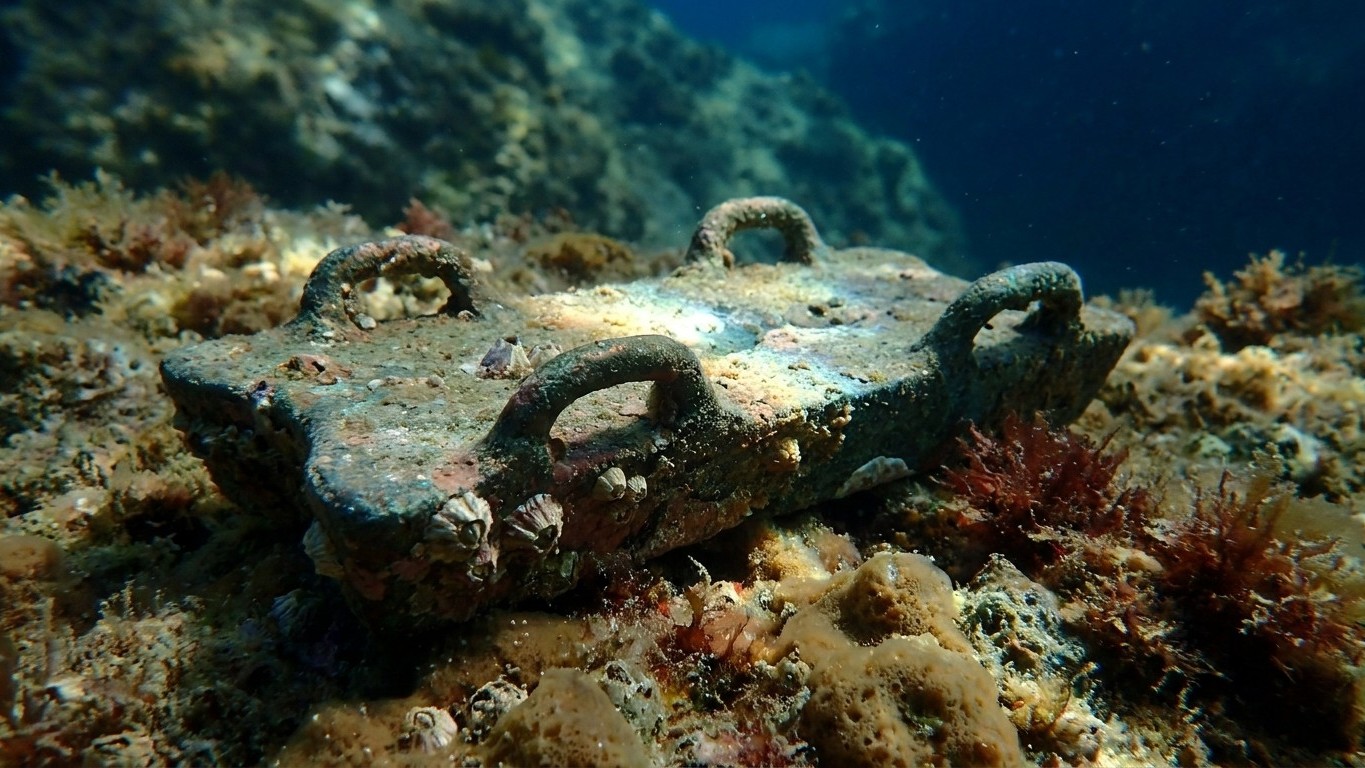
Ten tonnes of copper and one tonne of tin were hauled up by hand, ingot by ingot, from a steep underwater slope more than 40 meters deep. Between 1984 and 1994, American and Turkish archaeologists carried out eleven campaigns, each lasting three to four months, for a total of 22,413 dives at a single site off the coast of Turkey. The result of this decade-long persistence: the best-preserved commercial shipwreck ever found in the Mediterranean, sunk around 1320 BCE with its cargo intact.
Key takeaways
- A sponge diver unexpectedly discovers copper ingots shaped like “ear-shaped biscuits” at a depth of 40 meters
- Eleven years of relentless labor: how to extract 11 tonnes of fragile metal without destroying it?
- A chemical fingerprint shows the tin travelled thousands of kilometers from Central Asia
A Sponge Diver and the “Ear-Shaped Metal Biscuits”
It all began by chance in 1982. A young Turkish diver was exploring the seabed off Cape Uluburun, near Kaş, looking for sponges. He spotted objects that the ship’s captain recognized as copper ingots shaped like oxhide from the Bronze Age. The archaeologists would remember his description for posterity: “ear-shaped metal biscuits,” a reference to the rectangular ingots equipped with four handles.
The information reached George Bass, founder of the Institute of Nautical Archaeology (INA), affiliated with Texas A&M University. He was not a novice: fifteen years earlier, he had already excavated a wreck comparable to Cape Gelidonya, about sixty kilometers away. An initial survey quickly confirmed the presence of ceramics and ingots, allowing dating to the late 14th century BCE. The actual digs began the following year, revealing within a few months the astonishing scale of the archaeological deposit.
Eleven years, 22,413 dives: An Extraordinary Undertaking
Working more than 40 meters underwater imposed constraints that few terrestrial archaeological projects experience. The artifacts were found between 44 and 52 meters of depth, with remnants dispersed as far as 61 meters, on a steep rocky slope where the slightest misstep could send three-thousand-year-old items tumbling. The teams lived on site, in a camp perched on the cliff and aboard a research vessel.
Each diver had only twenty minutes per dive, with a maximum of two sorties per day. The margin for maneuver was thus razor-thin: at this pace, it would take years to map the site by triangulation, clear sediments with underwater vacuums, and then haul the cargo out one item at a time. Some copper ingots, weakened by centuries underwater, even required a special glue injection before extraction, lest they crumble upon contact with air.
The result of this meticulous, dogged effort surpassed anything underwater archaeology had seen to that point. A total of 354 copper ingots, weighing ten tonnes, were recovered, whose significance is underscored by how widely they spread through finds and contemporary records. In addition, one tonne of tin ingots was recovered. This ten-to-one ratio is no coincidence: it matches exactly the proportion needed to produce high-quality bronze, the era’s strategic alloy.
The Largest Reserve of Metal in the Ancient World Found Intact
Putting these numbers into perspective helps gauge the magnitude of the discovery. Based on estimates drawn from the bronze composition of Mycenaean-era weapons, the eleven tonnes of metal from the wreck could have forged equipment for roughly 5,000 soldiers. A single ship, wrecked by accident, carried enough to arm an army. It’s a stark illustration of the intensity of Mediterranean trade networks that stretched across the eastern Mediterranean fourteen centuries before our era.
The geographic origin of these metals had long puzzled researchers. The copper came from Cyprus, a lead confirmed for some time by the isotopic composition of the lead it contained. The tin, however, remained a metallurgical mystery until a 2022 study that compared its chemical and isotopic signature with all known sources—from the British Isles to Central Asia. The results showed that about 65% of the tin originated from deposits at Kestel in Turkey, while the remainder had traversed a staggering distance from isolated mines in Central Asia, thousands of kilometers from where the ship had embarked in the Levant.
Yet the metal was only one part of the treasure. The divers also recovered jars of terebinth resin, cobalt-blue glass ingots among the oldest recorded, elephant ivory, hippopotamus teeth, and a scarab engraved with the name of the Egyptian queen Nefertiti, which helped refine the dating of the shipwreck.
A Project That Rewrote the History of Mediterranean Trade
The Uluburun cargo is not only impressive for its volume; it has upended historians’ understanding of Bronze Age trade networks. Most of these goods were previously known only through ancient texts or Egyptian tomb paintings, never through material remains directly linked to a single cargo. The connection with the Amarna letters, the XIVth-century Egyptian diplomatic correspondence, even allowed for identifying striking correspondences between the recovered cargo and lists of royal gifts exchanged between rulers of the era.
Today, the objects recovered during these eleven campaigns are displayed at the Bodrum Underwater Archaeology Museum, in a full-scale reconstruction of the hull and its load. But the analyses continue: nearly forty years after the excavation began, researchers and laboratories still regularly publish new data on the provenance of the metals, the composition of the glass, or the shipbuilding techniques of this cedar-wood vessel from Lebanon, considered one of the oldest deep-sea ships ever studied in detail.
Sources: nauticalarch.org | lesitedelhistoire.blogspot.com
