
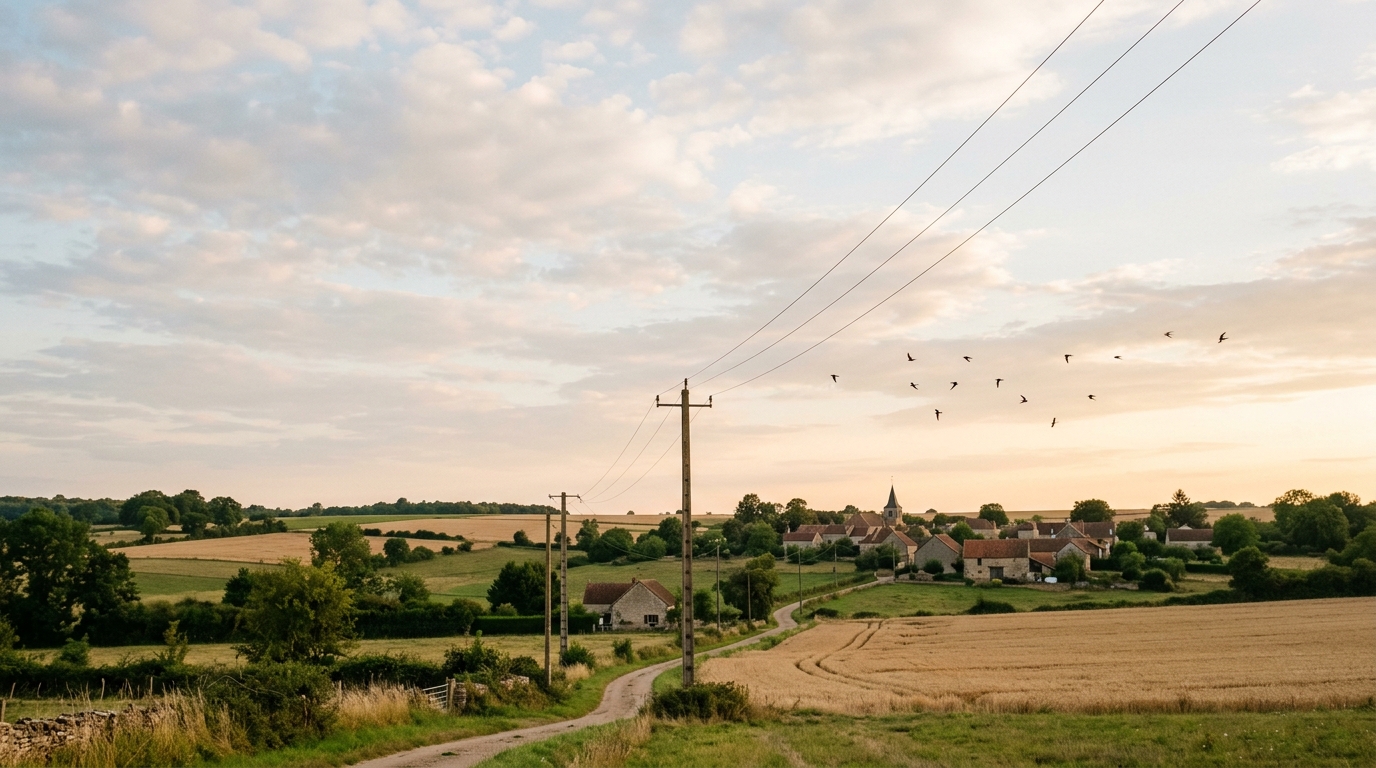
A power line trembling under the weight of about thirty small bodies pressed close together, slender silhouettes nervously preening themselves before launching into a tight, coordinated ascent: you may have witnessed this spectacle in recent days without really paying it much heed. We often associate swallows with long summer evenings, with moments when they skim terraces at dusk to hunt insects. Yet, as summer still lingers and terraces host the season’s final drinks, these birds are already beginning their exodus. A striking mismatch between our sense of the calendar and the biological reality of these winged travelers, one that deserves our attention.
The Great Departure Does Not Wait for Cold Weather
Contrary to a widely held belief, swallows do not flee the cold. Their departure follows a logic that is quite different, almost counterintuitive when you think about it. Records kept by the LPO over more than four decades show that the migratory movement actually spans from August to October, with a peak in intensity generally observed toward the end of September. Yet as early as mid-August, the first signs appear: pre-migratory gatherings form on wires, rooftops, and eaves, like a dress rehearsal before the big jump southward.
This early timetable is explained by the birds’ own biology. Some pairs manage to raise a second brood in late July or early August, when the weather allows. Fifteen days of incubation, then at least a month to rear the chicks until they can fly properly: the countdown is tight. It is precisely the youngsters’ ability to undertake a journey of several thousand kilometers that triggers the departure signal. No latecomers are possible; nature does not wait.
An Internal Clock Set by Light, Not Temperature
If temperature isn’t the primary trigger, what then drives these birds to pull up stakes so early in the season? The answer lies in one word: food. Swallows feed exclusively on flying insects they catch in midair, a diet extremely dependent on seasonal conditions. By mid-August, the progressive scarcity of these prey begins to be felt, long before temperatures actually drop.
This sensitivity to food availability rather than to the thermometer explains why other species follow a similar schedule, or even earlier. The black martins, often mistaken for swallows by the general public though they belong to a different family, actually lead the way in departures. They leave our regions from the beginning of August and become particularly rare after August 15 in northern France. A precursor signal that announces, in a way, the movement to come among their fork-tailed cousins.
The Sahara, the No. 1 Obstacle Before Sub-Saharan Africa
Once the departure signal is given, the swallows nesting in France embark on a journey that will carry them to sub-Saharan Africa, thousands of kilometers from their starting point. This voyage is far from improvised: it follows relatively stable routes from year to year, transmitted genetically rather than learned.
The majority of birds favor a passage through Spain, then cross the Strait of Gibraltar before tackling the dreaded Sahara crossing, a true endurance test where refueling points are scarce. A minority chooses an alternative route, skirting the eastern Mediterranean coast before tracing the Nile southward. In both cases, the desert remains the most perilous segment of the journey, the test for the fat reserves accumulated in the weeks leading up to departure.
What This Calendar Reveals About the State of Our Farmlands
Behind this migratory ballet lies a less poetic reality. The population of barn swallows declined by 40 % in Europe between 1970 and 2020, according to data compiled by BirdLife International. A staggering drop, largely attributed to the disappearance of flying insects, which itself is tied to the widespread use of pesticides in intensive agriculture. Fewer insects means less food available for these birds whose diet tolerates no real substitute.
In France, the decline is somewhat less severe, with an estimated drop of around 20 % over the same period. A figure that remains troubling, especially since migration phases are particularly critical for population survival. Each leg of the journey, every refueling stop, every night spent sheltered represents an added risk in an increasingly biodiversity-poor environment. Watching these gatherings on power lines at late summer is thus also witnessing, perhaps unknowingly, a discreet indicator of the health of our ecosystems.
The next time you encounter these silhouettes lined up on a power line at the end of summer, know that this is not merely a moment of rest before returning to the nest, but the prelude to an extraordinary journey to sub-Saharan Africa. An ancient, millennial biological rendezvous, governed by a precision that has nothing to do with the thermometer, but everything to do with daylight and the abundance of insects. The question remains: for how much longer will this spectacle continue to repeat itself before our eyes, if the decline in insect populations ever intensifies further?
