
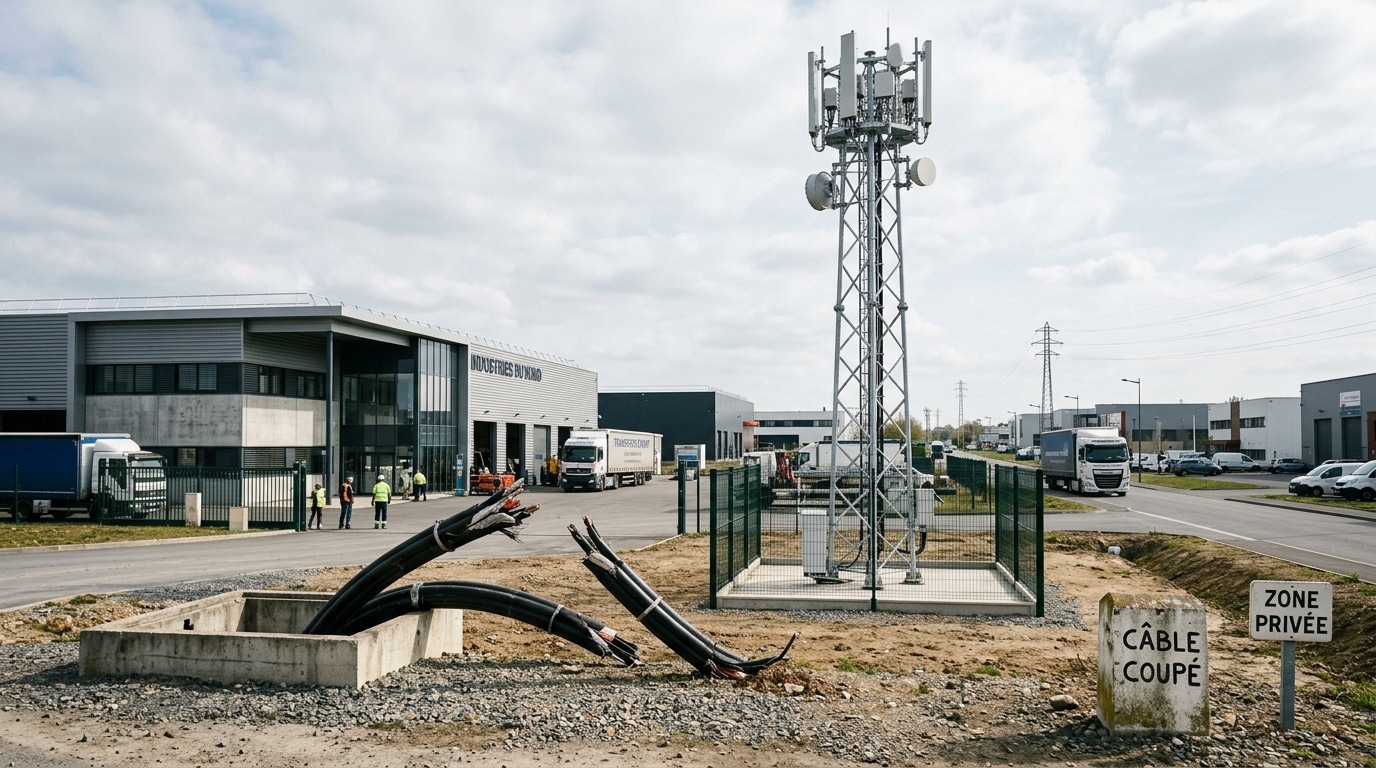
Important clarification before diving into the heart of the matter: this revolution does not concern your mobile plan nor the 5G you catch in the street. It unfolds behind the walls of factories, in giant warehouses and on logistics sites where connectivity has become as vital as electricity. There, a discreet but radical phenomenon is currently shaking up habits: more and more industrial players are deciding not to depend on the big telecom operators. Their solution? Build their own network, install their own antennas, and manage their connectivity themselves. For a few million euros, these companies literally cut the cord with traditional providers. A costly gamble, but one that could well outline the contours of the factory of tomorrow. Let us dive into the behind-the-scenes of this fascinating technological shift.
When public networks are no longer enough: the industrial trigger
Imagine a car manufacturing plant where hundreds of robots are active at the same time, where driverless autonomous forklifts roam, and where every machine continuously transmits thousands of information packets. In this meticulously choreographed ballet, the slightest latency can derail everything. However, public networks, even 5G, have a major flaw: they are shared by millions of users. When load increases, the connection can slow down, stutter, or even disconnect. For a person watching a video, it is a nuisance. For a production line, it is a potential catastrophe quantified in tens of thousands of euros per minute of downtime.
On top of that come concerns of security and confidentiality. Industrial data are often strategic, and routing them through an external network exposes risks. It is this combination of constraints that pushed certain sites to take the plunge: rather than suffering the operators’ limits, it is better to build a tailor-made infrastructure. The turning point had arrived.
Behind the scenes of a private antenna: how it really works
Concretely, these industrial players deploy what is called a private 5G network. The principle is easy to understand, even if it is complex to implement. It involves installing on the site its own antenna, its own equipment, and its own core network, exactly as an operator would do to cover a city, but on the scale of a single building or a single industrial zone.
The big difference is that all the bandwidth is reserved for the company. No neighbor crowds the network. It can be likened to a private highway: where the public network resembles a congested national road at rush hour, the dedicated infrastructure offers entirely free lanes, used exclusively by the factory’s machines. The result: extremely low latency, reliability close to 100%, and coverage perfectly adapted to the geography of the site, including areas that operators neglect, such as basements or metal warehouses that block signals.
Machines, sensors, robots: the silent revolution of connected sites
Once the network is in place, the possibilities become dizzying. The industrial private 5G network connects simultaneously machines, sensors and robots on the site, via an entirely dedicated infrastructure. Each piece of equipment becomes an intelligent node capable of talking in real time with others. A sensor detects overheating? The information goes up instantly. A robot needs to adjust its trajectory? The command is transmitted with no perceptible delay.
This connectivity opens the door to predictive maintenance, where a failure is anticipated before it occurs, but also to autonomous vehicles moving through the aisles without collision risk. It’s a silent revolution, invisible to the eye, but it profoundly transforms the way of producing. Data flows like a nervous system traversing the entire factory, coordinating every movement with unmatched precision.
Several million euros today, a head start for tomorrow
The lingering question remains: price. Installing such a network represents an investment of several million euros, between antennas, equipment, frequency licenses, and maintenance. An entry ticket that remains reserved for large groups with strategic sites. On top of that is the need for highly technical skills to manage an infrastructure that used to be handled simply by subscription.
But for those who take the plunge, the math quickly becomes clear. The total control of connectivity, reliability and autonomy more than compensates for the initial expense. It is a bet on the future, a way to gain a head start in the automation race. The industrial players investing today are laying the foundations of their competitiveness for the decade to come.
By cutting the cord with operators, these industries do not just save in the long term: they redefine the very notion of industrial performance. The private 5G network becomes a pillar of the smart factory, as essential as the machines it enables to communicate. One open question remains: will this technological autonomy stay the preserve of giants, or will we soon see more affordable solutions enabling smaller sites to cut the cord too?
