
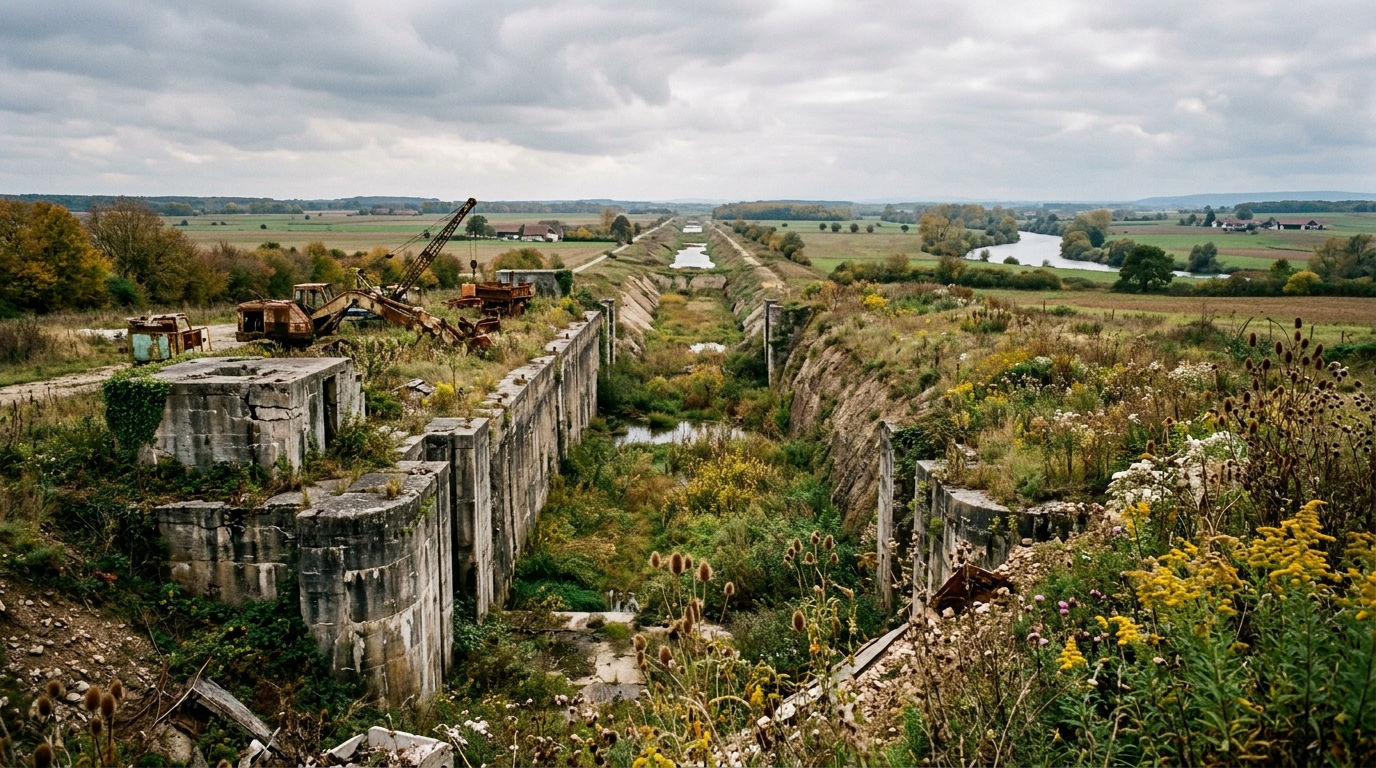
There are in France construction sites that span decades without ever reaching completion, leaving behind concrete remnants that nature eventually tames. The Rhine–Rhône Canal was one of these grand infrastructure projects that were meant to revolutionize French inland waterway transport but ultimately turned into a financial abyss. Even today, gleaming canal bridges stand in the middle of Franche-Comté fields, with neither water nor ships, silent witnesses to a thwarted ambition. A look back at a story where public money literally evaporated into the landscape.
- The Rhine–Rhône canal project, launched in the 1960s, was definitively halted in June 1997 by the Jospin government under the leadership of Dominique Voynet, formalized by a decree on 30 October 1997.
- Expenditures before the halt totaled about 1 billion francs of the period, i.e., around 152 million euros in current terms, while the total cost of works carried out over 283 kilometers reached about 2.3 billion euros.
- The constructed infrastructures, such as the canal bridges and the Niffer–Mulhouse lock that remained unused, now stand isolated in the middle of fields and are progressively repurposed toward leisure boating and river tourism.
- A pharaonic dream launched amid general indifference
- Canal bridges, locks, lands: where did the 152 million euros go
- Jospin ends thirty years of illusions with a signature
- Concrete remnants that still haunt the Franche-Comté landscape
A Pharaonic Dream Launched Amid General Indifference
Everything begins in the 1960s, with the enticing idea of linking the Rhine to the Rhône by a large-gauge navigable waterway capable of handling massive river convoys. Between 1968 and 1997, the State undertakes a colossal land operation, expropriating hundreds of parcels along a 229-kilometer route. The project advances with relative discretion, carried by successive decades during which no government truly questioned its relevance.
But the 1990s reshuffle the cards. Between 1995 and 1996, a complete cost reevaluation sends the projected bill soaring, rising from 17 billion to nearly 49 billion francs, including interest and VAT. Such a financial leap began to seriously worry public decision-makers, while competition from rail and road made the economic profitability of the project increasingly uncertain.
Canal Bridges, Locks, Lands: Where Did the 152 Million Euros Go
Before the axe fell, money had already flowed. Expenditures incurred before the project’s halt amounted to about 1 billion francs of the era, i.e., roughly 152 million euros in current value. This sum mainly funded three major items: preliminary technical and environmental studies, land acquisitions along the planned route, and the initial development works, notably on the Doubs.
But this figure represents only part of the total bill. The cost of works already completed on the 283 kilometers of navigable routes concerned is actually in the vicinity of 15 billion francs, or about 2.3 billion euros in current terms. A colossal sum invested in structures erected before the project was officially halted. Among these investments is a brand-new lock, sized to accommodate convoys of 4,500 tonnes, left unused for almost thirty years in the Alsatian stretch between Niffer and Mulhouse.
Jospin Ends Thirty Years of Illusions with a Signature
In June 1997, the government of Lionel Jospin decided to definitively halt the project, under the impetus of Dominique Voynet, then Minister of Territorial Development and the Environment. The decision, shaped by pressure from environmental movements and growing doubts about the project’s economic profitability, would be legally formalized a little later, by a decree of 30 October 1997 repealing the public utility declaration of the Saône–Rhône waterway.
This pause brought nearly three decades of work and expropriations to a close. Yet the file would not be entirely buried: a feasibility study launched by Haut-Rhin in 2008, followed by a revived debate in 2009 around an alternative route via the Moselle, would attempt several times to resurrect the idea. Without success. The administration then had to manage the heavy legacy of hundreds of parcels bought over three decades along a route that had become literally a ghost, before deciding to resell them.
Concrete Remnants That Still Haunt the Franche-Comté Landscape
Today, the scene is almost surreal. Monumental canal bridges and locks rise in the middle of fields, cut off from any coherent river network. The large-gauge European segment built in Alsace is the most striking example: it leads to no compatible network, stuck between the Rhine and a French network still operating at the Freycinet gauge of the 19th century. In other words, infrastructures designed for the future end up utterly unusable for current needs, due to a lack of technical continuity.
Faced with this legacy unusable for industrial freight, a gradual conversion is under way. The canal contracts signed by Voies Navigables de France for the 2026–2030 period now redirect the Rhine–Rhône Canal toward leisure boating and river tourism, far from the initial industrial ambition that justified so much expenditure.
This Rhine–Rhône Canal story illustrates how large infrastructure projects can become prisoners of their own scale, caught between economic promises, environmental constraints, and budget realities. A question still runs through the Franche-Comté and Alsace landscapes: are these concrete remnants, transformed into unintentional tourist curiosities, a symbol of pure and simple waste, or of an era when people were bold enough to dream big, even if they were wrong?
