
At a depth of 12,262 meters, beneath the Arctic tundra of the Kola Peninsula, Soviet drillers ran into an invisible wall: heat. While contemporary geophysical models predicted around a hundred degrees at that depth, the SG-3 well’s instruments measured 180°C. In 1989, SG-3 reached its final depth as the temperatures rose from the expected 100°C to 180°C, and at these temperatures and pressures the rock began to behave plastically, slowly flowing into the borehole. The deepest hole ever drilled by humans had found its limit, not in the rock’s hardness, but in its softness.
Key Takeaways
- Scientists expected rock to become increasingly compressed and hard: geological reality contradicted them
- At what exact depth does the rock begin to flow like soft plastic?
- How did a thermal detail erase two decades of a monumental Soviet project?
A borehole designed to reach the mantle
The drilling began on May 24, 1970, on the Kola Peninsula near the Norwegian border, with an initial target of 7,000 meters—a trivial objective compared to the project’s true ambition: to reach roughly 15,000 meters in order to touch the boundary between the crust and the mantle. It was a colossal undertaking, conceived as a Soviet scientific answer to the American space race: instead of looks toward the heavens, Moscow looked downward.
The progress did not proceed like a smooth voyage. The Soviets kept breaking records: 9,583 meters in 1979, then 12,262 meters in 1989, surpassing the American record held up to then by an Oklahoma oil well. In the meantime, the venture turned into a technical catastrophe. In 1984, after a year-long pause to celebrate breaking through 12,000 meters, the drill string broke five kilometers down and became stuck in the borehole, forcing engineers to re-drill an entire branch starting from 7,000 meters. This kind of incident, repeated several times over two decades, gives an idea of the stubborn perseverance required to push this project to its end.
The rock that refuses to stay hard
The geological intuition of the time seemed clear: the deeper you go, the more compressed the rock, and therefore the harder it should be. Kola demonstrated the exact opposite at great depths. This surprising heat gradient is explained by the heat flow from the mantle, much warmer beneath the crust, rising by roughly 25 to 30°C per kilometer of depth. But at Kola, this gradient escalated far sooner than planned, catching the teams off guard.
The concrete onsite result was spectacular, and frankly a little absurd from a distance: every time the drill bit was withdrawn to change tools, the hole would close up on its own. At these temperatures, the surrounding rock became ductile and viscous, behaving more like soft plastic than solid stone: the drill bits deformed, the rods blurred, and the rock itself flowed into the bore after being cut, rendering progress almost impossible. Picture digging a hole in wet sand that slides closed behind the shovel—that is roughly what the Soviet drillers experienced, but with tons of steel and higher degrees of heat.
The rock did not reveal only this thermal surprise. The cores retrieved at 12 kilometers also showed an unexpected saturation with water, even though one would assume such depth would be too compressed to allow any free fluid. Gas fluxes, notably hydrogen, were also detected in the drilling mud, another sign that the continental crust still guards secrets not anticipated by theory.
1992: the stop and the sealed lid
The combination of heat and political collapse sealed the project’s fate. The Soviet Union itself had dissolved by the end of 1991, and the funding that had sustained this two-decade scientific marathon simply evaporated. Without a budget, developing heat-resistant alloys that would have been required to push the drilling beyond 180°C became impossible. The fourth borehole was halted due to temperatures higher than expected, 180°C, at a depth of 11,882 meters in 1992.
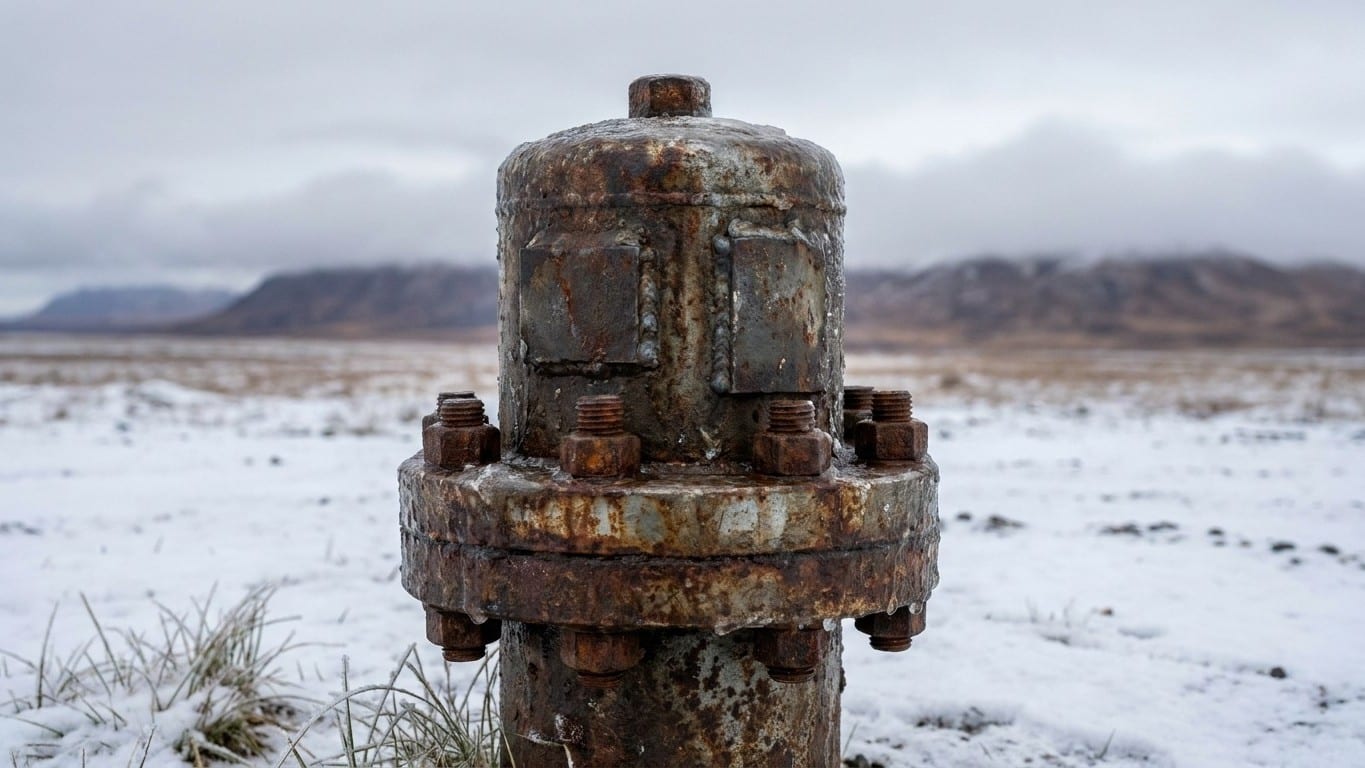
A final, more modest attempt was revived a few years later, but never regained the original momentum. Drilling on the deepest branch stopped in 1992 at 180°C, with a last attempt on a deeper branch completed at 11,882 meters, while a shallower branch launched in 1994 was abandoned at 8,578 meters due to lack of funds. The site continued to exist, slowly, for another decade before its definitive closure. Since then, the borehole has been sealed with a bolted and welded metal lid, a steel slab nearly incidental resting on what remains, yet still the deepest scar ever inflicted on the Earth’s crust by human hands.
Sources: sciencesetcivilisations.fr | objetsscientifiques.com
