
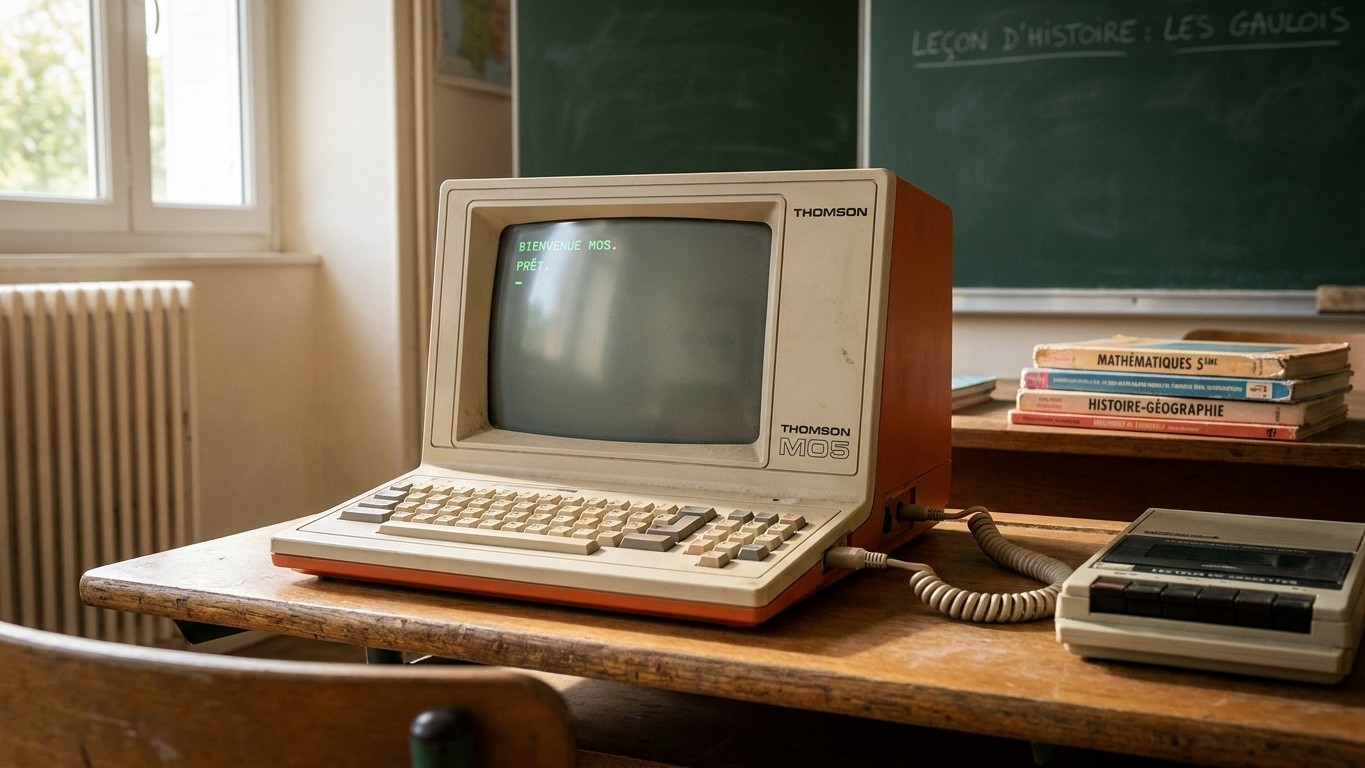
On January 25, 1985, Prime Minister Laurent Fabius rose to the podium to announce an extraordinary project: equipping French schools with 120,000 micro-computers and training 110,000 teachers, all before the September start of the school year. Nearly two billion francs were to enable 11 million students to be introduced to computing, to bring 120,000 computers into schools, and to train 110,000 teachers, in a very short window: ready for the September 1985 rentrée. A year before the legislative elections, the move was also political. A year ahead of the legislative elections, the French had to see that the socialists had changed, for the better.
What equipment did they choose? French, of course French. The government’s hardware solution was 100% French, with the Thomson line as the core tools: the MO5, a true R5 in the microcomputer world, and the TO7-70, a still more capable device. A decision that followed a clear industrial logic: to revive a French manufacturing sector battered by American and Asian competition. Yet forty years later, the record of this “Informatique pour tous” plan is taught as a case study of public technology fiasco. And contrary to a common belief, it wasn’t the cost of hardware that dragged the project down.
À retenir
- A pharaonic plan conceived in a few months with an original technical architecture: the nanonetwork
- The price of hardware was competitive relative to 1985 market standards — so why did it become a disaster?
- Incompatible technical choices, rushed training, and isolation within a proprietary architecture sealed the project’s fate
A pharaonic project assembled in a few months
The logistical scale is dizzying. Eleven million students were to be initiated into computing, using 120,000 computers across more than 40,000 primary schools, and 110,000 teachers were to be trained. To meet this tight schedule, the state relied on an original technical architecture: the nanonetwork, which linked up to 31 student workstations to a master computer in each classroom. Concretely, the nanonetwork allowed connecting up to 31 student stations (MO5 or TO7-70) to a master station (typically a Bull Micral running MS-DOS), via a coaxial cable and a proprietary protocol.
On paper, the idea was even ahead of its time. Designed with the 16-bit Bull Micral PCs as the network’s backbone, the nanonetwork proved to be a technological and pedagogical success. The tangible result on the ground: nearly 12,000 networks of this type equipped 12,000 institutions, including 9,000 primary schools and 2,700 middle schools. An impressive mesh for the era, when the family computer remained a rare object in French households.
The price wasn’t the problem
That is the point that is too often overlooked when pointing to public money waste. Compared with market standards, school equipment was not a luxury. It should be remembered that in 1985 a PC-compatible cost around 25,000 francs, roughly 3,800 euros in today’s terms; the nanonetwork was a realistic solution because for that price you could outfit an entire room. The MO5 itself was sold in a budget version for under 2,400 francs, an affordable price that allowed multiplying workstations rather than installing just one per school.
The economic trade-off thus looked perfectly sound. The real problem lay elsewhere: in the technical choices and in the speed of execution demanded by the political timetable. Trying to move too fast on such a structural project ended up costing more than money itself.
A technical and pedagogical dead end
The first grievance, and not the least: even within the Thomson lineup, nothing fit neatly together. The MO5, the low-cost version of the TO7-70, was unfortunately also largely incompatible with it. Software written for one did not necessarily run on the other, forcing publishers to produce multiple versions for a market already tiny. The MO5 was not 100% compatible with the TO7; programs had to be modified.
The second flaw, even more serious: the crash training of teachers did not suffice to create a generation of digital pedagogy experts. Training 110,000 teachers in fifteen days was not enough to create digital educators; many found themselves at a loss facing capricious machines, unreadable tapes, and unstable nanonetworks. This finding is corroborated by later analyses of the plan, which explicitly highlight the lack of teacher training, the choice to emphasize programming education at the expense of using office software, so much so that today this plan is regarded by some as a failure.
The third problem, the heaviest in the long run: technological isolation. The Thomson optical stylus, touted as an innovation, never caught on elsewhere. The concept of the optical pen, available on Thomson machines, was not adopted by major personal computers, in either the hobbyist or professional sectors. While France bet on a proprietary architecture and a homegrown language, the rest of the world moved toward MS-DOS standards and then Windows. A decade later, these machines had nothing in common with anything else.
The commercial consequence was immediate, even outside schools. The industrial mobilization mandated by the state drained production capacities intended for the general public. Orders monopolized production lines at the expense of deliveries to ordinary consumers, leaving room for competition and, in particular, the Amstrad CPC. As a result, for the entire year 1985: 250,000 machines of all models were sold against an objective of 400,000.
A lesson more timely than it seems
The Thomson fleet, once the credits were exhausted and the machines aged, eventually faded away in a few years, a victim of an overly narrow software ecosystem and obsolescence programmed by the global market itself. The nanonetwork, however, deserves rehabilitation: its centralized distribution principle of content to student workstations mirrors very closely the architecture of today’s computer labs and digital work environments. A question remains which resonates oddly today, as tablets are distributed in middle schools: does investing in sovereign hardware make sense if teaching practices and teacher training do not keep pace with the purchase of machines?
Sources : retro-computing-club.fr | franceinfo.fr | unesdoc.unesco.org
