
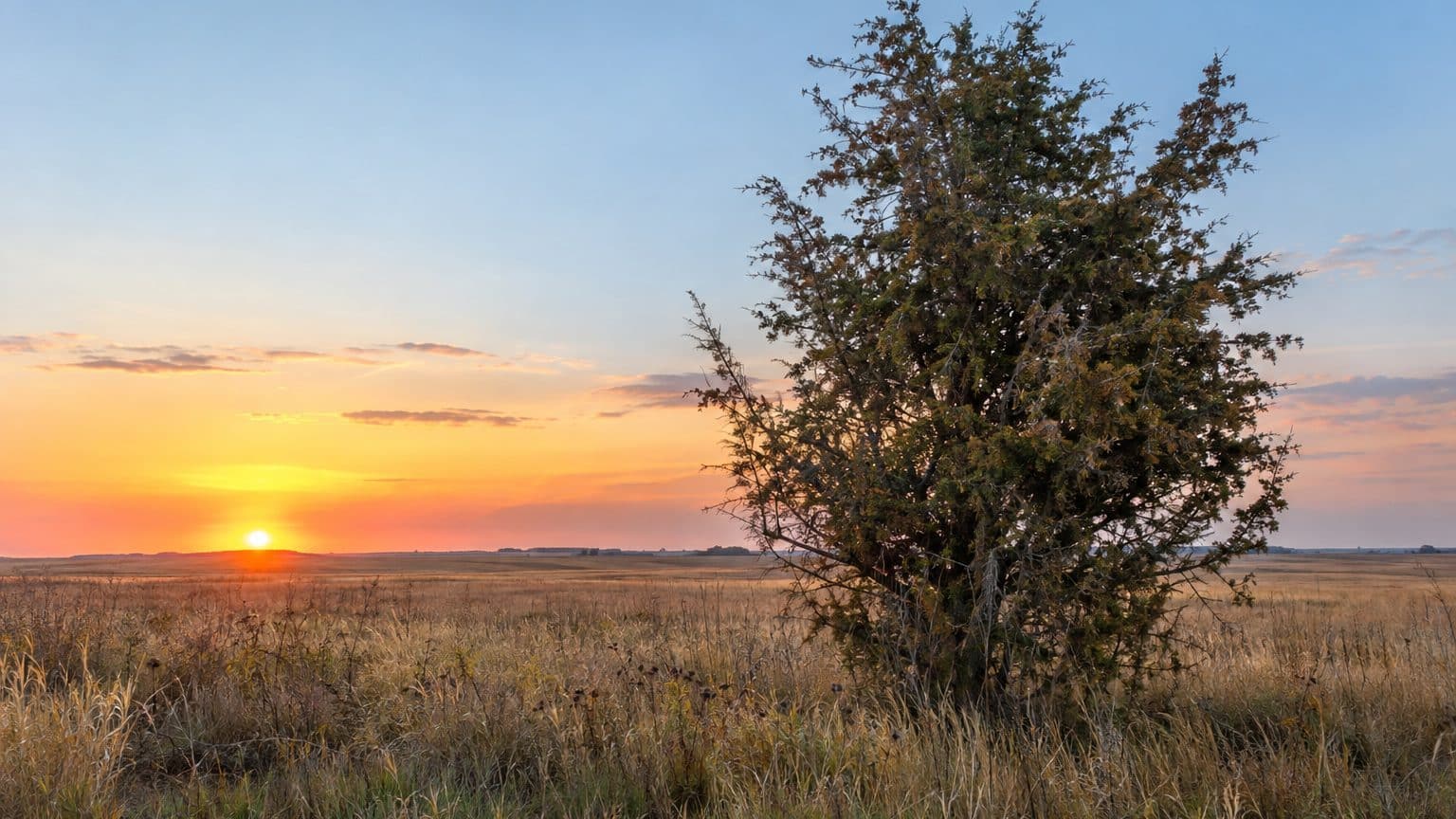
Red cedars planted as early as 1935 across the Great Plains are now over 90 years old. They stretch from North Dakota to the Brazos River in Texas, in rows inherited from the Great Plains Shelterbelt, also known as the Prairie States Forestry Project. Many, aged and thinning, no longer fully serve their original purpose: to break the wind that once ripped the soil from the farms.
The curtain was meant to be 160 km wide.
- More than 220 million trees were planted in 1942 on the Great Plains.
- The windbreaks were planted along roughly 160 km of width, from North Dakota to Texas.
- Many trees planted in 1935 are now over 90 years old and protect fields less effectively.
- Federal subsidies have funded the renovation of these windbreaks since 2010.
A Curtain of Trees Promised by Roosevelt
The project began with an order from Franklin D. Roosevelt, signed on July 21, 1934, during a drought and the Dust Bowl’s dust storms. The idea boiled down to one sentence: plant a band 100 miles (160 km) wide, from Canada to the northern reaches of Texas, to slow the wind that carried away the fertile topsoil. The estimated cost reached 75 million dollars over 12 years. The first plantings date back to March 1935, according to the American PBS public broadcaster, which is why “as early as 1935” serves as the reference point.
To plant, the administration paid the farmers themselves. They dug in, tended the young trees—primarily red cedars and green ash—aligned along the fences of their parcels.
The legal framework dated back to the Clarke-McNary Act of 1924, before the Works Progress Administration (WPA) took charge of the project. In 1937, Congress passed the Norris-Doxey Cooperative Farm Forestry Act, which gave a formal basis to Roosevelt’s dream. A federal project, but carried out farm by farm.
By 1942, 220 million trees had been planted.
That number is more than three times the population of France, distributed across 30,233 windbreaks. These bands stretched from North Dakota to the Brazos River in Texas. Each was merely a line or a few rows, but laid end to end, they traced a grid of wooded areas across six states.
A verdict PBS calls “limited success”
Should one believe that these trees defeated the Dust Bowl? No, history is more nuanced. PBS describes a “limited success,” and the return of rainfall weighed heavily in ending the dust storms. What the plantings left behind is not a outright victory over the dust, but a 160-km-wide curtain of trees spanning the Plains.
A tree does not provide protection from the moment it is planted. According to the technical sheets of the Natural Resources Conservation Service (NRCS), a windbreak may take 20 years or more to become fully functional, since protection depends on the height of mature trees. The sheltered area on the windward side then reaches roughly 10 times the maximum height of the tallest row.
Well-maintained trees often surpass 60 years before needing restoration, the NRCS notes.
Those planted in 1935 are now more than 90 years old. Many have been uprooted over time to make way for crops or roads, according to American agricultural press. Others persist, still sheltering cattle and farmsteads, but their condition and effectiveness have diminished. The red cedar, planted densely at the time, also suffers from competition among trees: NRCS records describe subjects that hinder one another, lose vigor, and become more vulnerable to diseases and insects.
Aging windbreaks, a subsidized renovation
Around 2010, the public realignment became clear: many windbreaks in Kansas and the Great Plains were now too old to perform their role. Federal subsidies were then opened for their maintenance and restoration in Kansas, across the two Dakotas, and Nebraska, under the proposals “Central Great Plains Shelterbelt Renovation” and “Central Great Plains Forested Riparian Buffer.” In the same year, the NRCS published a conservation standard dedicated to windbreak renovation, aimed at restoring the function originally envisioned.
Renovation does not mean demolition. The standard envisions replacing or clearing certain trees, adding rows to regain density, or pruning branches, all of which can unfold over several years to limit the period during which shelter is reduced.
What remains, and what exists, is still to be determined. In Nebraska, Kansas, North Dakota, and South Dakota, 12 million acres are covered by trees, including 5 million acres of windbreaks and riparian corridors along waterways, outside of forests, that had not been recently inventoried. A project from the National Agroforestry Center in Lincoln (Nebraska) has digitized the original paper maps to compare them with current aerial photos, in order to target renovation work.
In Orchard, Nebraska, the Nebraska Forest Service and the Upper Elkhorn Natural Resources District, working with the Schleusner family, created two demonstration zones within a historic windbreak to show how to restore vitality to the remaining trees. The portion closest to the road remains intact, a living reminder of the Prairie States Forestry Project.
Sources: nrcs.usda.gov | en.wikipedia.org | grokipedia.com
