
And what if touch extended beyond the skin? British researchers have just revealed the existence of a new kind of perception capable of detecting objects without direct contact. This “remote touch,” observed for the first time in humans, redefines the boundaries of our senses and could revolutionize fields ranging from robotics to space exploration.
A New, Unexpected Sense: the “Remote Touch”
We believed our senses were well defined: sight, hearing, smell, taste and touch — with occasional mentions of the “sixth senses” discussed by psychology and extrasensory perception. Yet a study conducted by Queen Mary University of London adds an unexpected candidate to this list: the “remote touch.”
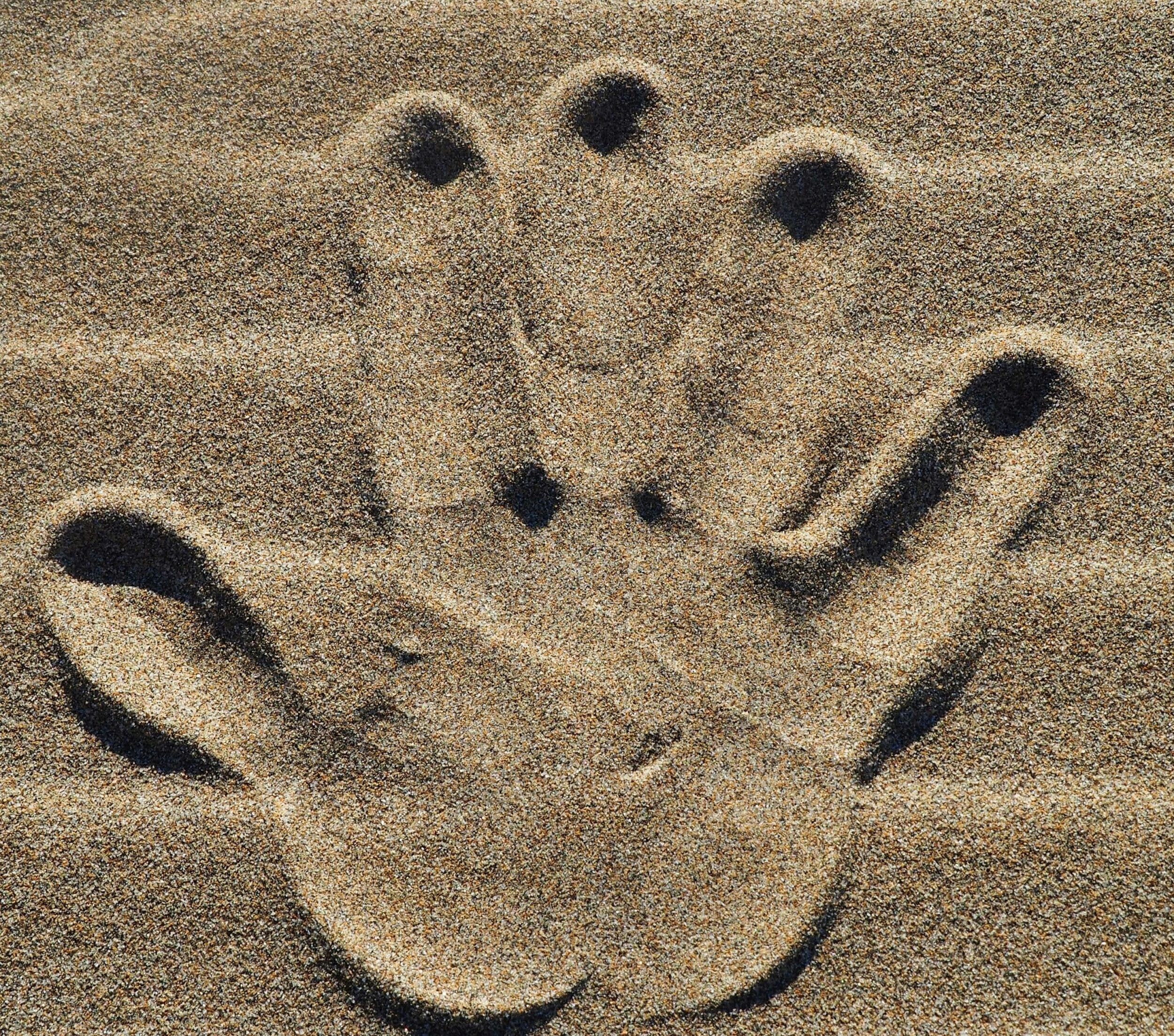
This phenomenon refers to the ability to perceive the presence of objects buried in granular materials, such as sand, without direct physical contact. In other words, our fingers would be capable of sensing tiny mechanical signals generated by the movement of particles around a hidden object.
This kind of perception isn’t unknown in the animal world. Some shorebirds, like sandpipers, probe the sand with their beaks to detect worms or crustaceans hidden beneath. The team led by psychologist Elisabetta Versace wanted to know if humans, too, could exhibit a similar form of distal tactile sensitivity. Their experiments suggest yes — and with surprising effectiveness.
When Humans Detect the Invisible
In the first phase of the study, volunteers were invited to locate objects hidden under the sand using only the fingertips. No visual, auditory, or thermal cues were provided. The results astonished researchers: participants identified the presence of objects in nearly 70% of trials, sometimes at depths of up to seven centimeters. A feat hard to attribute to chance alone.
Scientists estimate that these performances rely on detecting minute vibrations or pressure variations transmitted through the sand. These signals are so faint that they exceed the limits predicted by classical models of tactile perception.
According to the theory of particle interactions in granular media, mechanical cues normally attenuate after about a millimeter. Yet the volunteers seemed to perceive these perturbations at much greater distances, suggesting the existence of an unprecedented perceptual mechanism.
This discovery challenges the way we conceive touch: no longer a simple contact, but a distant interaction with the surrounding matter.
When Robotics Takes a Cue from the Human Body
The researchers did not stop at observing humans. In a second experiment, they sought to replicate this “remote touch” in a robot. Using a robotic tactile sensor paired with a long-term learning algorithm (LSTM), the team trained the machine to recognize buried objects in the same way humans do.
The results, though less precise (about 40% success), showed that the robot could perceive objects at a range modestly beyond that of human participants. This synergy between experimental psychology and robotics opens a new path: machines capable of feeling without seeing or touching.
As Lorenzo Jamone, a robotics and artificial intelligence expert at University College London, notes, this research demonstrates how studies on humans and robots can feed each other. By gaining a better understanding of our own sensory capabilities, we could design robotic systems that are more intuitive, able to explore environments where direct contact is impossible — whether it’s Martian soil, the depths of the oceans, or fragile archaeological sites.
Toward a New Era of Augmented Perception
Beyond scientific fascination, the “remote touch” opens substantial technological prospects. By extending the reach of the tactile sense, engineers could develop more sensitive assistive tools capable of detecting objects without contact, or ultra-precise robotic surgeons operating in confined environments.
For researchers, this discovery is not merely a sensory curiosity: it redefines the very notion of perception. If humans can feel beyond direct contact, our senses may be far more flexible, adaptable and powerful than we imagined.
In other words, this study marks a turning point: humanity beginning to understand how it might one day feel the invisible.
These works are published in IEEE Xplore.
