
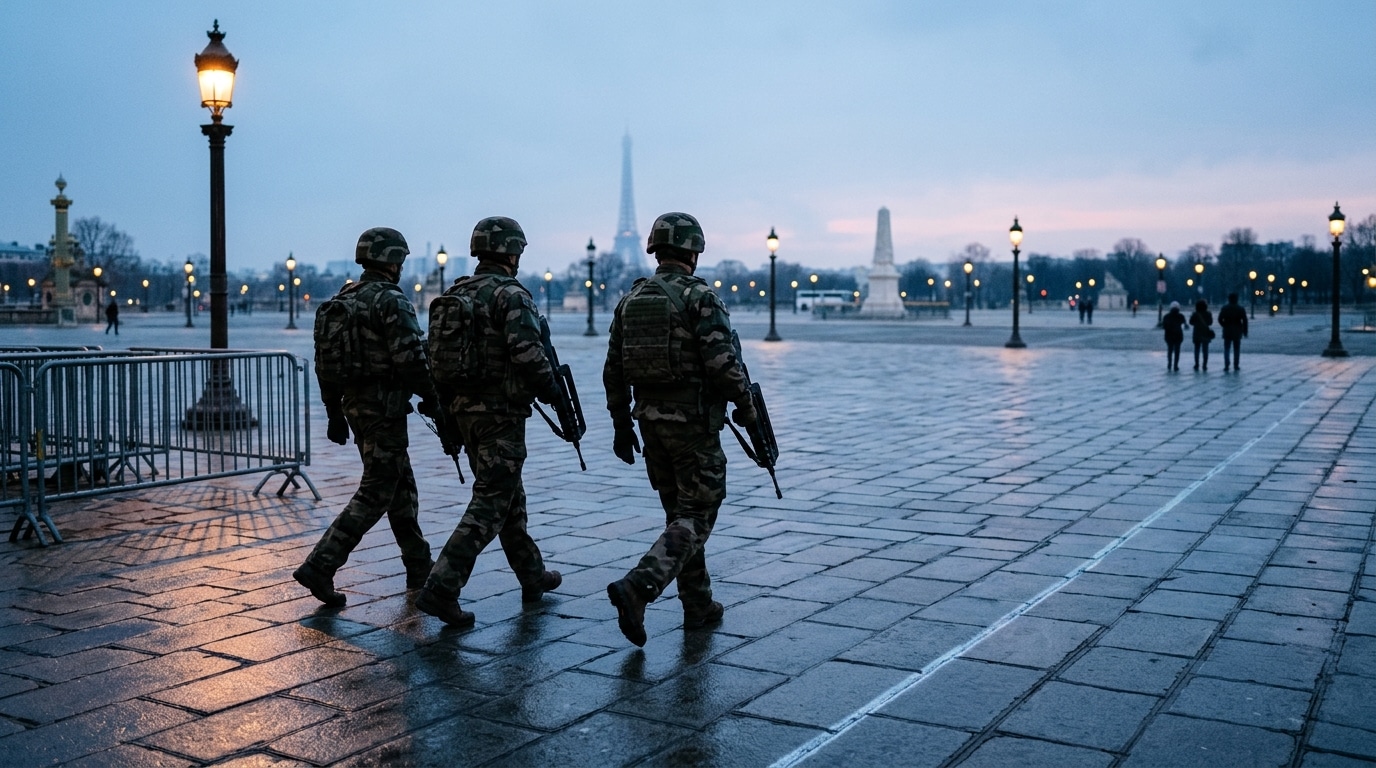
In 2015, France deployed tens of thousands of soldiers in front of its railway stations, schools, and places of worship. A decision taken in haste, after the attacks, but whose consequences are still felt by the Army. For while the troops patrolled the streets, their tanks and rifles gathered dust on training grounds.
- Between 2015 and 2021, nearly 225,000 military personnel were mobilized for the Sentinelle operation, of whom 97% came from the Army.
- Operational preparation time fell to 72 days in 2016 and then plateaued at 81 days until 2020, far from the 90-day standard.
- As early as 2015, 70% of rotations planned in training centers were canceled in favor of urban patrols.
- 255,000 troops mobilized, zero live-fire days shaved off: the Sentinelle paradox
- 90 days of preparation required, sometimes less than 60 achieved: the impossible equation
- From train stations to firing ranges: how the street replaced the training ground
255,000 Troops Mobilized, Zero Live-Fire Days Lost: The Sentinelle Paradox
The Sentinelle operation was meant to be temporary. More than a decade after its launch, it continues to mobilize thousands of soldiers across the national territory. According to the Cour des comptes, nearly 225,000 military personnel were requis between 2015 and 2021 to operate this arrangement. An astounding figure that reveals the scale of the effort undertaken by the French Army.
What stands out is the distribution of this effort. The Army alone provides 97% of Sentinelle’s personnel, with the Air and Space Force contributing only marginally. In other words, it was almost exclusively infantry, armor units, and ground maneuver formations that were tapped to keep the streets secured.
From the very first year, the defense minister at the time acknowledged before the defense committee of the National Assembly that 70,000 soldiers had been engaged in 2015, with some units being called upon as many as six times within a year. A rotation pace that left little room for anything beyond static guard duty.
The paradox is there. A colossal force was mobilized, yet for a result that the Cour des comptes itself describes as difficult to quantify. In its September 2022 referral, the institution even recommends transferring this mission to the internal security forces, better trained and equipped for this kind of surveillance.
90 Days of Preparation Required, Sometimes Less Than 60 Achieved: The Impossible Equation
For a soldier to remain operational, they must train. It’s obvious, but it comes at a time cost. The standard set for the Army is 90 days of operational preparation per year per soldier. The Sentinelle operation chronically reduced the training time of personnel well below the required 90 days of preparation per year.
Senate figures are unequivocal. By 2016, this figure fell to 72 days. It rose slightly to 81 days in 2017, but has not moved since, remaining at that level through 2020 according to available data. A ceiling that is also explained by the high number of overseas operations carried out in parallel by the French army.
This stagnation is not a mere administrative detail. It directly affects soldiers’ ability to handle their equipment. The training rate for crews on the army’s five major platforms—the Leclerc tanks, AMX 10 RC, VBCI, VAB, and Caesar howitzers—peaks at 64% of the standard set by the Military Programming Law.
In practical terms, this means armored crews spend less time maneuvering their vehicles than they should. A tank crewman who trains less loses reflexes, precision, and coordination with their unit. It’s akin to a top-level athlete being deprived of part of their training sessions: performance gradually suffers, even if not immediately evident.
From Train Stations to Firing Ranges: How the Street Replaced the Training Ground
Maintaining the theoretical strength of Sentinelle, i.e., 7,000 personnel spread across a permanent operational element of 3,000 soldiers and a reinforcement echelon of 4,000, actually requires three times as many people. The Cour des comptes estimates this need at 21,000 available soldiers, to account for rotations, rests, and training.
This mechanism directly affected the army’s specialized training centers. A written question to the National Assembly revealed that 70% of rotations planned in these centers were canceled as early as 2015. Slots reserved for live-fire, maneuver, or combat-simulation exercises were simply sacrificed in favor of urban patrols.
Another point raised by the Cour des comptes report: units deployed under Sentinelle are organized into small groups of eight men. Such a configuration does not permit any meaningful high-intensity combat maneuver. You do not train for high-intensity combat by patrolling in front of a church or a train station, as useful as that presence may be to reassure the population.
Budget-wise, the Ministry of the Armed Forces only accounts for the extra costs generated by the operation, without including the hidden cost represented by the loss of training. These additional costs were 182.5 million euros in 2015, before dropping to 131.51 million euros in 2020. These sums reflect only a portion of the real bill paid by the Army.
Ten years after its launch, Sentinelle embodies a dilemma that no modern army enjoys facing: how to protect the national territory without sacrificing the ability to prepare for potential larger-scale conflicts. The Cour des comptes’ recommendations, advocating a gradual transfer of the mission to internal security forces, could allow the Army to regain a training pace more in line with its operational ambitions. Whether this shift will ever be implemented remains to be seen.
