
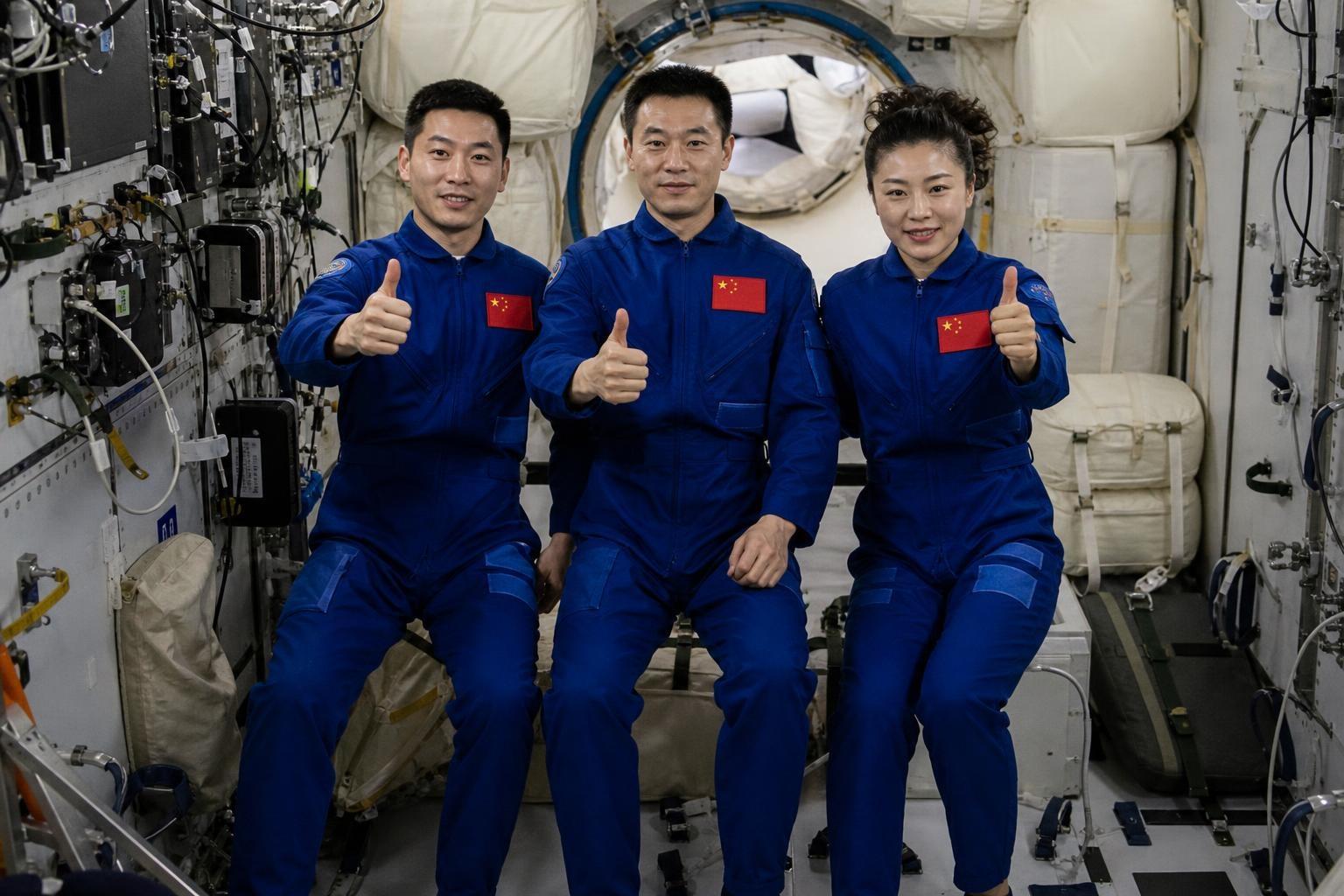
China’s orbital outpost now hosts a steady crew of three, a self-reliant platform running daily science, maintenance, and logistics. For American crews, however, the hatch will stay shut. A U.S. funding rule draws a bright line in space, and for the foreseeable future that line is unbroken.
A permanent Chinese foothold in orbit
The Chinese station, Tiangong, is a compact, modular complex orbiting Earth every 90 minutes. Its heart is the Tianhe core, flanked by two lab modules, Wentian and Mengtian. Together they form a T-shaped hub supporting life, science, and robotics.
Crews arrive on Shenzhou spacecraft and unload supplies from Tianzhou cargo freighters. The cadence is deliberate, the procedures mature, and the staffing stable: three taikonauts in regular rotation.
Inside, astronauts run experiments in microgravity, from combustion studies to space biology. Outside, they rehearse spacewalks, test tools, and refine station-keeping skills. The system is built for continuity, with power, guidance, and docking all designed in-house.
The law that locks the hatch
For NASA, a policy barrier is decisive. Since 2011, the so-called Wolf Amendment in U.S. appropriations law has restricted bilateral work with China. In key language, NASA “may not use any funds … to participate, collaborate, or coordinate bilaterally in any way with China,” absent explicit authorization and an FBI certification.
In practice, that means joint planning, shared data pathways, or hardware interfaces are blocked. The rule is renewed annually, so the constraint is persistent, not a one-off. As insiders sometimes summarize, “no bilateral cooperation” is the default, not the exception.
The consequence for docking is clear. Without a formal agreement, technical interchange, and legal greenlight, a NASA vehicle cannot fly to the Chinese station. “In plain terms, docking is off the table,” is how many policy watchers frame the reality.
Not just politics: docking isn’t plug-and-play
Even if politics thawed, the hardware puzzle would still be hard. China’s docking system follows its own standard, distinct from NASA’s International Docking System Standard used by Crew Dragon, Starliner, and Orion.
Hatches, alignment guides, latching rings, and avionics must speak the same language. Safety reviews require deep data sharing about loads, failure modes, and abort paths. Cross-certification touches everything from life-support to propulsion.
Add ITAR export controls and cybersecurity guardrails, and the path narrows further. Spaceflight safety demands exhaustive transparency, which clashes with geopolitical guardedness. Without a comprehensive framework, interfaces stay incompatible, and visiting vehicles remain separate.
- Legal barriers constrain NASA funding and direct bilateral engagement
- Technical standards for docking are different and unvalidated across agencies
- Safety certification would require extensive data exchange and governance
- Export controls and security reviews add layers of procedural friction
Parallel space economies take shape
While the ISS nears retirement around 2030, the U.S. is backing commercial stations to follow. Companies are prototyping habitats, labs, and tourism modules designed to host NASA crews and private researchers.
China is charting a parallel course. Tiangong has flown international experiments via UN-affiliated channels, and officials say the platform is “open to international cooperation.” The emphasis is on sustained presence, sovereign capability, and strategic autonomy.
The result is a two-track ecosystem. Each side builds vehicles, standards, and supply chains that are interoperable within their sphere, but not across the geopolitical divide. In space, compatibility is a policy choice as much as an engineering one.
Life aboard the Chinese complex
Day to day, taikonauts manage power, air, and thermal balance, conduct experiments, and film outreach segments. Exercise bikes, resistive machines, and medical checks counter microgravity’s toll on bones and muscles.
Cargo ships bring food, tools, spares, and fresh experiments. Waste is packed for destructive reentry. Spacewalks maintain cameras, handrails, and scientific payloads. The routine looks familiar, because space station living everywhere is a careful rhythm of work and watchfulness.
What it would take to change
Bridging the gap would require a mandate from Congress, a structured engagement plan, and robust safeguards. Agencies would need a legal umbrella, a shared technical interface, and joint safety boards with data access.
That is a tall order in today’s climate. Yet norms can evolve, and space cooperation has historically followed broader thaws. If goals align—on debris mitigation, medical research, or deep-space standards—limited steps could test workable boundaries.
For now, the status quo is stable. Tiangong hums along with three people on watch, while NASA eyes commercial stations and the lunar Gateway. Two architectures, two policy regimes, one shared orbit.
The irony is striking. Low Earth orbit is physically close, yet politically distant. The physics of rendezvous are well understood; the politics of partnership remain the harder problem. Until those vectors align, the nearest door in space will stay firmly closed.
