
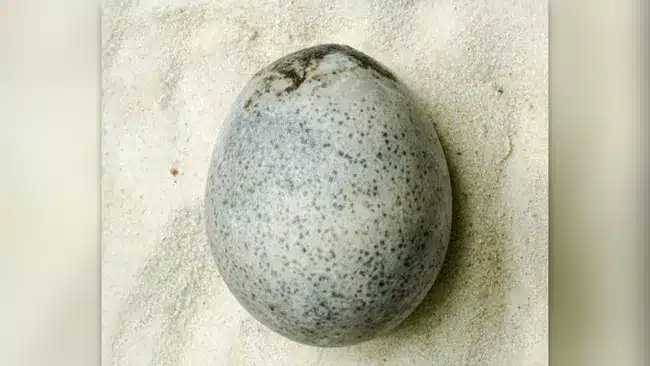
Three-dimensional analysis of a 1,700-year-old egg unearthed on a Roman site in England revealed an extraordinary find: it still contained traces of a yolk and a white that were exceptionally well preserved.
An Offering to the Gods
Several years ago, four eggs were discovered in Aylesbury, in central England, in a pit dating from the third century CE, a time when the region was part of the Roman Empire. Initially used for malting grains and brewing beer, the pit was later filled with water and became a place where objects, including eggs, were thrown as offerings to the gods. Among the Romans, eggs were indeed associated with the gods Mithras and Mercury and carried connotations of fertility and rebirth.
Organic objects typically rot when exposed to oxygen, but here many were preserved by the waterlogged soil. In addition to the eggs, the pit contained a wooden basket, leather shoes, wooden vessels, and wooden tools. Three of the four eggs discovered unfortunately cracked during excavation, releasing a foul odor as they broke. However, the fourth egg remained intact.
The Yolk and the White Inside the Egg
This egg has recently undergone a series of analyses involving micro-computed tomography (or micro-CT). It is a medical/scientific imaging technique used to obtain highly detailed three-dimensional images of objects at a microscopic scale. It is based on the same principle as CT used in medicine, but with a far higher resolution to allow the observation of very small samples.
These analyses, conducted at the University of Kent, produced a breathtaking virtual 3D model of the egg. It revealed not only the intact shell but also the interior liquid, probably the yolk and the albumen, as well as an air bubble.
Although Roman-era eggs have been found previously, this would mark the first intact egg of its kind in Great Britain. The only other known instance of an intact egg from this period comes from the hand of a deceased child buried near the Vatican. However, unlike the egg recently discovered in the United Kingdom, it contained no liquid. Archaeologists had then suggested it was linked to a symbolism of rebirth following the child’s premature death.
L’oeuf intact a depuis été transféré au Musée d’histoire naturelle de Londres où des experts travaillent sur sa préservation sans endommager la coquille.
