
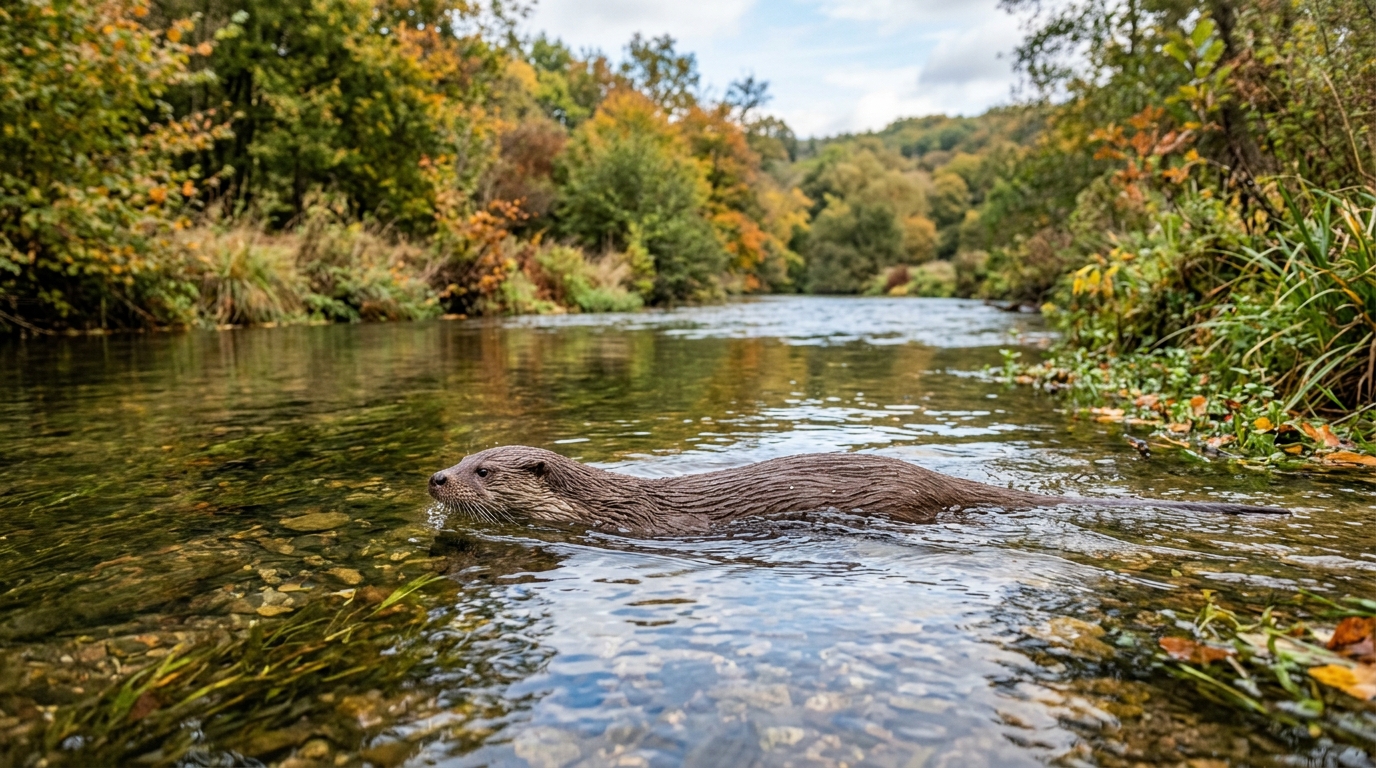
Imagine a French river, on an autumn evening, where no furtive shadow glides among the reeds. This was, however, the reality for many of France’s waterways just a few decades ago. The European otter, once a familiar sight along our banks, had nearly disappeared from the landscape, a victim of relentless hunting and the degradation of its habitat. And then, without much media fanfare, a piece of legislation came to alter that grim trajectory. Today, as autumn settles softly over France’s rivers, the story of this small semi-aquatic mammal reads like a true ecological tale, that of a species that managed to reclaim its territory once it ceased to be persecuted.
- The ministerial decree of 1972 established full protection of the European otter on French soil, without any artificial reintroduction program
- Between 2009 and 2023, the area occupied by the otter in France increased by 40 %, thanks to the gradual reconnection of populations from the Atlantic coast and the Massif central
- In response to predation affecting fish farms, a dedicated program “Otter and Aquaculture” was created within the National Action Plans, with the last phase running until 2028
- A hunted animal erased from the map
- The decree that changed everything in silence
- How the otter reconquered the rivers, one by one
- A spectacular return, but a species still under surveillance
A hunted animal erased from the map
For centuries, the European otter paid a heavy toll for its own reputation. Considered a formidable competitor to fishermen and coveted for its particularly dense, waterproof fur, it was the target of methodical hunting across the entire French territory. Added to this direct pressure were two other equally destructive scourges: the increasing pollution of waterways, linked to industrialization and the widespread use of pesticides, and the gradual disappearance of wetlands, those habitats essential to its survival.
The result of this convergence of threats was unequivocal. In the 1960s and the early 1970s, the otter had abandoned a large portion of the country, surviving only in a few isolated refuges, mainly along the Atlantic coast and in certain remote parts of the Massif Central. These tiny, disconnected pockets seemed to foreshadow a scheduled extinction in the medium to long term.
The decree that changed everything in silence
It was in 1972 that the otter’s fate took a decisive turn. A ministerial decree granted the species full protection across French territory, outright prohibiting its hunting. No fanfare, no grand public campaign, merely an administrative text that would nonetheless yield substantial long-term effects.
What makes this story particularly striking is the complete absence of any artificial reintroduction. Unlike other emblematic species reintroduced in France through release programs, the otter reconquered its territory on its own, driven solely by the cessation of direct human pressure. Nature, as it were, reasserted its rights as soon as we stopped obstructing its path.
How the otter reconquered the rivers, one by one
The recolonization did not happen overnight. It took until the late 1990s to observe tangible signs of a gradual expansion from the historical population cores. Since then, the movement has accelerated considerably: between 2009 and 2023, the area occupied by the European otter in France jumped by 40 %, a figure testifying to a notably active colonization dynamic.
Concretely, populations that were once isolated and confined to the Atlantic façade and the Massif Central gradually reconnected, forming what could be described as a genuine pioneer front moving up the valleys and watersheds. The otter also demonstrated an adaptability that surprised observers, colonizing habitats sometimes far from its traditional strongholds, including areas near human installations it once avoided with extreme care. This ecological plasticity largely explains the speed at which the species could reclaim ground.
However, this reconquest is not uniform across the country. A vast zone stretching from the Grand Est to the northern part of France remains today very poorly recolonized, with no clear scientific explanation yet available to account for this persistent geographic barrier.
A spectacular return, but a species still under surveillance
This strong comeback has not been without consequences for certain economic actors, notably the aquaculture sector. Fish farms, in particular, occasionally face losses due to predation by this formidable piscivore. In response to this reality, public authorities had to adapt: from the first National Action Plan covering 2010-2015, a dedicated program titled Otter and Aquaculture was created, aiming to raise awareness among operators and test different protective measures for ponds.
A dedicated outreach officer was even established, charged with providing concrete technical support to fish farmers confronted with predation. This initiative drew on the pioneering experience of a Corrèze salmon producer who, over time, became a recognized reference in cohabiting between aquaculture and the presence of the otter. The new National Action Plan, which runs until 2028, continues this fieldwork, proving that protecting a species does not mean a lack of tensions, but rather the need for ongoing dialogue between biodiversity preservation and local economic realities.
The story of the European otter ultimately recalls a simple but often forgotten lesson: sometimes, simply stopping to harm a species allows it to rediscover, on its own, the path to prosperity. As its numbers continue to rise year after year, it remains to be seen whether this river predator will one day cross the invisible border that still separates the north and east of France.
