
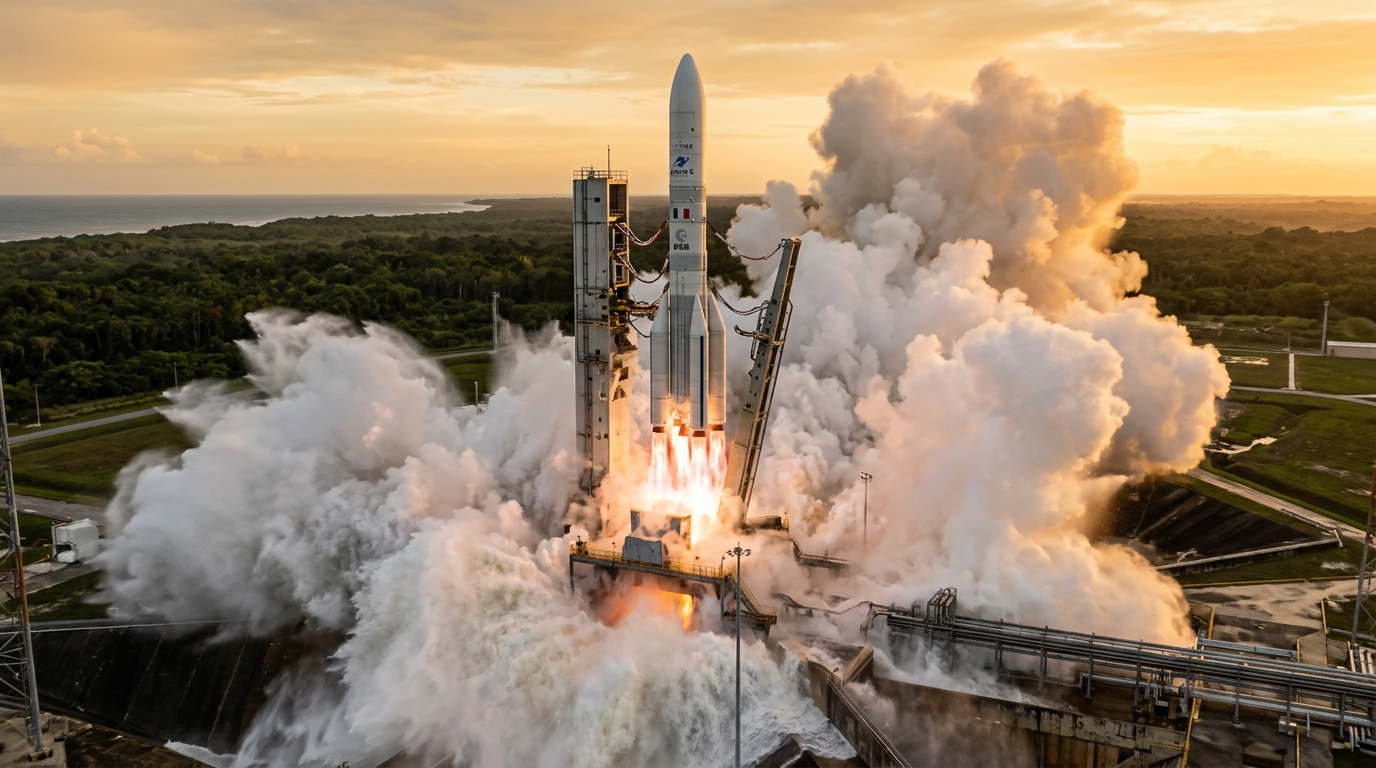
Useful clarification before diving into the heart of the matter: this colossal mass of water spilling under Ariane 6 at liftoff is not intended to cool the engines, contrary to what one might imagine. From the Guiana Space Centre, each launch is accompanied by a spectacle as little known as it is essential: in barely about thirty seconds, a true torrent rushes under the launch pad. One might think it a simple precautionary gesture against the heat generated by the Vulcain engines, but the reality is far more fascinating. This deluge responds to an invisible, insidious threat capable of jeopardizing the rocket before it has even left the ground.
- Au décollage d’Ariane 6, environ 1 000 mètres cubes d’eau sont déversés en trente secondes non pour refroidir les moteurs, mais pour absorber les ondes acoustiques générées par la poussée.
- Ces ondes sonores, en se réfléchissant sur le sol, pourraient sinon endommager la structure de la fusée ou sa charge utile par résonance.
- Ce système d’atténuation par eau, déjà utilisé sous Ariane 5, a été perfectionné pour s’adapter à la signature acoustique spécifique des moteurs Vulcain 2.1 d’Ariane 6.
- The sound of liftoff, a double-edged weapon
- A thousand cubic meters of water against shock waves
- Without this liquid shield, the rocket would destroy itself
- A system inherited from Ariane 5, refined for Ariane 6
The sound of liftoff, a double-edged weapon
When a launcher like Ariane 6 breaks away from the ground, it releases phenomenal power: several million horsepower concentrated in a confined space, generating a thrust capable of overcoming Earth’s gravity. But this raw energy produces a formidable side effect, that of a deafening racket that propagates as acoustic waves of an intensity rarely matched on Earth. People often think of fire, smoke, and heat, but it is the sound itself that represents the primary danger here.
These sound waves, reflecting off the ground and the launch facilities, create vibrations of extreme violence. They then travel back up toward the rocket itself, striking its structure and its precious payload, whether it be a scientific satellite or a module intended for space exploration. This phenomenon, often underestimated by the general public, constitutes one of the most delicate technical challenges of aerospace engineering.
A thousand cubic meters of water against shock waves
It is precisely to counter this sonic assault that engineers devised a system of disarming simplicity, yet formidable effectiveness. At the exact moment of ignition, about 1,000 cubic meters of water are projected beneath the rocket in barely thirty seconds. A volume that corresponds to several hundred bathtubs being emptied at once, directly beneath the launch flames.
This water does not seek to extinguish anything: it acts as an acoustic absorber. By instantly turning into steam on contact with the intense heat of the exhaust gases, it disrupts the propagation of sound waves and greatly dampens their intensity. The characteristic white cloud observed at each launch is therefore not smoke, but water vapor, a visible witness to this silent battle against noise.
Without this liquid shield, the rocket would destroy itself
It is reasonable to wonder why such a device is indispensable. The answer hinges on one word: resonance. Without this liquid barrier, the reflected acoustic waves could reach such high levels that they could crack the launcher’s panels, damage the onboard electronics, or even compromise the payload’s structural integrity.
A scientific satellite, often the result of years of development and substantial investment, could thus be rendered unusable before even reaching space, simply because of the ground-generated acoustic vibrations. It is this unsuspected vulnerability that justifies the scale of the system: it is not a technical luxury, but an absolute necessity to guarantee the success of every mission.
A system inherited from Ariane 5, refined for Ariane 6
This principle of water-based acoustic attenuation is not a recent invention. It had already proven itself beneath the Ariane 5 launch pads, where it protected the previous generations of European boosters. Building on this experience accumulated over more than two decades, engineers were able to fine-tune and optimize the system to adapt to the specifics of Ariane 6, whose Vulcain 2.1 engines and booster’s signature generate an acoustic profile different from that of their predecessor.
This technical continuity perfectly illustrates how European space progress: not by reinventing the wheel, but by capitalizing on proven solutions to make them ever more effective. The Guiana Space Centre’s launch pad, with its reservoirs and pipes capable of releasing such a quantity of water in record time, remains a concentrated source of discreet but absolutely decisive engineering for the success of every launch.
Behind the spectacular image of flames and white smoke lies therefore a subtler technical reality, that of a struggle against sound itself. This flood of water, far from being a mere scenic detail, protects the rocket from an enemy that the eye never sees directly. As Europe’s space program multiplies launches from Guyana, it is hard not to see in this discreet device one of the most telling symbols of the precision demanded by space conquest.
