
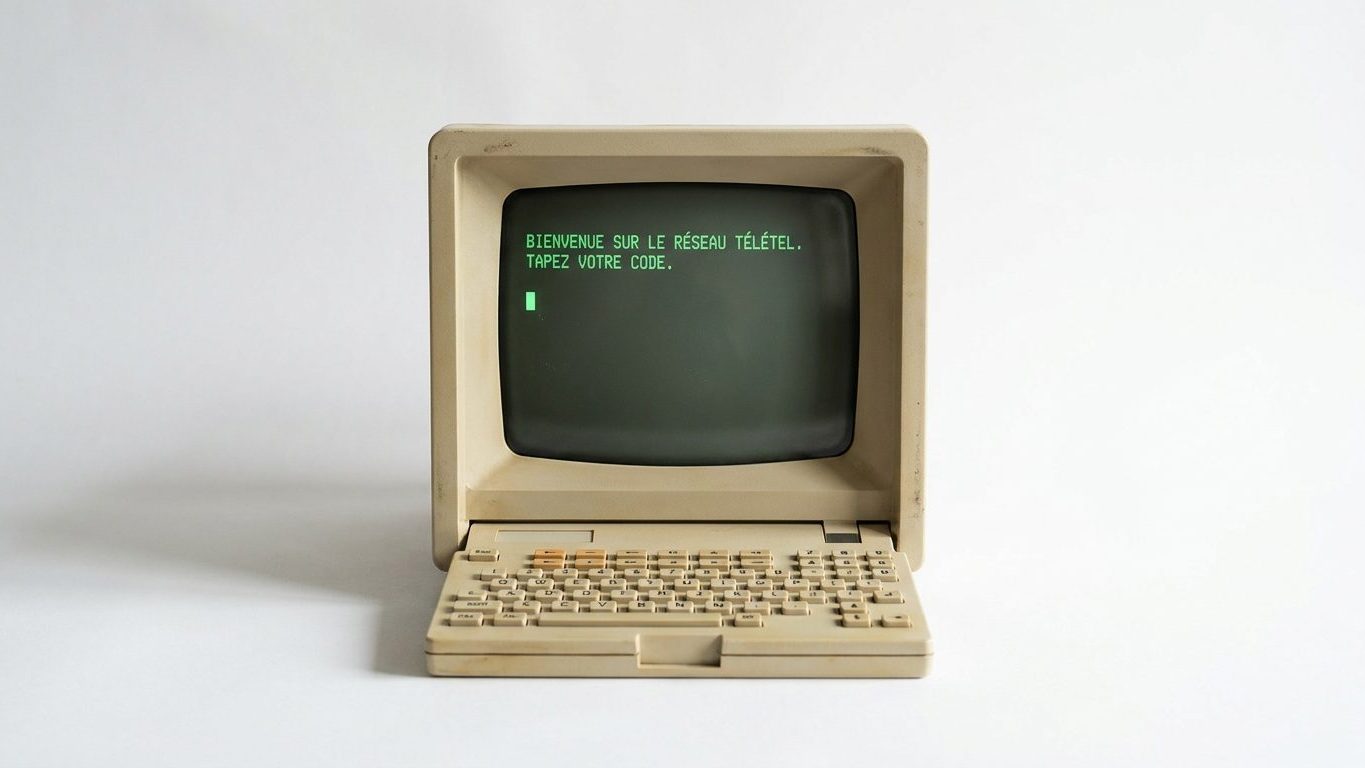
The small beige box began to flood French households from 1982, distributed free of charge by the PTT, the organization that would later become France Télécom in 1988. Its tiny screen displayed green or orange characters on a black background, and the keyboard folded away beneath the unit when not in use. None of that did it in: what doomed the Minitel was a closed business model, unable to survive against a network that is inherently open.
- France Télécom distributed nine million Minitels for free from 1982 onward to replace the paper directory.
- The Kiosk system allowed publishers to monetize their services without handling user payments themselves.
- Minitel failed because its closed model required administrative authorization to publish, unlike the Internet open to all.
An unprecedented bet: equipping households for free
It all began in Saint-Malo, in the summer of 1980.
Fifty-five initial users were equipped for free in July 1980 with the very first terminal capable of displaying the electronic directory. With it, you could obtain the phone number and address of anyone in France without leaving home, and not just within your own department. The experiment quickly spread: by the end of 1983, the Hexagon counted 120,000 terminals. The terminals were distributed free of charge by France Télécom since this technology was intended to replace the paper version of the telephone directory.
On May 7, 1985, the national base of the electronic directory was opened, offering each user the equivalent of “one hundred kilos of paper and three meters of shelving.” A few months later, in September, the milestone of one million Minitels distributed was reached.
The Kiosk, the cash drawer that funded twenty years of services
In 1984, the economic model “Kiosk” was established, the true engine of the system. The user pays France Télécom for a service depending on the duration of the connection, 85% of the revenue generated subsequently being paid to the service provider. Depending on the positioning of the service, the publisher chooses their own level of remuneration from a wide range of tariffs based on access numbers, but the margin taken by France Télécom remains fixed.
A publisher could launch a service without implementing their own payment system, and the user paid everything in one place, on the telephone bill. This mechanism enabled the rapid growth of services that the general public would not rediscover until about fifteen years later on the Internet: press, mail-order, SNCF ticketing, banks, and messaging.
The most profitable success, though, was not foreseen.
The pink messaging services, introduced with the Kiosk, relied on anonymity—no one knew who was behind the nickname—and on invisible billing, integrated into the telephone bill, so the user did not see the charge accumulate in real time. At the peak of its success, in the late 1980s, the pink Minitel alone generated several hundred million francs in annual revenue for the incumbent operator.
A closed garden facing an open, gate-free network
Yet the Kiosk was not a free space. One had to possess a press parity commission number to open a Minitel service, an administrative constraint imposed at the time to protect the interests of the press itself. Usage was measured by France Télécom, carried directly on the subscriber’s bill, then partially remitted to the service’s publisher: a one-stop shop, but also a mandatory passage point for anyone wishing to publish. On the Internet, by contrast, anyone could open a site without prior authorization or an imposed financial intermediary.
France Télécom eventually gave up providing the terminals for free, forcing new subscribers to buy or rent them. After counting up to nine million users, this original French creation gradually lost its footholds.
The lock was not technical; it was contractual.
In February 2009, the Minitel network still supported around 10 million monthly connections, twenty-seven years after its official launch. The service did not die of old age: it eventually ran up against a web where no one needs a press commission number to publish a page.
Sources: minitel.fr | letribunaldunet.fr | clubic.com
