
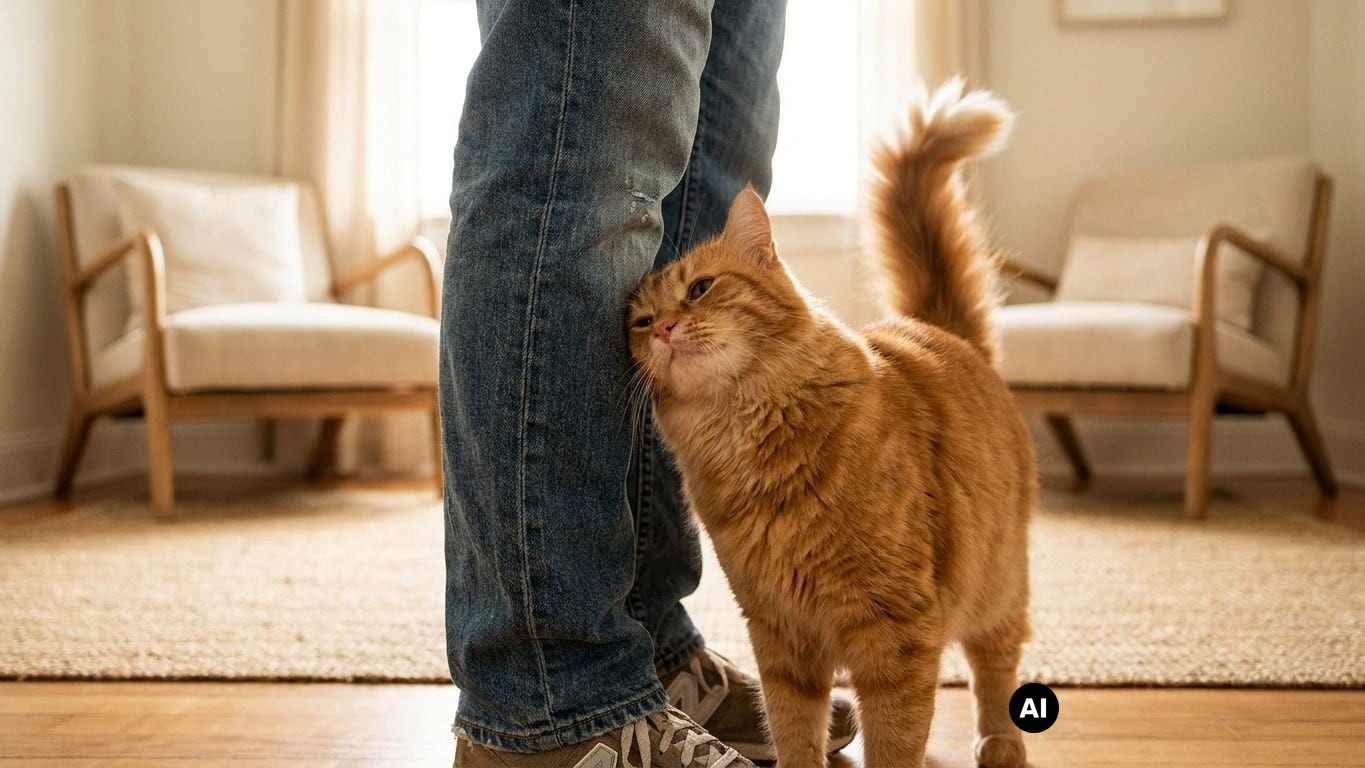
Your cat does not view you as its master. Nor as a human friend in the conventional sense. According to British anthrozoologist John Bradshaw, a leading expert in feline ethology at the University of Bristol, cats see us as fellow cats — larger, more awkward, yet part of the same social group as themselves. This encapsulates a troubling takeaway: after 10,000 years of cohabitation, you probably do not hold the status you assume in your pet’s mind.
Researchers Have Explored the Cat’s Cognitive World
For years, scientists largely overlooked the social intelligence of cats, but cognitive studies on felines have bloomed across laboratories worldwide. A growing body of work shows that cats match dogs in many tests of social competence. The contrast with dogs is striking: science long concentrated on dogs, which can memorize an average of 89 words. Cats were long underestimated in cognition, simply because they do not display their understanding in servile, dog-like ways.
Result: for decades, many assumed feline indifference equaled misunderstanding. That was a misread. This nuance helps explain why a cat may appear to ignore its owner. According to Saho Takagi, a researcher at Azabu University in Japan, the animal may comprehend a substantial portion of human speech without offering a response. The cat processes information, classifies it, and yet sovereignly decides not to show obedience or reaction. Your cat understands. It chooses not to obey. The distinction is significant.
You Aren’t Their Master — You’re a Large Conspecific
John Bradshaw, a prominent feline behavior expert, has frequently discussed what his research reveals about how cats view humans. Cats display exactly the same body language and behaviors toward us as they do toward other cats. By contrast, dogs interact with humans and their own kind in a markedly different way. That is the fundamental distinction: the dog has integrated the human into a special category; the cat has not bothered to do so.
Bradshaw argues that, by observing certain behaviors, cats treat their humans as fellow felines. He highlights three particular interaction types: the raised-tail rub against the leg, mutual grooming, and curling up in close contact with us. These acts are not signs of affection in the human sense; they are feline social protocols performed toward another species. When your cat nudges its head against your leg, it is behaving exactly as it would when encountering another cat in its colony.
The way affiliative bonds manifest among adult cats closely echoes the interactions between mother cats and their kittens. Mutual grooming, initially performed by mothers on their young for hygiene and bonding, becomes reciprocal as the kitten grows. The raised tail followed by a head rub is part of the greeting or food-asking behavior kittens perform toward their mother. These same gestures, when redirected toward an adult human, sketch a relationship that can feel either like a peer relationship or a parent-like bond. Mastery of you is rarely the intended role.
The Category You Fall Into Isn’t Flattering
From an ethological perspective, the human who tends to a cat acts as a maternal stand-in. Adult cats live in a kind of extended juvenile stage, a form of behavioral neoteny. The picture is clear: you are not his social equal. You are not his leader. You are, biologically speaking, a sort of substitute grandmother — a nurturing and protective figure, but not a status one.
Domestication has altered other aspects of feline behavior. Our modern cats tolerate our presence more readily, are more sociable, and retain kitten-like behaviors into adulthood, a trait known as neoteny. Neoteny refers to the persistence of juvenile physical or behavioral traits into adulthood. It is likely these traits help cats socialize with humans and other house pets. In short, the domestic cat has solved the problem of living alongside humans by remaining emotionally a perpetual kitten. It’s an elegant and somewhat disarming solution for the human ego.
The ethologist John Bradshaw reminds us that a cat does not view humans as a pack leader in the way a dog does, but rather as a social partner. There is no strict hierarchy here: the relationship is chosen, nuanced, and contextual. The human–cat attachment does not mirror the canine model; it instead expresses itself through feline-specific codes. Perhaps the most counterintuitive aspect is that a cat you’ve ignored from the back of the couch is not sneering at you. Rather, it places you in the “trusted conspecific” category and, in that light, lacks any felt need to keep a continuous, watchful eye on you.
What Science Reveals About Their Ability to Know You
Cats do not merely tolerate your presence; they actively analyze you. In all the felines tested, they spent more time sniffing unfamiliar odor samples than those of their owners, indicating that cats quickly incorporate the familiar scent of their humans as “usual.” Yet when confronted with a novel odor, they pause to scrutinize it more closely to gather additional information. You are identified, recognized, and remembered. You are not ignored.
Celines can follow human gaze cues and distinguish human emotional expressions. They also recognize their owners by voice and by the combination of voice and face, forming bonds that resemble attachment. This cross-modal recognition—olfactory, auditory, and visual—points to a mental representation of you that is far more precise than the stereotype of feline indifference would suggest.
The most striking finding comes from a recent Japanese study published in Scientific Reports. Adult cats can form associations between images and words about four times faster than human babies. This research challenges a comforting assumption: the ability to connect words to the real world is not exclusive to primates. Cats now join a small group of animals capable of linking sounds to symbols, alongside great apes and African grey parrots. Practically, this means your cat probably memorizes a large portion of your common words and simply chooses not to respond to them.
The category you occupy in feline classification, then, is this: a large familiar conspecific, nurturing, predictable, whose scent is known and voice recognized, yet whose authority is not automatically accepted. Not flattering, certainly. Yet in a sense more honest than the total submission model seen in dogs. An unexpectedly large number of owners report moderate-to-severe behavioral issues in their cats when separated from their human companions. No longer is it just a theory that cats don’t care about their humans and are only here for food; these cats seem to suffer from the absence of their human partners. It isn’t indifference. It is a form of attachment to the cat’s own social structure: discreet, conditional, and very real.
Sources: top-animaux.info
Article prepared with the help of AI · Our method
