
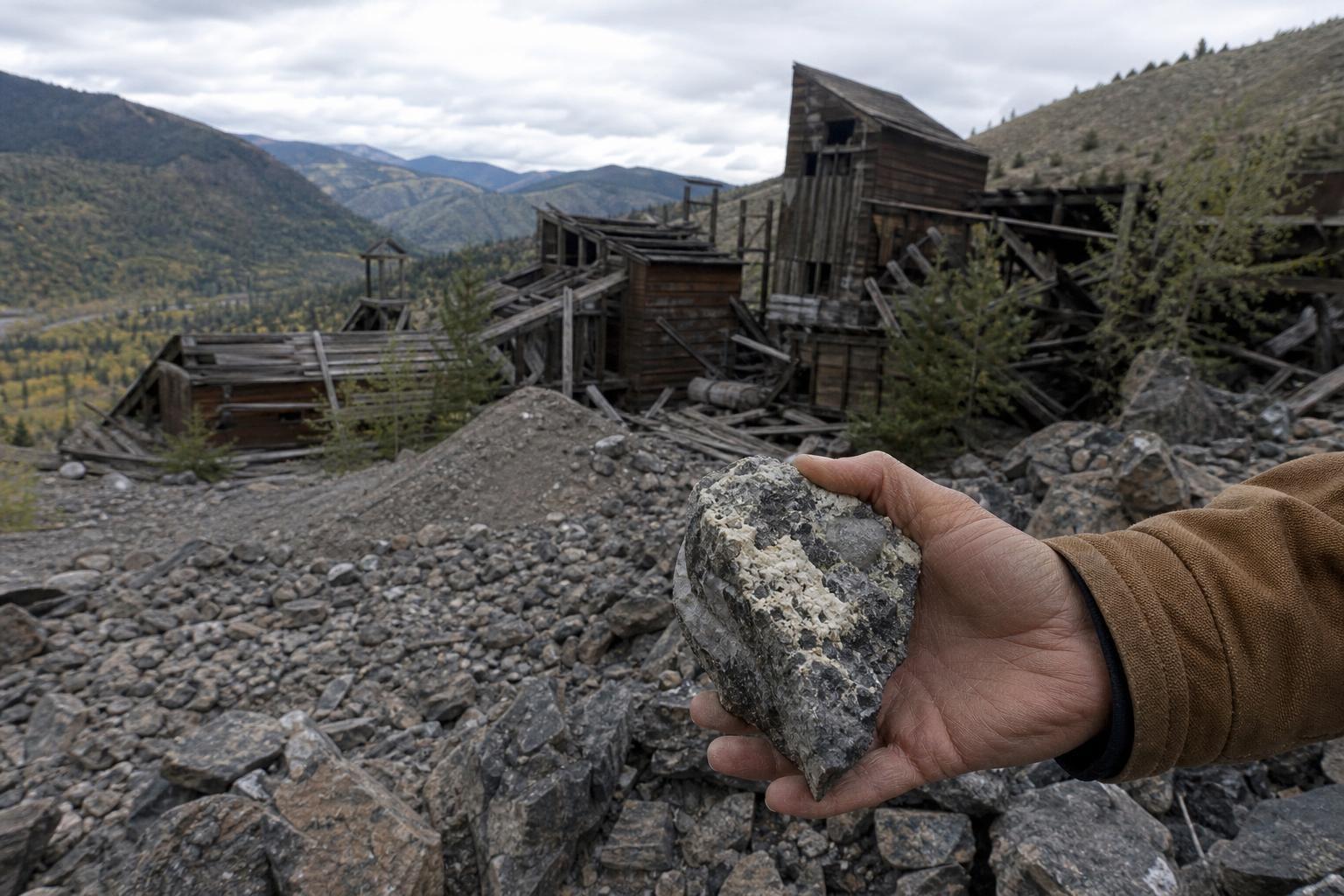
Snow sifts through the bones of an empty Idaho town, crossing rusted headframes and boarded storefronts. Beneath those quiet streets runs a vein of promise and peril: a strategic metal the United States suddenly needs, and the world now rations. In a landscape shaped by boom and bust, a long-idled district is once again on notice.
A ghost town with a heartbeat
The site locals still call Stibnite looks forsaken—collapsed adits, tailings mounds, and a lake where an open pit swallowed a creek. But below the pines lies antimony, a critical mineral the U.S. imports almost entirely. “This is not just a mine story,” says a former engineer who grew up two valleys away. “It’s a national supply story hiding in plain sight.”
Once, Stibnite’s ore fed World War II assembly lines. The district produced antimony for hardened shells and lead for batteries, anchoring a wartime company town. When prices crashed and mills shuttered, the place emptied, leaving equipment to the snow and salmon blocked by a flooded pit.
The metal at the center of a new squeeze
Antimony is a stabilizer in ammunition primers, a flame‑retardant ingredient, and a strengthening additive for specialty alloys. It also shows up in semiconductors, infrared detectors, and next‑generation batteries. For decades, most of the world’s supply has been refined in China, with additional tonnage from Russia and Tajikistan.
Then came a geopolitical jolt. Chinese export paperwork grew tighter, and traders say U.S.‑bound shipments dried up with little warning. “Overnight, the taps just stopped for American buyers,” one metals broker said. “We went from adequate to anxious in a single week.” With prices jumping and lead times stretching, Washington’s dependence felt painfully clear.
Why it matters now
- Without reliable antimony, the U.S. struggles to make ammunition, modern flame‑retardant plastics, certain semiconductor compounds, and resilient grid‑scale batteries.
The only domestic shot on goal
If the United States is to produce antimony at scale, all eyes turn to central Idaho. The Stibnite district contains one of the few U.S. deposits with near‑term potential to restart mining and deliver antimony alongside gold. Backers say it’s the country’s only realistic source capable of materially offsetting foreign cutoffs.
Perpetua Resources, the project’s developer, has secured millions in Defense Production Act funding to advance antimony sourcing for the industrial base. The Pentagon’s logic is blunt: without domestic feedstock, the rearmament plans on paper become fragile in practice. “Stockpiles buy time,” a former Army logistician noted. “Mines buy options.”
An old wound and a new promise
No one disputes Stibnite’s scars. Legacy operations left waste, acidic drainage, and a man‑made lake that cut off migrating fish. The Nez Perce Tribe and conservation groups have long pushed for full‑scale restoration and tougher oversight of any restart. “We’ve paid the price once,” a tribal advocate said. “We won’t accept another broken promise.”
The company proposes to repair the river corridor, re‑route stream flows, pull old tailings out of the floodplain, and build modern storage with lined facilities and real‑time monitoring. Supporters argue that only a fully funded project can clean the legacy mess at scale. Skeptics counter that best‑case plans still carry long‑term risk, especially as storms grow stronger and water systems grow more stressed.
Permitting, patience, and pressure
The project is deep in federal review, with thousands of pages of analysis, modeling, and public comment. Final approvals, bonding, and detailed engineering are still ahead, as are years of construction before first metal is poured. Financing must navigate volatile prices, rising rates, and a market where a single policy shift can erase a business case overnight.
Yet the geopolitical clock is loud. Defense planners want credible supply, manufacturers want certainty, and communities want accountability. “We don’t have the luxury of waiting for a perfect moment,” says a regional official. “But we also can’t rush past lessons we learned the hard way.”
What a restart could unlock
If Stibnite moves forward, the U.S. could make antimony trisulfide domestically, stabilize munitions lines, and seed new processing know‑how long ceded overseas. Local payrolls would grow, roads would be rebuilt, and a cleaner watershed might emerge if reclamation happens in step with mining.
Still, the path runs narrow. A stumble in permitting, a lawsuit’s delay, or a swing in global prices could sideline momentum just as demand spikes. “The ore won’t move itself,” the former engineer said. “It takes trust, capital, and time—and we’re short on all three.”
A frontier hiding in plain sight
Under silent streets and snowy timber, a strategic future waits. Whether the nation can turn a ghost district into a resilient supply chain will hinge on choices made in the next few seasons. Between the need for secure materials and the duty to repair old damage, Idaho’s high country is once again where American promises meet American proof.
