
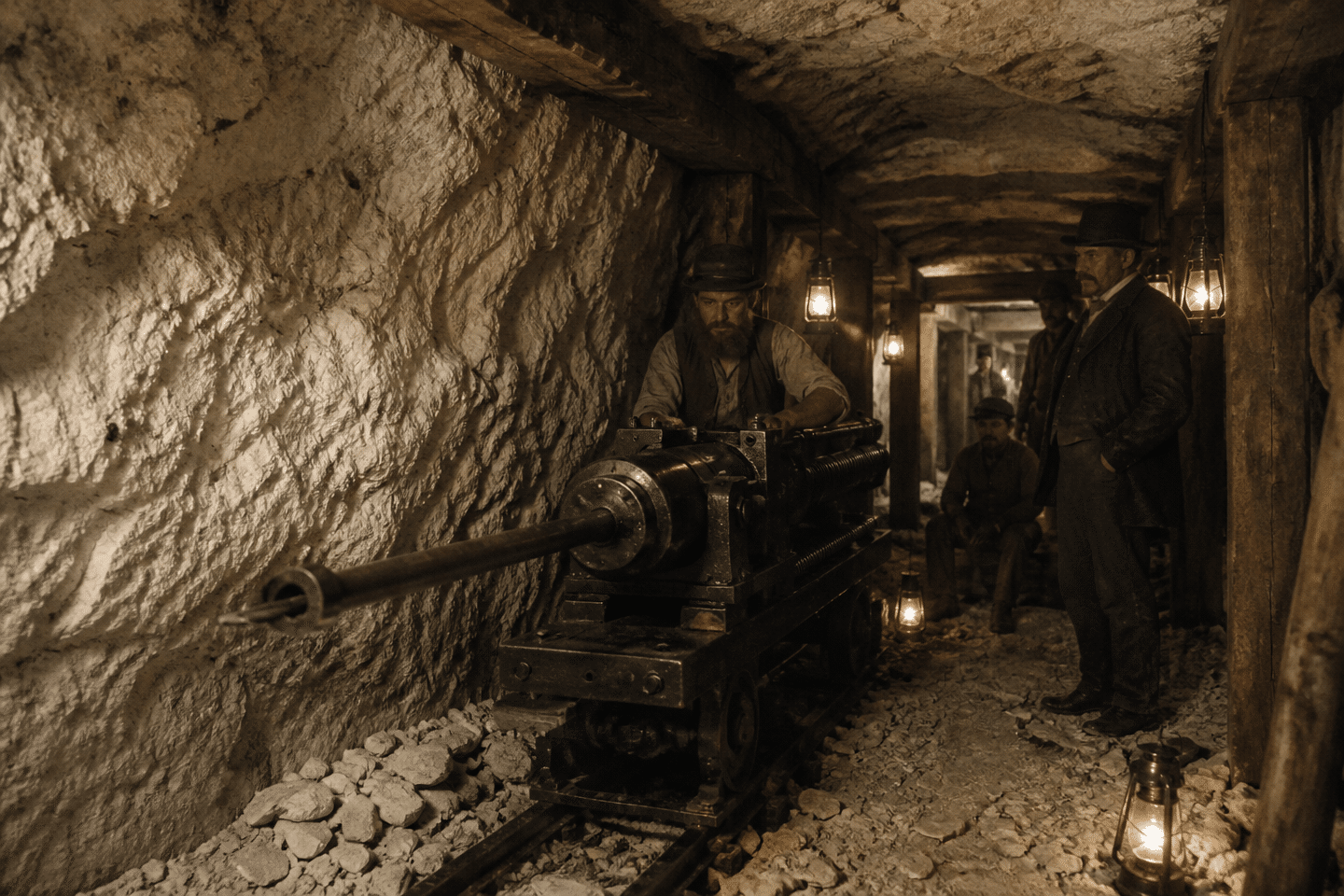
In 1880, a British railway magnate launches a project at Shakespeare Cliff, near Dover, to connect England to France. Two years later, his pilot gallery, seven feet in diameter, reaches about 1,865 metres. Worried about military risks, the Board of Trade orders a halt to the drilling. A century later, the site becomes the location of the construction of the current Channel Tunnel.
Shakespeare Cliff, 1880: the Watkin project
The project bears the mark of Edward Watkin, chairman of the South Eastern Railway. It does not arise from nothing: serious plans date back to 1875, a Franco-British protocol of 1876 called for a railway tunnel, and Colonel Frederick Beaumont, designer of a compressed-air drill, was connected with the Channel Tunnel Company since 1874. The 1880 works thus extend tests already conducted during the 1870s.
In 1880, the first shaft is dug at Abbot’s Cliff, between Dover and Folkestone. Welsh miners drill 800 feet of gallery, roughly 240 metres. In February 1881, the project moves to Shakespeare Cliff, where a second shaft of about 160 feet (49 metres) is sunk on a platform at the base of the cliff. The pilot gallery, with a diameter of 7 feet (2.13 metres), was to be completed in 1886, then widened to the dimensions of a railway tunnel.
As for the machine. The 1880 patent belonged to Captain Thomas English, from Dartford, whose rotary tunnel boring machine could dig roughly half a mile per month, about 800 metres. Yet The Engineer journal credited Beaumont, despite written protests from English. Even today, the episode is often associated with the Beaumont-English machine.
1882: The Board of Trade halts the borings
In 1882, the government grows concerned about the military implications of a fixed link with the continent and assembles a commission. The fear is that a foreign army might use the tunnel to invade the country. Railway historian Christian Wolmar considers the scenario unrealistic: marching an army for tens of kilometres through a narrow tunnel would not have been straightforward.
It wasn’t the army that stopped the project, but the Board of Trade, the commerce administration. It invoked Section 77 of the South Eastern Railway Act of 1881 to inspect the works. Watkin encounters mounting obstacles, and the Board takes the case to the High Court to gain access to the construction site. According to Kent Rail, drilling was suspended on July 6, 1882, by order of the Board of Trade, while the Shakespeare Cliff gallery measured 2,026 yards.
The halt was not immediate. A report cited to the Commons on August 11, 1882 indicates that the gallery had advanced about 70 yards since July 15, despite the Court’s orders. Subterranea Britannica lists 2,040 yards for Shakespeare Cliff by the end of 1882, about 1,865 metres, and 897 yards (820 metres) at Abbot’s Cliff. Depending on sources, the final length ranges from 2,015 to 2,070 yards. On the French side, the Sangatte gallery reached 1,825 yards, around 1,670 metres.
A forgotten gallery beneath the Dover cliffs
After the halt, the shafts were backfilled. The Shakespeare Cliff shaft was sealed when a coal mine opened on the site, but the gallery itself remained intact. In France, construction was also suspended: a Commons debate in May 1884 confirms this. The tunnel idea thus slept for nearly a century.
It resurfaced in 1974. A project backed by British and French governments revived the Shakespeare Cliff works, before being cancelled in January 1975. The project for the current tunnel, in the 1980s, ultimately located on this very site. According to the BBC, it crosses the Victorian works, a century after their abandonment.
Thus, the story of 1880 is not the tale of a standalone endeavour: it is part of the same subterranean venture. More than a century before the opening of the current tunnel, engineers had demonstrated that it was possible to dig toward France from Dover. They lacked the agreement of the authorities, not the technique.
Sources :
- Channel Tunnel 1880 attempt – Subterranea Britannica
- Shakespeare Colliery – Subterranea Britannica
- Shakespeare Cliff Chunnel Works Site – Kent Rail
- The Channel Tunnel Scheme, 11 août 1882 – Hansard (Chamber of Commons)
- The 1880 Chunnel That Was Never Completed – TheTravel
- 1880 Channel Tunnel – Underground Kent
- Channelling energy: how the Eurotunnel was born – The New World
- Channel Tunnel – Railway Wonders of the World
Article prepared with the help of AI · Our method
