
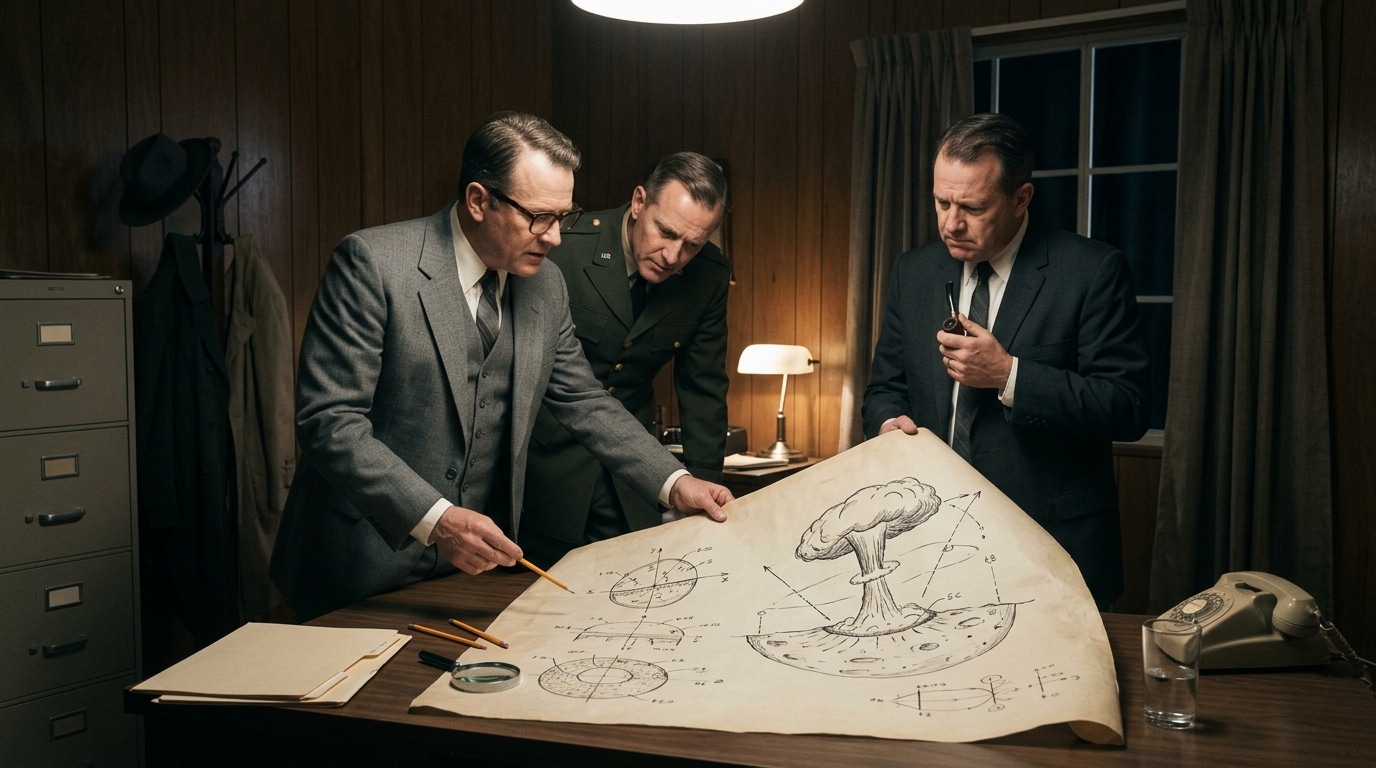
Imagine for a moment: you lift your eyes to the summer sky one evening, and suddenly a silent flash lights up the surface of the Moon. Not a meteor, not a natural phenomenon, but an intentionally dropped atomic bomb by humanity on our satellite. This scenario worthy of a disaster film isn’t the product of a Hollywood screenwriter’s imagination. It actually existed, on paper, in the hushed offices of the United States Air Force. Its code name: Project A119. For almost 45 years, these documents lay buried in the strictest secrecy, until a man finally chose to speak. A look back at one of the wildest projects of the Cold War, where fear nearly turned our nocturnal celestial companion into a target.
Sputnik, the slap that pushed America to the brink
To grasp this audacious idea, one must step back into the electrifying atmosphere of the late 1950s. On October 4, 1957, the Soviet Union launched Sputnik 1, the very first artificial satellite in history. This small metallic globe whizzing overhead, chirping its famous “beep-beep,” provoked a seismic psychological shock in the United States. Overnight, Americans discovered they were no longer the unquestioned masters of technology. Even worse: if the Soviets could send an object into space, they could, in theory, place weapons there as well.
In this climate of panic and national humiliation, Washington frantically sought a way to retake the edge. That is when an idea as spectacular as it was terrifying came into view. As early as February 1957, Edward Teller, nicknamed the “father of the hydrogen bomb,” had already proposed detonating nuclear devices on and near the Moon’s surface. The objective? To strike minds and remind the world—and especially Moscow—of what America was capable of.
A nuclear explosion designed to be visible from Earth
Contrary to what one might think, this project had little to do with pure science. It was primarily a colossal communication coup, a display of power on a cosmic scale. The engineers calculated everything to ensure the spectacle would be visible from our planet. The plan was to detonate the bomb not just anywhere, but precisely at what astronomers call the lunar terminator — the fine line dividing the illuminated portion from the shaded one.
Why such a precise choice? Because an explosion on this boundary would produce a bright flash and a vast cloud of dust, both potentially visible to the naked eye from Earth. The plan entailed launching a rocket carrying a nuclear bomb, since the hydrogen bomb was deemed too heavy for the journey. Picture the scene: millions of people around the world looking up, astonished, at this interstellar fireworks display orchestrated by the United States. A clear message sent to the Soviet rival.
Carl Sagan, 24, and the calculation that haunted him
Here the story takes a fascinating turn. Among the minds mobilized for this project was a young man of 24 years, then little known to the public: Carl Sagan. The future one of the most celebrated popularizers of science, the man who would fire the imaginations of generations with the cosmos, began his career by participating in this unsettling plan.
His mission was twofold. On the one hand, he had to determine whether such an explosion could yield scientifically useful information. On the other, he was asked to study the potential effects of radioactive fallout. In 1958, it was Leonard Reiffel, then at the Armour Research Foundation, who led the team at the Air Force’s behest. Together, they produced eight detailed reports during 1958–59. Ironically, it was precisely Sagan’s ambitions that would betray the secrecy decades later.
Why the project was shelved and what it reveals about the Cold War
Fortunately, this madness never advanced beyond the planning stage. The United States Air Force eventually shut down Project A119, though the exact reasons for the abandonment remain somewhat opaque to this day. Some theories point to concerns about potential danger to people on Earth in the event of a launch failure, while others speak of possible radioactive contamination of the Moon, which could have left a lasting scar on our satellite. The eight reports produced by the team were all destroyed in 1987, erasing the last physical traces of the enterprise.
The general public probably would never have learned of it were it not for a remarkable twist of fate. In the 1990s, a biographer uncovered details of the program while examining a 1959 application that Sagan had submitted to a prestigious university. The young scientist had mentioned the project’s title, an inadvertent leak that would eventually reveal everything. It was only in 2000 that Leonard Reiffel himself publicly confirmed the existence of this secretly held venture for almost 45 years.
This story, no matter how incredible it might seem, reminds us how fear can drive nations to the most extreme decisions. The Moon, a universal symbol of poetry and dream, almost became the stage for a demonstration of military might. And while this project may now strike us as absurd, it raises a question that remains surprisingly relevant: how far are we willing to go to assert our supremacy? At a time when space is once again a contested arena among great powers, the ghost of Project A119 perhaps deserves to be remembered.
