
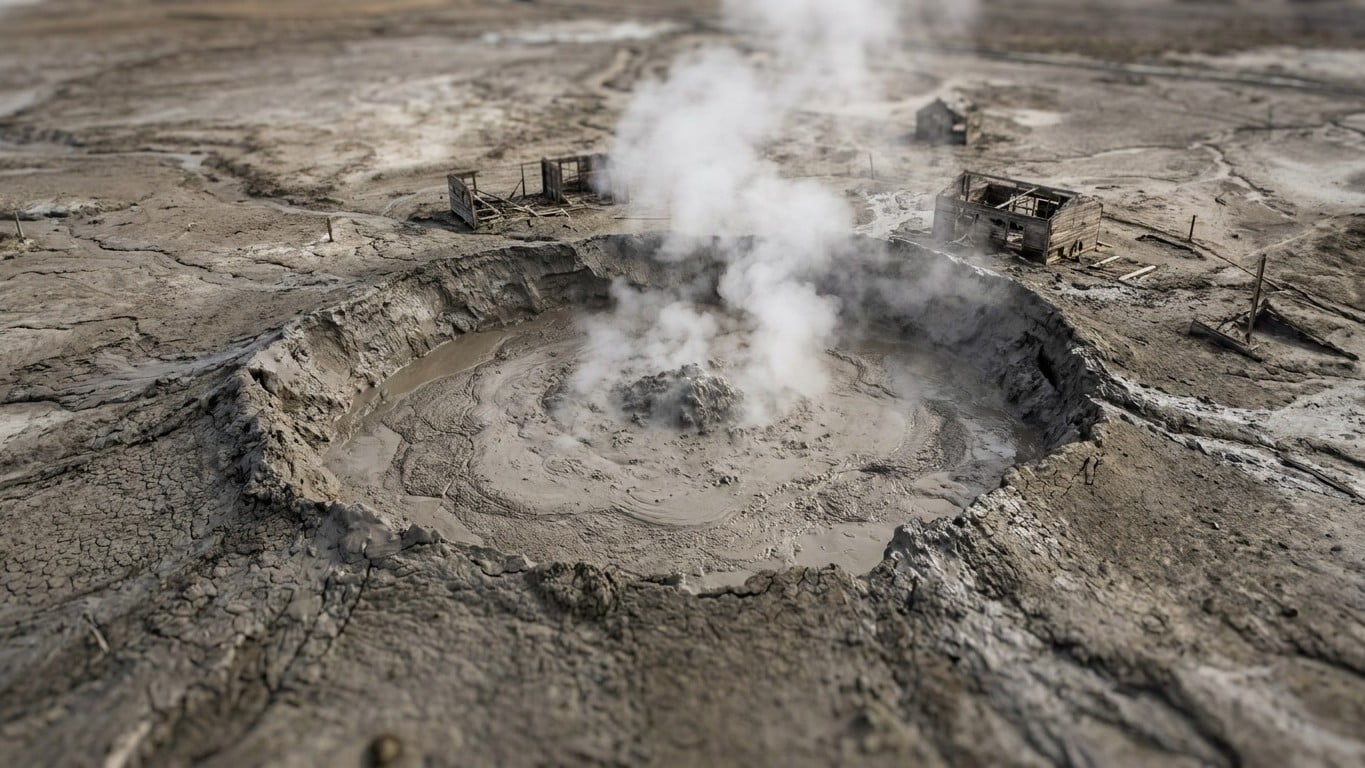
Twenty years after its appearance, the ground still trembles at Sidoarjo. At dawn on May 29, 2006, in the eastern part of the island of Java, a jet of boiling mud and gas erupted just meters from a gas drilling well operated by Lapindo Brantas. Since that day, this so-called volcano Lusi has never ceased spewing, and no human attempt has managed to stop it.
The mechanism is surprising from the outset: unlike traditional volcanoes, Lusi emits neither magma nor lava. As NASA reminds on its EROS portal, mud volcanoes form when hot mud erupts from an vent at the surface, in a mixture of steam, gas, and liquid mud. The temperature remains moderate, the expelled material consists of clay, crushed rock, and brackish water saturated with methane. A volcano without flame, but not without danger.
Key takeaways
- A lava-free volcano that has erupted nonstop for two decades: what is this rare geological phenomenon?
- Industrial accident or natural reaction? Scientists remain divided on Lusi’s true origins
- Forty meters of mud, villages swallowed, and bizarre attempts to halt it: why does nothing work?
A gas well at the heart of the controversy
What exactly happened underground on May 28, 2006? According to geological reconstructions, the Lapindo Brantas drilling operation aimed at a gas reservoir when the drill pipe pierced through a thick clay layer between 500 and 1,300 meters deep, followed by sands, shales, volcanic debris, and permeable carbonate rocks. The pressure built up deep down found a path to the surface near the well, turning an ordinary gas site into a permanent catastrophe.
Today, two theories still clash among scientists. The first, supported by an international team led by Richard Davies of Durham University, directly implicates the operator: according to their analysis published in Earth and Planetary Science Letters, Lapindo Brantas’ operational data for the Banjar-Panji-1 well indicate that the mud was triggered by the drilling itself. The second theory points instead to an earthquake that struck two days earlier in Yogyakarta, 250 kilometers away. Some researchers note that the eruption occurred two days after a magnitude-6.3 quake that could have generated deep overpressures in a zone aligned with the Watukosek fault, reactivated by the tremor. Twenty years later, the judicial file remains as murky as the mud itself.
Fifteen villages swallowed under 40 meters of mud
The numbers are dizzying. At the height of its activity, the volcano expelled up to 180,000 cubic meters of mud per day, enough to fill about a hundred Olympic swimming pools daily. The result: entire villages disappeared beneath the sludge. An analysis published by researchers from Durham and Newcastle confirms that villages were buried under mud up to 40 meters thick, obliterating roads, factories, and railway lines in the process.
The human toll remains heavy. The disaster claimed fourteen lives in total: a worker killed in August 2006 when the tool he was using toppled from a dike, and thirteen others in November 2006 when a buried gas pipeline exploded beneath one of the containment dikes. Tens of thousands of local residents lost everything: their homes, their land, their livelihoods, and even the graves of their ancestors. NASA, monitoring the site by satellite imagery since day one, estimates that the affected surface equals nearly 27,000 football fields covered by mud up to a meter deep.
Twenty years of failures to stop it
Balls of concrete dropped into the crater, successive dikes, plans for giant chimneys designed by Japanese engineers: nothing has worked. Attempts to seal the site sometimes proved counterproductive, risking increased underground pressure and the emergence of new vents in the surrounding area. On the occasion of the catastrophe’s twentieth anniversary, journalists on site observed white smoke still escaping from the center of the mud lake, proof that the hot mud continued to shoot from the vent, while excavators kept dredging the lake bed. Lusi is no longer fought; it is managed.
Scientists also disagree on the phenomenon’s duration. A Durham team modeled in 2011 that underground pressure would keep the volcano spewing until around 2037, after which volumes would become negligible, though gas would continue to escape for decades, if not centuries. More recent satellite measurements suggest a faster slowdown than expected, the pressure of the system apparently dropping more quickly than anticipated. The scientific consensus now leans toward a mixed origin: human activation of a naturally pressurized system, neither purely industrial accident nor entirely tectonic whim.
Perhaps the most striking aspect of this story lies in a geographical detail that escaped many: a few hundred kilometers away in Sumatra, people today worry about similar scenarios near a geothermal well, where at least 123 people have been hospitalized for suspected toxic gas exposure following repeated incidents since 2021. The specter of Lusi evidently still looms over every new underground exploration project in Indonesia, twenty years after proving that a single bore can open a geological wound that no one knows how to close.
Sources: planet-terre.ens-lyon.fr | claudegrandpeyvolcansetglaciers.com
