
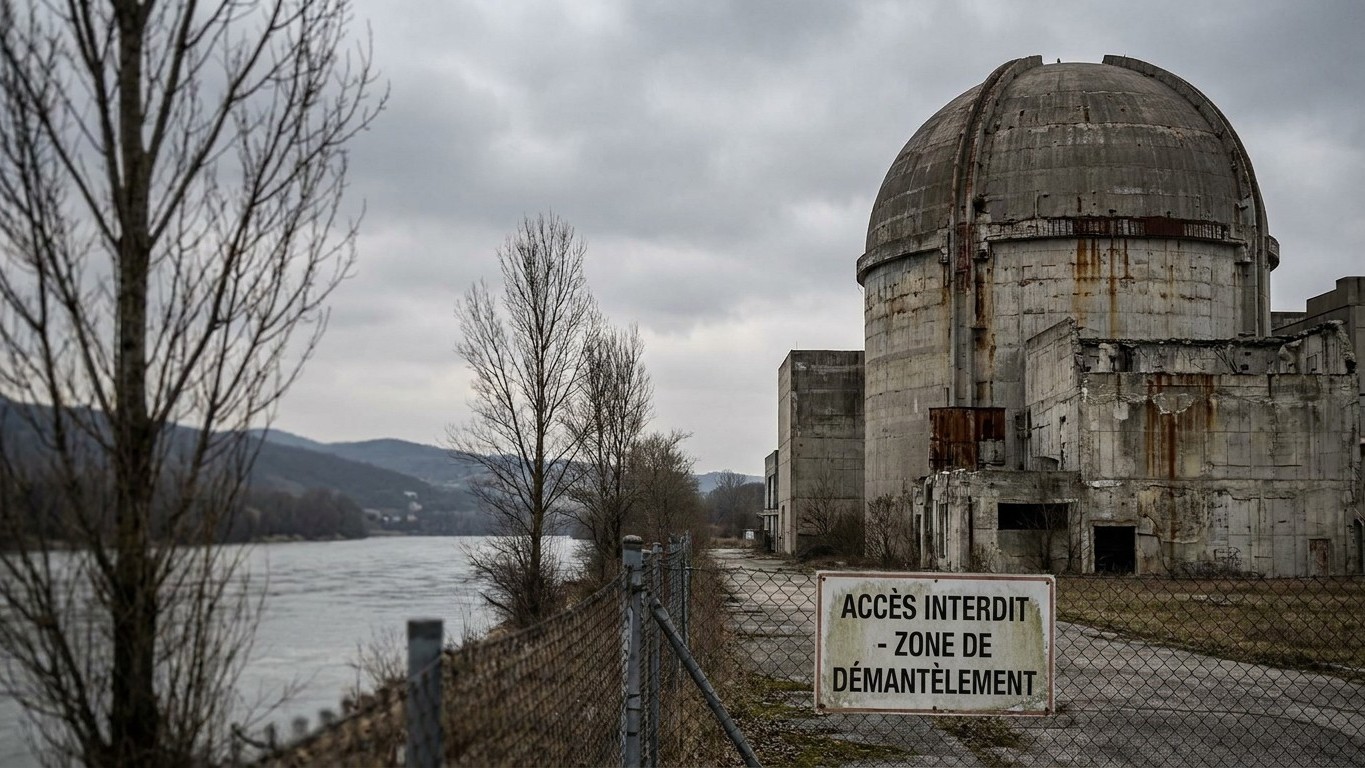
A brand-new 730-megawatt reactor, fully built, never started. This is the starkest summary one can give of the Zwentendorf power plant, perched on the banks of the Danube about fifty kilometers from Vienna. Construction of the facility was completed, but it never entered service, its startup blocked by a referendum held on November 5, 1978, where a narrow majority of 50.47% voted against energizing it. Since then, the building has stood intact, as if frozen at the precise moment history changed course.
The project was far from incidental. It was the first commercial nuclear power plant intended for electricity production built in Austria, originally planned as part of a trio of installations. Construction began in 1972, with a boiling-water reactor rated at 692 megawatts electric according to official figures, though other sources cite 730 megawatts for the initial project. The cost, however, is not in question: the initial price of the plant ran to about 5.2 billion Austrian schillings, roughly 1.4 billion euros when adjusted for inflation. A colossal sum for a country that would never see a single bulb lit by this facility.
Key takeaways
- A brand-new 730-megawatt reactor, never started: why?
- A historic decision decided by less than 1% of the votes, sealing the fate of a completed construction
- From a nuclear graveyard to a world training ground and a solar plant: the most ironic repurposing on the continent
November 5, 1978, a vote by a handful of votes
Everything hinged on just a few thousand ballots. The referendum took place on November 5, 1978, with a turnout of 64.12%, and the “No” won by only 30,068 votes, i.e. 50.47% to 49.53%. A margin so slim it could almost fit in a classroom, yet it decided the fate of a project completed months earlier. The political context explains this shift: facing the rise of environmental and student protests, the Social Democratic Chancellor Bruno Kreisky chose to stage a popular referendum, with the government defending the electricity sovereignty after the oil crisis.
The gamble went badly for the incumbents. It wasn’t an isolated project: Zwentendorf was intended to be the first stone in a broader program, the first in a string of nuclear power plants meant to supply electricity to six million Austrian households. In other words, the referendum condemned not only a building but an entire national energy strategy conceived in the wake of the oil shock. The popular vote was not a mere symbol: following the referendum, the Austrian parliament passed in 1978 a law banning the use of nuclear energy, the Atomsperrgesetz. The text would stiffen over time: after the Chernobyl disaster in 1986, its scope was strengthened in 1999 with the law for an Austria without nuclear energy, embedded in the country’s Constitution. The ban is therefore no longer just a political preference; it is enshrined in constitutional law. The concrete result of this legal lock: no commercial nuclear plant, designed to generate electricity, ever entered service in Austria.
An atomic graveyard turned parts reserve and training ground
What does one do with a brand-new reactor that can never be switched on? One partially dismantles it. Since the referendum, the plant has been partially decommissioned, its technical equipment repurposed for other European nuclear facilities that were short on spare parts. A nearly ironic rebound: the turbines and components of a site barred by the ballot eventually help keep other plants running elsewhere on the continent.
Yet the building itself was not abandoned to rust. On the contrary, it found an unexpected use as a full-scale training ground. Zwentendorf offers a unique opportunity to test procedures on a real site, but without the radiation risks and thus without the costly safety measures. Nuclear technicians from several countries still come here to practice the craft, using installations that are perfectly authentic yet completely safe. The plant also serves as a training center for nuclear technicians from other countries, a pedagogical use that is not matched anywhere else in the world on such a scale.
Then came the solar episode. In 2005, the site changed hands: the electricity supplier EVN AG purchased the plant’s buildings and land, establishing a safety training center there. Four years later, the company took the conversion to the pinnacle of irony: it installed a photovoltaic plant worth 1.2 million euros on the site in 2009. The outcome goes beyond symbolism. Zwentendorf’s nuclear plant now produces 180,000 kWh of renewable electricity annually and stands as one of Austria’s most powerful solar farms. The site that was meant to generate atomic power ends up generating power, but from the sun.
From an industrial graveyard to a tourist attraction
The “dark tourism” that seeks out places heavy with tragic or unusual history has long since claimed the site. Since 2009, guided public tours of the plant’s interior have been offered. Visitors wander through a control room frozen for nearly fifty years, among dials that were never operated and corridors that have never seen an active technician. The site also serves as a filming location and notably hosted the movie Grand Central by Rebecca Zlotowski, featuring Tahar Rahim and Léa Seydoux.
The contrast is almost vertigo-inducing as you walk these halls: a place designed for the densest energy imaginable, repurposed as a cinema set and a classroom for apprentice technicians. This Austrian paradox resonates even more today as European neighbors revisit the nuclear debate, with programs being revived and aging reactors being closed. Zwentendorf remains fixed in its role as a monument to a form of energy that never flowed, a silent reminder that sometimes a handful of votes is enough to rewrite the industrial history of an entire country.
Sources: dailygeekshow.com | dark-tourism.com | fr.euronews.com
