
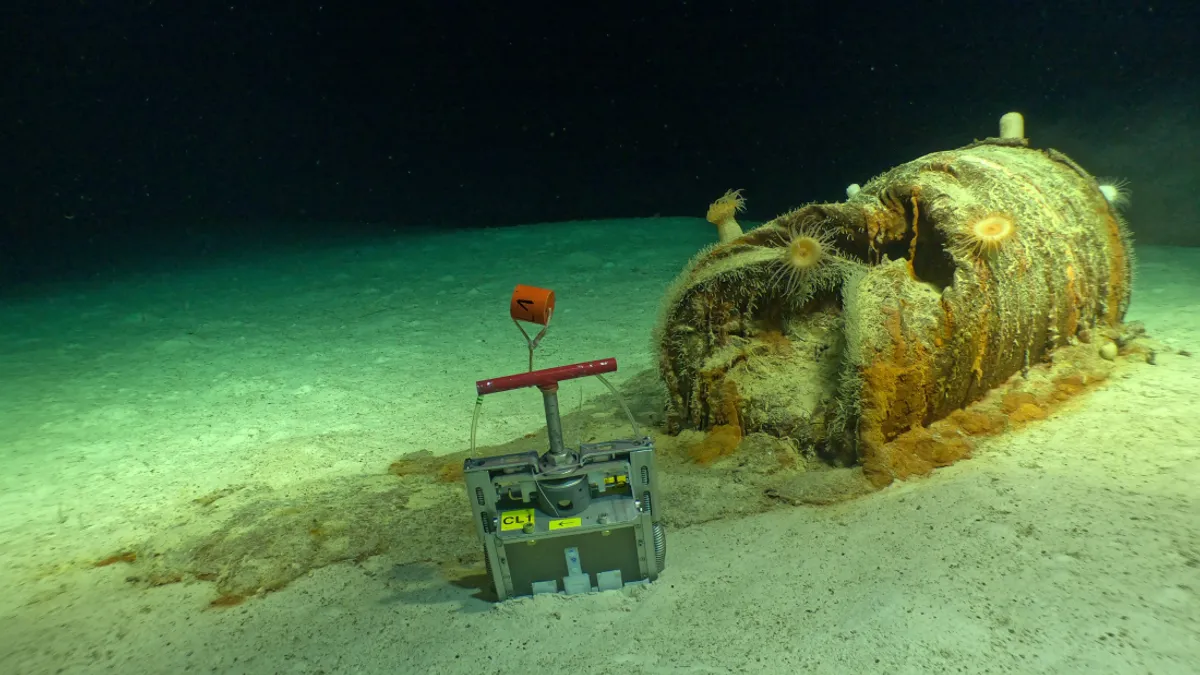
Can we really dispose of radioactive waste by dumping it at the bottom of the ocean? That was precisely the bet made by several countries, including France, for four decades. Nearly 4,700 meters beneath the surface of the northeast Atlantic, 200,000 rusted barrels have rested since that era when people believed the vastness of the sea would neutralize the danger. Between 1950 and 1990, these drums were dumped with little hesitation, driven by the conviction that oceanic dilution would do the job. In May 2025, a CNRS team descended to verify what remains, and the finding is as fascinating as it is worrying: cracked barrels, colonized by marine life, as if life had finally reclaimed its rights over this forgotten dump.
When dumping nuclear waste at sea seemed like a good idea
We must situate ourselves in the context of the era to understand a decision that now seems dizzying. Between 1950 and 1990, about 200,000 barrels of radioactive waste were dumped into the North Atlantic. The prevailing logic at the time rested on a simple, almost naive idea in hindsight: low-level radioactivity would gradually dissipate naturally inside the drums, never posing a real threat to the marine environment.
This practice did not last forever without oversight. The London Convention, which came into force in 1975, gradually limited then completely banned this type of dumping at sea. But the harm, so to speak, had already been largely done: decades of dumping had occurred before international regulation brought a definitive end.
A submersible, 4,700 meters down, and barrels that did not live up to their promises
It is in this context that the Nodssum project was born, led by the CNRS, with a clear mission: to return to this site to assess, decades later, the real impact of these barrels on deep-sea ecosystems. In May 2025, about 30 scientists boarded the ship Pourquoi Pas ? to carry out this unprecedented expedition.
On site, the exploration required a very particular tool: the submersible Nautile, belonging to the French Oceanographic Fleet. With it, the team carried out 20 manned dives, descending to depths exceeding 4,700 meters. What the cameras returned was far from reassuring: the barrels, after more than thirty years in the depths, are now severely degraded. Several of them have evidently begun to leak, releasing their radioactive contents directly into the surrounding water.
Radioactivity leaked, but not as one might have imagined
Faced with this finding, the first question that comes to mind is obvious: what is the real extent of contamination? Measurements taken on site provide a nuanced answer. The radioactivity detected remains broadly low, even if it exceeds the natural levels expected in this zone. It is by no means a major contamination event, but rather a slow and progressive leak, mirroring the wear of the drums themselves.
This relatively low level has, moreover, allowed the scientific teams to handle the collected samples without the need for significant radiological protection, a detail that speaks volumes about the true scope of the phenomenon. To deepen the analysis, researchers collected samples of water, sediments, and living organisms, intended to be studied in the laboratory to better understand how radiation interacts with this peculiar deep-sea environment.
Marine life settles where humans wanted there to be nothing
The most surprising detail of this expedition surely remains this: the photos brought back by the team show that marine animals have colonized the barrels. Where humanity thought it had created a lifeless, condemned, sterile space, organisms have instead found a foothold. This image, nearly paradoxical, illustrates how adaptable nature can be, sometimes in the places we least expect.
This observation also recalls a broader reality: human impact on the oceans remains immense, even though less than 0.001% of the seafloor has been explored to date. These barrels, hidden in the deep sea for decades, have been the subject of this in-depth assessment mission. How many other traces of our passage remain entirely unknown?
What this seabed reveals about our future nuclear waste containers
Beyond the observation, this mission has a scope that far exceeds simply inventorying a forgotten site. The researchers hope that the data collected will better guide future waste disposal methods, drawing lessons from a practice that has been abandoned today but whose consequences are still felt more than thirty years after the last discharges.
This return to the field, in its own way, underscores an evident truth too often forgotten: what we bury or submerge never truly disappears; it transforms, degrades, and ultimately resurfaces, one way or another. At a time when the question of nuclear waste management remains more relevant than ever, these 200,000 rusted barrels at the bottom of the Atlantic remind us that a solution that seemed obvious yesterday can prove far more complex decades later. It remains to be seen which traces our current choices will leave, themselves, in the depths we do not yet know.
