
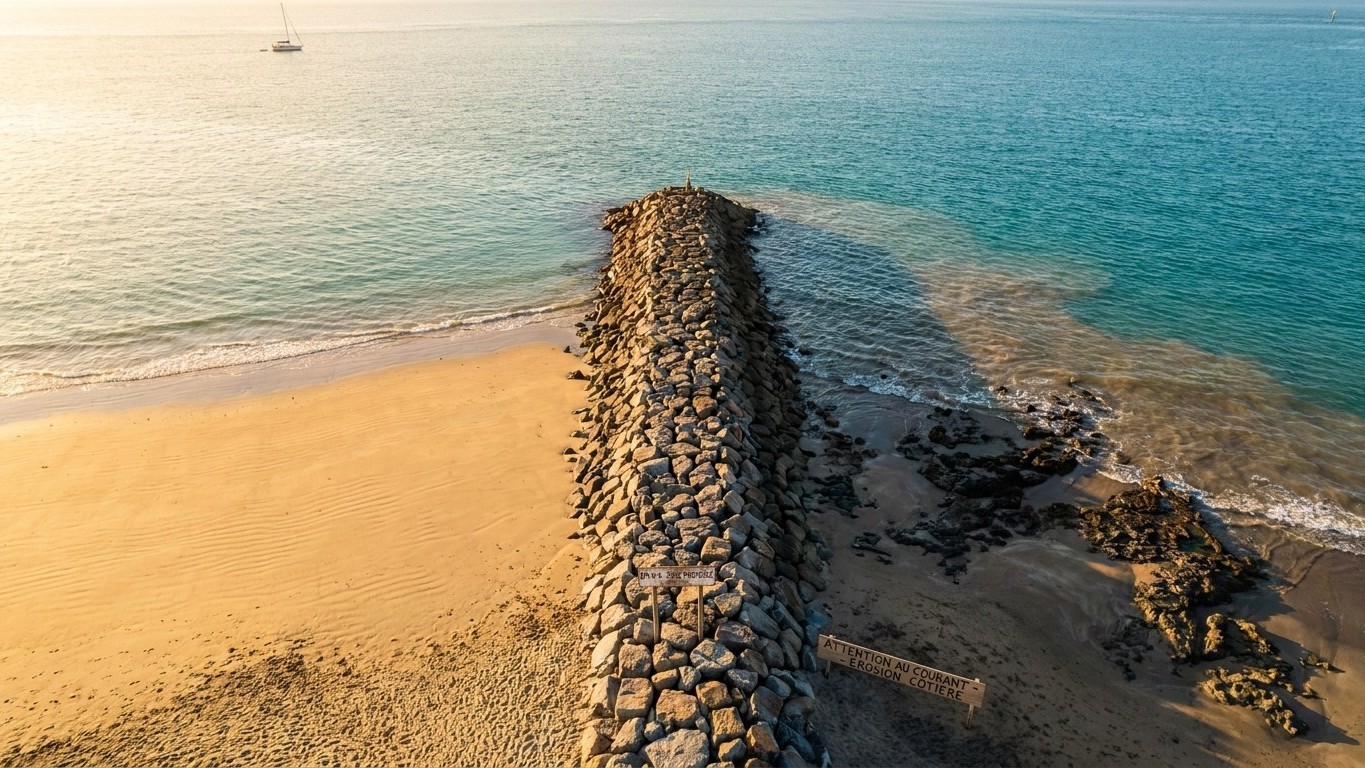
A groyne planted perpendicular to the shore does hold sand well, but never the sand you expect. The beach it was supposed to save sometimes thickens in dramatic fashion. What vanishes is not the sand of that protected beach nor the seabed of the neighboring bay: it is the following beach, the one that used to receive the sand carried by the coastal current, and which is suddenly deprived of its natural supply.
Key takeaways
- A groyne saves a beach by starving the neighboring one of the sand naturally delivered to it
- The domino effect forces nearby communities to build their own structures to compensate
- Fifty years of coastal concrete have not solved the problem but have amplified it exponentially
A groyne that cuts off the sand’s supply
The littoral drift, that current that pushes sand along the coast with the help of oblique waves, behaves like a perpetual conveyor belt. A groyne is a physical barrier that slows the sediment transport caused by the littoral drift along the coast, creating an accumulation of sediment on the up-current side, the side facing the main current. From the protected beach, the effect is immediate: sand piles up, the dune rebuilds, and beachgoers regain a comfortable strip of sand.
But this conveyor belt does not magically stop elsewhere. The interruption of sediment transit mainly results in a substantial buildup of sediment at the structure, upstream of the littoral drift, and significant erosion downstream. The sand missing downstream has not disappeared entirely: it has simply been trapped against the groyne, on the upstream side, while the next beach waits in vain for its supply. A coastal observatory in Réunion documented this shift with almost clinical precision: installing a transversal structure across the beach interrupted the sediment transfer, causing a heavy accumulation of sand upstream at Brisants Beach, and strong erosion downstream at Roches Noires Beach.
The beach that pays the neighbor’s bill
On English shores, this transfer of sand follows a simple rule. In Hornsea, along the Holderness coast, a height difference of nearly two meters is measured between the beach on one side and the other side of the same groyne. On one side, a wide, elevated beach; on the other, a sharp step that exposes pedestrians to real danger, especially for young children. The phenomenon is by no means anecdotal: beaches downstream of the structures are deprived of materials due to their impact on littoral drift, which leads to increased erosion with economic consequences further along the coast.
In France, the Mediterranean coastline has served as a natural laboratory for this mechanism for half a century. On the Picardy coast, a use as divergent as mussel farming has produced the same perverse effect: the deployment of tens of thousands of piles for mussel farming induced strong local sedimentation at the expense of beaches downstream of the littoral drift. Sand makes no distinction between a groyne built for swimming and a stake planted for oyster farming: it stops where it is stopped, and it is missing where it is not expected.
The endless race of structures that respond to one another
When faced with a suddenly hungry beach, the most common response is to build a new structure right beside it to patch the problem created by the first. This usually leads to the installation of new similar structures to counter the effects of the previous one, resulting in a gradual intensification and artificialization of the coastline. In the long term, the result is measured in kilometers of concrete and riprap: France has historically managed its coastline with hard-engineering techniques to fix the shoreline, and the length of coastal developments has doubled over the past fifty years.
The rise of recreational boating has amplified the phenomenon to a scale far beyond simple beach groynes. The rapid growth in the number of marinas since the 1950s has altered sediment movement and may have intensified marine erosion on adjacent sectors, as the breakwaters of these ports act as formidable barriers to sediments carried by the littoral drift, creating significant deficits downstream along the drift. A port built to shelter boats can condemn, kilometers away, a beach that has never seen a single sailboat.
Coastal engineers do not all agree on the exact extent of this erosion shift. According to an analysis published on Coastal Wiki, a reference scientific platform in coastal engineering, if a natural littoral drift exists downstream of a field of groynes, the erosion there will be comparable to that produced by a single groyne, and could even be stronger if the field of groynes greatly reduces the passage of sediments upon which the downstream coast depends. This technical point matters: it means that the magnitude of downstream damage depends not only on the number of structures built but on the width of the surf zone and the amount of sand that still manages to bypass the obstacle. Although they are widely used, groynes generally are not an effective solution when used alone, as they cause significant downstream erosion without creating a new source of sediment; where the coastal sediment balance is negative, their construction must be complemented by artificial replenishment or other sediment-management measures.
Some municipalities have ended up swapping concrete for imported sand, a solution deemed less aggressive for the neighboring coastline. Regular sand replenishment at the base of the beach appears effective and affordable, note specialists in coastal dynamics, even if it requires repeated maintenance that many small seaside towns struggle to fund year after year.
Sources: observatoire-littoral-lareunion.re | coastal-management.eu | brgm.fr
