
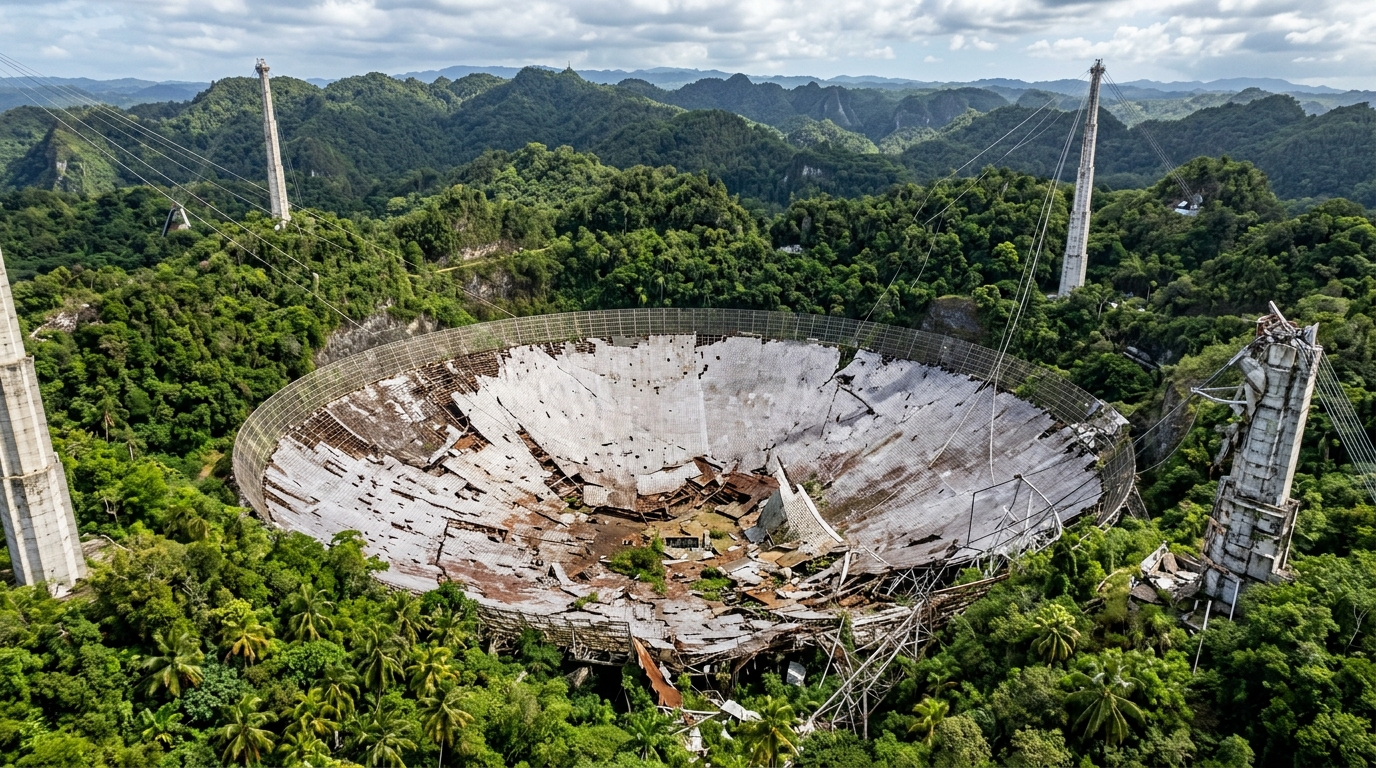
It took only a few seconds for fifty-seven years of scientific history to crumble into a cloud of dust. Nestled in the heart of a tropical valley in Puerto Rico, a colossal 305-meter-diameter metal mirror had watched the sky since 1963. Then, on a morning like any other, everything shifted.
- The Arecibo radio telescope, the world’s largest until 2016, collapsed on December 1, 2020 after the failure of several supporting cables.
- The 900-ton receiving platform crashed onto the dish without causing injuries, as the site had been evacuated beforehand.
- The NSF decided not to rebuild the instrument, estimated at $400 million, and since 2022 has been transforming the site into a STEM education center.
- A giant nestled in the Puerto Rican jungle since 1963
- When the cables began to fail one by one
- Nine hundred tons of steel in free fall onto the instrument
- Arecibo gone, what science truly loses
This is the story of the Arecibo radio telescope, an engineering feat that long fascinated astronomers around the world before meeting a brutal and spectacular end. A look back at the downfall of a colossus that forever left its mark on the history of astronomy.
A giant nestled in the Puerto Rican jungle since 1963
Imagine a fixed antenna so vast that it could swallow several football fields, carved directly into the karst terrain of a Caribbean island. That was the audacious bet American engineers undertook when they built, inside a Puerto Rican hillside, this immense 305-meter-diameter parabolic dish. For more than half a century, this instrument remained the world’s largest radio telescope, a title it relinquished only in 2016 to China’s FAST, an even larger facility.
What made Arecibo special was not only its size but also its unique architecture. Unlike conventional telescopes that rotate on their own, its reflective surface remained fixed, while a receiving platform suspended 137 meters above the dish allowed it to capture signals from space. This structure, held up by a web of steel cables, enabled major discoveries: the first detection of an exoplanet and the demonstration of gravitational waves emitted by a binary pulsar. Arecibo wasn’t merely a scientific instrument; it was a symbol.
When the cables began to fail one by one
Every giant has its vulnerabilities, and for Arecibo, it was the slow fatigue of its supporting cables. In August 2020, an auxiliary cable gave way without warning, leaving a gaping hole in the metal dish. Engineers grew concerned, yet the installation seemed to hold. Three months later, in November, a main supporting cable snapped as well, a far more critical factor for the structure’s stability.
Facing these alarming signs, the National Science Foundation (NSF), which runs the site, made a radical decision: on November 19, 2020, it announced the definitive decommissioning of the telescope, deemed too dangerous to repair. Teams then weighed options, but the structure seemed doomed. Yet no one could have foreseen how quickly the end would arrive.
Nine hundred tons of steel in free fall onto the instrument
On December 1, 2020, at around 8 a.m., the inevitable happened. The receiving platform, this colossal metal structure weighing nearly 900 tons, abruptly detached from its final supporting cables. In mere seconds, it plunged 152 meters and slammed onto the dish it had loomed over for decades. The impact was devastatingly violent: the two structures—the fixed dish and the suspended platform—were destroyed simultaneously.
Notably, and almost miraculously given the scale of the damage: no injuries were reported in the collapse. The site had been evacuated beforehand, authorities having anticipated the worst-case scenario. Footage of the catastrophe, shot by surveillance drones stationed on-site, quickly circulated worldwide, showing in real time the disappearance of this monument to modern science.
Arecibo gone, what science truly loses
The loss of Arecibo was not just the disappearance of a single scientific building. Beyond its contributions to fundamental astrophysics, the telescope played a strategically underappreciated public role: it served as NASA’s planetary defense radar, allowing precise tracking of asteroids approaching Earth on potentially dangerous trajectories. Its disappearance significantly weakened this surveillance, leaving a gap difficult to fill in our ability to anticipate possible threats from space.
Five years after the catastrophe, the question of rebuilding was raised with notable insistence, but the NSF’s answer was blunt: there will be no new Arecibo. The cost of a comparable instrument, estimated at roughly $400 million, was deemed excessive given the agency’s current budget priorities. Since October 2022, the strategy has shifted: rather than reviving the telescope, the site has been gradually transformed into an educational center dedicated to science, technology, engineering, and mathematics—STEM. The site continues to live on, hosting researchers and students, but it will never again regain the iconic instrument that had made it world-renowned.
This story resonates as a reminder of the fragility of our greatest structures in the face of time and wear. Arecibo shaped astronomy for nearly six decades before it faded away in seconds under the weight of its own structure. The question remains open: with other giants like China’s FAST taking the baton, how far are we willing to invest to continue peering into the far reaches of the universe?
